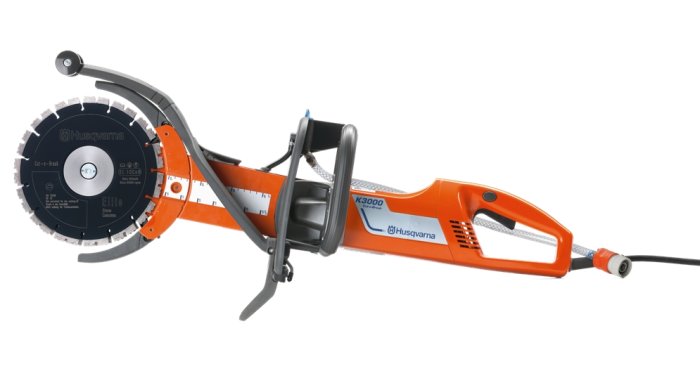
Need concrete cutting, quite a few linear meters. Believe I can cut it down myself.
One option is to hire a cutting company, but the price reflects that...
This tool was recommended by a rental company
Husqvarna K3000 cut n break
Has anyone used this tool? Is it reasonably easy to use even if you're not a "professional"?
Considering renting, but daily cost + ordering time + round trip + needing the tool at various stages of the renovation makes the rental calculation quite expensive.
All prices incl. VAT
Considering buying. Available at Verktygsproffsen.se for about 18,600 pix, + 2 discs which I guess could cost around 2,500.
I imagine being able to sell it for about half the price when the job is done in about 6 months.
Are there really no others selling this online? Can't find others through surfing
Maybe could go down to Germany and buy if the price is advantageous?
Ebay and others often sell 120V machines so that's not an option.
What would you do buy or rent?
(Rental company price proposal rent machine 385:-/day). Minimum wear per rental occasion 615:- and then the same amount per worn down mm. A bit unclear how this is exactly calculated). Insurance fee also applies.)
I am always in favor of buying, but 20lök for something quite odd I think is too much. If you don't have a very special and extensive need for this saw's special function, I would go with a regular motor saw, husq has an electric variant too. There are used ones in good condition for 4-5k.
The difference is that you can't go as deep with a power saw as you can with this machine. This one takes 350-400 mm deep from one side. So it greatly depends on how thick the walls are that you need to get through, as you'd need gigantic blades to achieve the same with a power saw.
The machine works well, saw as recently as a week ago when drilling a hole in a concrete element. However, I can't confirm if it was the exact same model.
But what you should remember, whether renting or buying, is that the discs are expensive and an inexperienced user can destroy them very quickly.
Personally, I would get a few quotes first and have a good comparison. But sure, they are small convenient machines, but you shouldn't underestimate the cost of the discs in the context.
I am going to start converting an "abandoned" shelter into more usable spaces.
We do not know what the reinforcement looks like, but 3 door openings (900x2000) need to be made in a concrete wall about 250 mm thick.
2 windows 1350x1250 in a 385 mm wall and the demolition of a wall 150 mm 2370xca 3500).
+ some other small cuttings.
Since the pieces will be heavy, there will be quite a few additional cuts to make them manageable. Currently unknown number of lpm.
The windows need to be cut near an existing wall, so this tool seems good for that.
One might imagine using different cutting machines for different cuts, but I imagine that won't be particularly cheap, either in rental price or logistically compared to sticking to just one machine.?
Then you should probably look at the construction drawings a bit before you start, because if it's a shelter of a relatively modern design, there is almost more reinforcement than concrete in these walls.
I actually don't even think you can use this type of machine for what you want to do. It relies on you cutting a slit with the two parallel discs in the concrete and then using a crowbar to break away a piece to get in and make a new cut, and in this way, eventually get through.
In the construction you have to go through, there is endless reinforcement in all directions, i.e., both vertically and horizontally, and if you make a cut from top to bottom, you will have a lot of vertical reinforcement that will likely hold the concrete in place so it cannot be broken. You've only cut the horizontally lying rebar. To break it, you would have to make a lot of new cuts across the entire length as well. The reinforcement is closely spaced, so there is a high risk of this happening.
As MathiasS suggested, it might be better with a really large saw where you can go through the entire thickness or at least do it by cutting from two sides.
Yes, those construction drawings are something I can see in the stars after. The house was built in 1952, and there are no drawings whatsoever, not even with MSB, which is the authority responsible for shelters nowadays. But according to a constructor, there was also a building standard for shelters back then, but I haven't figured out how it looks... or should look.
An interesting fact is that I did a similar operation for a window in the same house 15 years ago in an exterior wall with the same dimension (385mm) but in another part of the house. (hired firm). There was no reinforcement whatsoever, so maybe all the reinforcement went to the shelter :wow:
What happens to the blades when cutting through reinforcement?
Making a cut and then chiseling might be wise... but tough tough....
Yes, according to the Husqvarna site there are 2 types of blades.
A hard type suitable for brick etc. that cuts less efficiently but lasts longer, and a softer type for hard concrete and reinforcement bars that cuts better but doesn't last as long. The machine is water-cooled, which is on the positive side.
Yes, it sounds expensive when you think about it....
I have yet to get quotes from companies, but I'm guessing at least 40,000+, and if they come in different phases there will be establishment costs, etc.
I cut open two doorways in a 220 mm thick concrete wall, 210x160 cm, using cheap 230 mm diamond blades (about 150 SEK from Clas Ohlson or maybe it was Bauhaus) with an angle grinder, and then I chiseled with a 7-8 kg machine (I don't remember exactly)... I started by drilling 6 mm holes in the corners and then along a straight line about 30 cm apart and made grooves from both sides to get straight edges, then I made approximately 20 cm wide tracks and chiseled between them. It took about a day (or as much as I could manage in one day) to make the tracks and then another two days to chisel both holes.
I used up 3 blades and four chisels... The blades cut through the reinforcement which was 6-8 mm well, but struggled with the 12 mm that I found, for that, I had to chisel around and use a regular metal cutting disc.
But what you need to remember, whether you're renting or buying, is that the discs are expensive and an inexperienced user can ruin them very quickly.
.
Yes, it does feel like the cost of the cutting discs falls on me, whether I do it "in-house," rent the machine, or outsource the service. No one can say in advance how many discs will be used, and that's pretty much where it's difficult to get a fixed price from a drilling company... it easily turns into a running cost, and then it's hard to say no thanks when you're halfway through the job
I opened up two doorways in a concrete wall 220 mm thick at 210x160 cm and I used cheap 230 mm diamond blades (around 150 SEK at Clas Ohlson or maybe it was Bauhaus) on an angle grinder and then chiseled with a 7-8 kg machine (can't remember exactly)...
I started by drilling 6 mm holes in the corners and then along a straight line at about 30 cm intervals and cut grooves from both sides to get straight edges, then I cut grooves about 20 cm wide and chiseled in between.
It took about a day (or as much as I could manage in a day) to cut the grooves and then another two days to chisel both holes.
I went through 3 blades and four chisels... The blades cut well through the reinforcement which was 6-8 mm but struggled with the 12 mm I found, there I had to chisel around and use a regular metal cutting blade.
Oh yes, all three several times, I'm afraid... Including the worst muscle soreness I've ever experienced and trembling hands for a week afterward... But oh, so wonderful when it was done!
Oh yes, all three several times over I'm afraid... Including the worst muscle soreness I've experienced and trembling hands for a week afterward... But oh so wonderful when it was done!
You have the habit and experience now, welcome to the upcoming spring in Skåne. I have a task for you....