
18,891 views ·
19 replies
19k views
19 replies
Sparse paneling, ceiling in garage, how to attach the last pieces in the gables?
Member
· Västerbotten
· 549 posts
Hello,
I'm going to insulate the roof in the garage; I was thinking of using the customary cc30 battens across the rafters. But the last rafter at each gable is "on" the wall, so the last piece of batten nearest each gable has nothing to attach to. How is this usually done?
Thanks in advance!
I'm going to insulate the roof in the garage; I was thinking of using the customary cc30 battens across the rafters. But the last rafter at each gable is "on" the wall, so the last piece of batten nearest each gable has nothing to attach to. How is this usually done?
Thanks in advance!
Member
· Västerbotten
· 549 posts
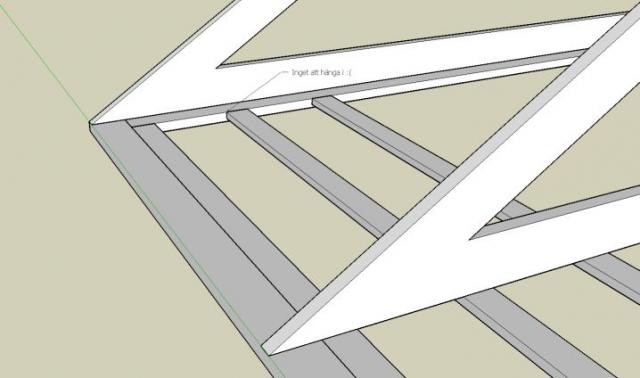
I'm not quite following this turn,
But I usually set a board on the wall, level with the rafter (hanbjälken), above the battens,
Underside of the board=underside of the rafter,
If you then place the drywall under the battens, the board isn't visible...
But I usually set a board on the wall, level with the rafter (hanbjälken), above the battens,
Underside of the board=underside of the rafter,
If you then place the drywall under the battens,
the board isn't visible...
Member
· Västerbotten
· 549 posts
Ah sounds convenient. But I don't really have a wall to attach the rule to, the wall only reaches up to the underside of the roof truss..
Member
· Västerbotten
· 549 posts
I'm going out to get a card, it's quicker than drawing from memory
Member
· Västerbotten
· 549 posts
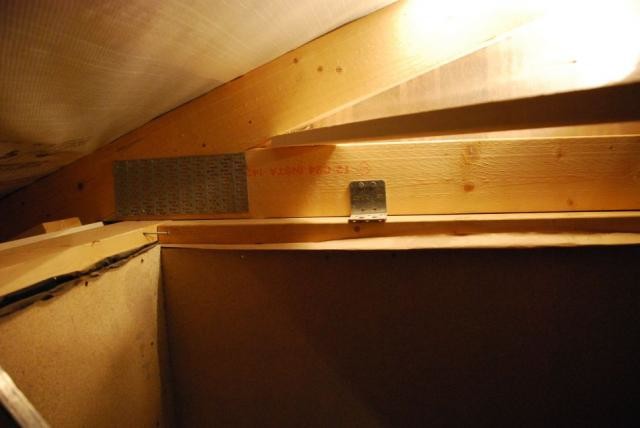
Member
· Västerbotten
· 549 posts
Although the distance out to where the sparse panel stops is medium, it's not visible due to perspective, but the truss is far from being level with the wall, properly embedded there. It's essentially on the outside of the wall. Complicated A stud doesn't help then, I have to stack stud on stud on stud before it reaches out to the sparse panel.
A stud doesn't help then, I have to stack stud on stud on stud before it reaches out to the sparse panel.
Member
· Västerbotten
· 549 posts
Ah perfect. I'll add a rule on the page then.
Next question I bought end-matched paneling, the sales guy said you wouldn't need to splice on rafters with that. Is he right?
Next question
I bought end-matched paneling, the sales guy said you wouldn't need to splice on rafters with that. Is he right?If I were to cover the underside of the roof with it, I would make sure there's something behind the joints to nail into anyway, just in case the wood dries and starts moving around.
Though I might be picky and overly cautious...
I write nail, but I prefer to screw, Viva la screwdriver!!
Though I might be picky and overly cautious...
I write nail, but I prefer to screw, Viva la screwdriver!!
Last edited:
Member
· Västerbotten
· 549 posts
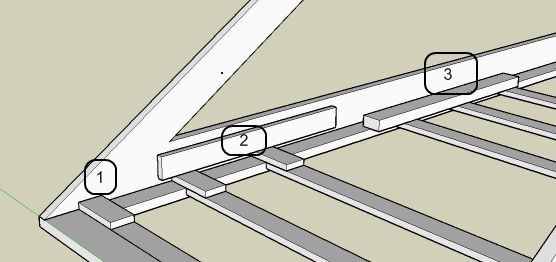
Thank you so much for the help! It's invaluable when you're a complete beginner in construction. I'll probably go with one of the following three options, depending on if I find a good joist in the lumber pile or not. I want to move forward around Christmas Day, and no hardware store is likely to be open.
Option 1: Screw an extra piece of glespanel from above onto the wall, a piece per real glespanel length.
Option 2: Same as 1, but primarily secured via another bit of glespanel directly in the truss only. Less dependent on good attachment down to the wall.
Option 3: As suggested, a horizontal joist of more substantial dimensions.
Only option 3 really provides a good grip for screws or nails from underneath.
Option 1: Screw an extra piece of glespanel from above onto the wall, a piece per real glespanel length.
Option 2: Same as 1, but primarily secured via another bit of glespanel directly in the truss only. Less dependent on good attachment down to the wall.
Option 3: As suggested, a horizontal joist of more substantial dimensions.
Only option 3 really provides a good grip for screws or nails from underneath.
Last edited: