
20,602 views ·
17 replies
21k views
17 replies
Made a fool of myself with vapor barrier?
Hello! I am in the process of expanding by 50sqm on my existing house (formerly a summer house) built in '89. The existing house has 120mm glass wool insulation and plastic on the inside. The expansion has 170mm rock wool in the walls (+45mm rock wool on installation battens) and the plan is to blow in cellulose in the ceiling and floor. But I'm afraid I've made a mistake; I initially planned to use plastic in the walls and ceiling, but the carpenter convinced me that a vapor barrier is a better solution because it breathes. I've installed a Halotex D20 with an sd value of 2. (The outside has a weatherproof membrane of 0.035 sd, so the inside is 5 times denser.) Is this a poor construction? Should I address this or just stay calm? We have already started closing the walls with plywood, so it's not a "quick fix" to resolve. We use the house as a permanent residence and it will always be heated.
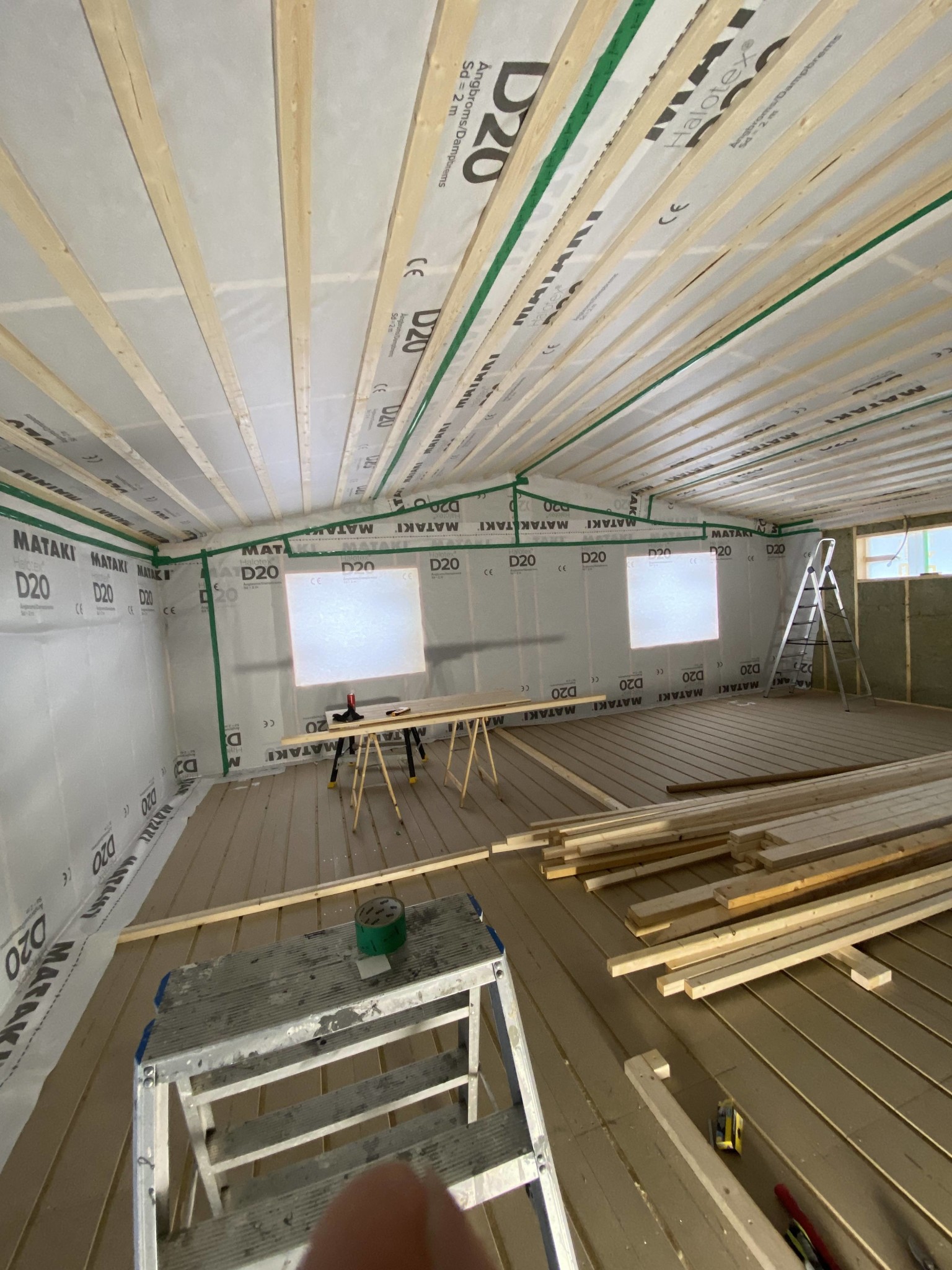


In a wooden structure, your steam brake pairs well with cellulose insulation, but rock wool, on the other hand, should be kept completely dry. A vapor barrier with rock wool would have been a better design, but that doesn't necessarily mean that there will actually be problems. For a building with high moisture load (often populated, cooking, spa, bathroom, poor ventilation), the risk of problems is significantly greater. If you ensure that you have functioning ventilation and keep the indoor humidity low, the risk of problems is small. You should assess for yourself how much work it is to tear down the walls, but personally, I would ignore it. There are plenty of healthy old houses without any functional vapor barrier in the walls.
In bathrooms, one should have a vapor retarder to avoid two tight layers where moisture can accumulate between them. The waterproofing layer absorbs all moisture, so that is not a problem. It's hardly an issue elsewhere either; it's only in recent years that there has been an emphasis on perfecting penetrations and taped seams, so the vapor barrier has leaked to some extent.

As long as you have installed it the right way, you can be at ease. There are absolutely no dangers with a vapor brake. It is sealed from the inside out but can breathe from the outside in when needed. This is especially good on warm days when it gets cooler indoors than outdoors as you get reverse moisture migration.
No. That is not correct. There are no one-way vapor brakes. I find it hard to see any advantage to a vapor brake at all. In general, a vapor barrier is better.

There are two schools of thought that generally apply now, which are vapor barrier or airtight plastic. Neither seems to be wrong at the moment, and I definitely do not think you should tear down what you've set up. There are advantages and disadvantages to both methods. But this is often how building is done today.Oscarvon said:
Hey! I am in the middle of an expansion of 50 square meters on my existing house (formerly a vacation home) built in '89. The existing house has 120mm glass wool insulation and plastic on the inside. The extension has 170mm rock wool in the walls (+45mm rock wool on installation battens) and the plan is to blow in cellulose in the ceiling and floor. But I'm afraid I've made a mistake, I initially planned to use plastic in the walls and ceiling, but the carpenter convinced me that a vapor barrier is a better solution because it breathes. So I have installed a Halotex d20 with an sd value of 2. (The outside has a wind barrier with 0.035 sd, so the inside is 5 times tighter) Is it a bad construction? Should I fix this or just stay calm? We have already started to close the walls with plywood so it's not a "quick fix". We use the house as a permanent residence and it will always be heated.
What is the disadvantage of a diffspärr?
U
Utsliten och utdömd
Building conservationist
· 2 858 posts
Utsliten och utdömd
Building conservationist
- 2,858 posts
But they both have their different uses. The main purpose is that you want to prevent moisture from reaching the wall, and then a barrier is better. Then you want moisture migration outward, which makes the brake's "function" a bit counterproductive. But technically speaking, the brake becomes very tight in a modern wall with wood panels, gypsum, and plastic paint.D Daniel 109 said:
A brake is probably only better in the context if the building is left cold and you allow moisture migration inward. In spaces that are constantly heated, a barrier is probably better.
Thank you for all the answers! I will let the brake remain and complete this stage. I also had it explained to me that a steam brake is good if you plan to use AC for longer periods, so I added that to the "plus" side.
In the future, I plan to build a basement in this building, and it seems like I'll be considering a vapor barrier on the walls. It shouldn't be a problem to mix, right? (It's already mixed considering the old part anyway)
In the future, I plan to build a basement in this building, and it seems like I'll be considering a vapor barrier on the walls. It shouldn't be a problem to mix, right? (It's already mixed considering the old part anyway)
A basement is a whole chapter in itself with different solutions, I recommend that you read up before. You don't want diffusion plastic on the wall if the basement wall isn't drained and sealed correctly. Many also recommend an air gap between the basement wall and the interior wall or alternatively steel studs. Yes, you'll have to dig in before you decideThanks for all the answers! I will leave the brake in place and complete this stage. I was also told that a steam brake is good if you plan to use the AC for longer periods, so I added that to the "plus" side.
In the future, I plan to build a basement for this building, and I'm actually leaning towards using a steam barrier on the walls. It shouldn't be a problem to mix, right? (It's already mixed considering the old part)

It is understood that a vapor barrier is a must in newer passive houses with thick insulation. In such cases, the dew point will always be inside the insulation. Preventing warm, humid air from penetrating and reaching the dew point is therefore critical. Good mechanical ventilation then becomes naturally necessary, as the house becomes very airtight.
Those who advocate for vapor brakes usually also recommend using them in conjunction with thinner insulation so the dew point is outside the wall. Alternatively, an insulating material that can distribute moisture when it condenses, such as wood fiber/cellulose.
170mm doesn't sound extremely thick. Where in Sweden is the house located?
Those who advocate for vapor brakes usually also recommend using them in conjunction with thinner insulation so the dew point is outside the wall. Alternatively, an insulating material that can distribute moisture when it condenses, such as wood fiber/cellulose.
170mm doesn't sound extremely thick. Where in Sweden is the house located?