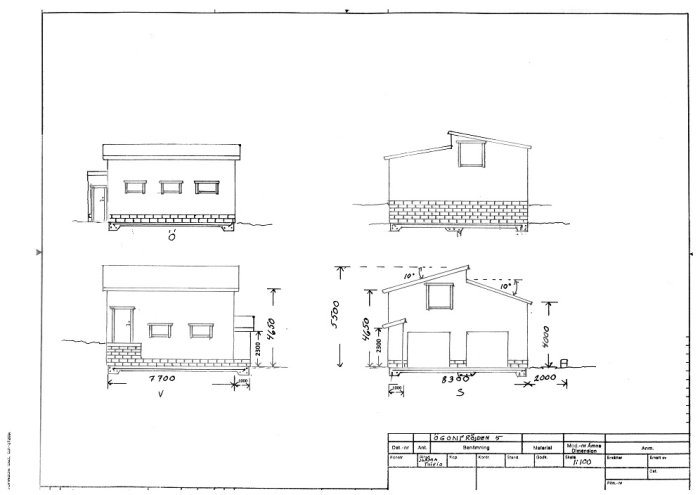
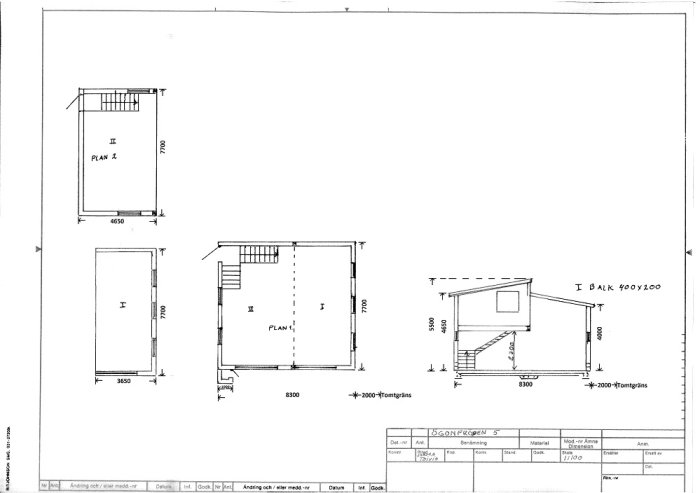
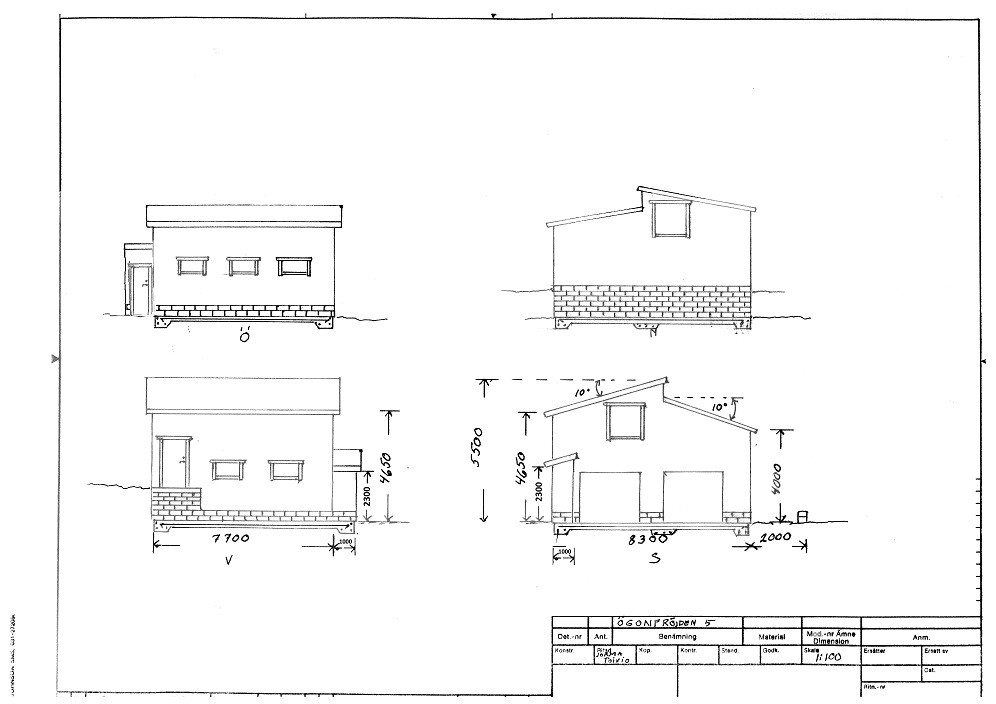
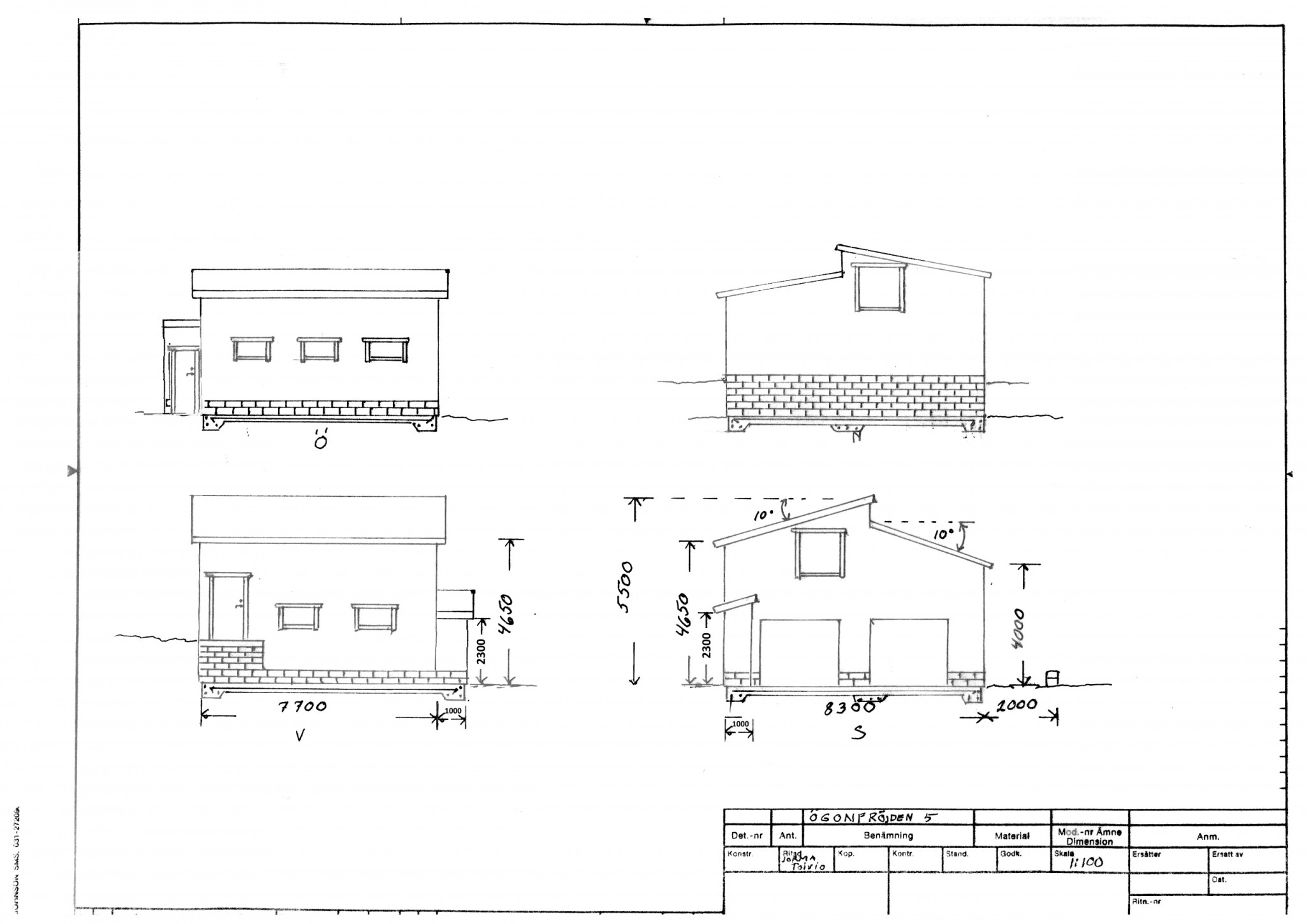
Hello, I am planning to build a garage that is 8.3m wide and 7.7m deep. The ridge height is 5.5m in the middle with a split shed roof with a 10-degree slope on both sides. On the left side at 4.65m, I will have an upper floor, and on the right side, I want it to have a high ceiling. To avoid having a post in the middle that would disrupt the lower part of the garage, I want to place a steel beam across to support the upper floor. On the sides, there should also be beams to support the long beam, so 3 beams in total: 2 approximately 2.3-2.4m and 1 at 7.7m. What dimensions should these have?
At the ridge, I was thinking of using a glulam beam. What dimension should this have? I am attaching a drawing.
hey
I'm not very familiar with that part
the ridge is leaning towards glulam beam 140x720.
the middle beam will be open to the rest of the garage, so there will be a glass railing so you can see down into the garage
the walls probably support the rest?
With the reservation that I may have misunderstood the load case or miscalculated.
The floor area of the upper floor is approximately 4.65x7.7 = 36m2 (probably slightly less, as I assume this is the building's external dimensions).
Load requirements for the intermediate floor are often 200kg/m2 + self-weight 50kg/m2.
The maximum load (in Newtons) on the floor joist then becomes 250x36x9.82 = 90000N, with half of it borne by the beam (the other half by the wall).
Acceptable deflection under maximum load, according to the rule of thumb "Length/400" = 7700/400 = 19mm
If you plug this into the formula for beam bending with a uniformly distributed load (load case 10 in Karl Björk's Bible for Engineers), after some calculations you find that a profile with a moment of inertia (I) of 6700 cm4 is required. It is suggested to choose an IPE 300 (8356cm4) or an HEA 240 (7763 cm4).
For supports/columns, you can use VKR/KKR 100x100 (optional wall thickness), which handles this perfectly.
Keep in mind that the ridge rests on the walls, which in turn rest on the columns below. I find it very cumbersome to calculate the whole thing Maybe I should hire a constructor?
I don't understand what you mean by the walls loading the steel column that supports the intermediate floor. Should the steel columns also bear the ridge beam? You write in #1 that the columns should be 2.3-2.4m, and then they can’t possibly reach all the way up to the ridge.
An alternative solution could be to have a stronger beam in the intermediate floor and then frame the partition wall with studs that can support the roof/ridge. Then you can have a much smaller (if any?) glulam beam in the ridge, you avoid the hassle with double beams, and you also avoid long columns in the exterior walls.
However, I don't want to suggest which size such a beam should be. If you are sure that glulam 140x720 is okay as a ridge beam, and if it’s possible to translate this glulam to an equivalent steel beam, I can easily answer how much stronger a steel beam is needed in the intermediate floor in my new proposal.
Hey
What I meant was that the roof ridge rests on the walls which in turn rest on the pillars + walls down to the slab.
Sure it's confusing... how would you have beamed it all? Joists, supporting pillars, and ridge or even 2 ridges for 2 roofs?
With the 720 beam, it was meant to hold the upper roof and the lower roof at the lower edge of the glulam beam... the carpenter knows the wood part but not the steel beams, which is why I need help. Some say I should have 1 IPE250-300 and 2 120x120 RHS and some say HEB 400 beams... so it's very confusing.
Edit: After reading your answer a couple of times, you confused me about whether you think I should have a wall from the joists to the ridge... I shouldn't, there should be a glass railing so you can see down into the other part of the garage and the upper floor will also have a glass floor of about 2-3 sqm.
I also calculated and I also get it to an !PE 300 for the 7-meter beam. So you can trust Gabbe1 probably has it figured out.
The glulam beam has such a small bearing surface that you can't say it rests on the wall; there must be a column underneath. That column must be dimensioned for the load from half of the glulam beam, then the column that stands directly underneath must be dimensioned so it can handle the load from half of the glulam beam and half of the IPE beam.
Editing: After reading your response a couple of times, you made me confused if you think I'm supposed to have a wall from the floor structure to the ridge... I'm not, there will be a glass railing there so you can see down into the other part of the garage and also the upper floor will have a glass floor of about 2-3 square meters
Ok, that way, then we can drop that suggestion from me.
After the new info that has emerged, I would probably invest in a couple of sturdy columns that can handle both the IPE 300 beam and the load of the glued laminated beam. These columns will be quite tall, but on the other hand, it shouldn't be a problem to brace them to counteract buckling. The attachment to the IPE beam will be a very effective bracing approximately in the middle of the length.
RHS (or VKR/KKR as I call them) 120x120 with a wall thickness of 5-6mm would probably solve that task with a very good safety margin.
But how does the concrete slab look where these two columns are supposed to stand, as there will be substantial point loads from both the roof and the floor structure? Is it already cast?
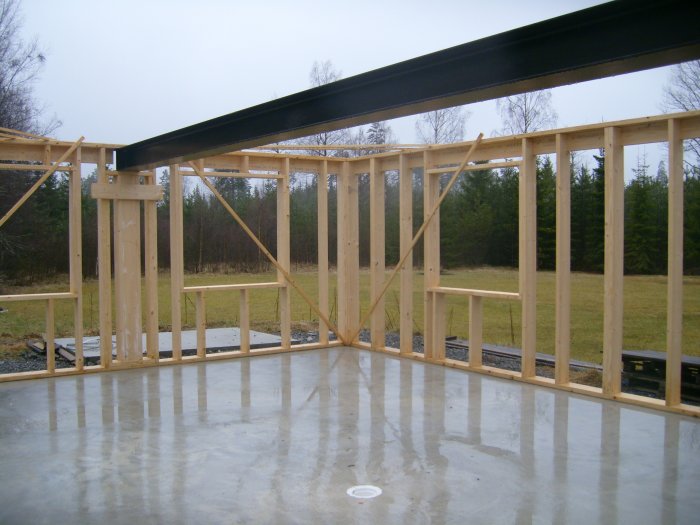
Attaching image of our garage build 6400x10800
The double garage itself became 6400x8200
The upper floor is supported by an HEA 260 instead of the calculated HEA 240 as I got a larger dimension
cheaply from the scrapyard. Drawings and construction were approved.
Some trivia:
HEA/HEB is an optimal profile for achieving high strength with low profile height, IPE is optimal for achieving high strength with low weight, since steel is paid per kg, IPE is a bit cheaper to purchase.
Ok, in that way, we can drop that suggestion from me.
After the new info that has come to light, I would probably go for a pair of sturdy columns that can take both the IPE 300 beam and the glulam beam's load. These columns become quite high, but on the other hand, there shouldn't be any problems bracing them to counteract buckling. The attachment to the IPE beam will be a very effective bracing roughly halfway along the length.
RHS (or VKR/KKR as I call them) 120x120 with a thickness of 5-6mm would probably solve the task with a very good safety margin.
But what does the concrete slab look like where these two columns are to stand, there will be significant point loads from both the outer roof and between floors? Is it already cast?
The slab has not been cast yet but will probably be cast next week. The carpenter had already planned to place some form of plates where the columns are to stand, something he needed to fiddle with after the reinforcement was laid according to him.. If you take heavy beam columns, one IPE300 beam (7.7m) and then take glulam beam as columns on the IPE beam to support the ridge and roof. Does that work, or do you need to look at beams there as well? Or should you have columns that go all the way up?


 Maybe I should hire a constructor?