
28,119 views ·
19 replies
28k views
19 replies
Question about drywall and reveal at windows
Living in a newly built Myresjöhus where the ground floor is completed and now working on the upper floor (sloped ceiling). Everyone says not to seam drywall at windows/doors, why not? In my case with sloped walls next to the windows on the short side, it becomes very difficult to seam the panels above the window, is it okay to have a separate panel above the window and on the sides?

Wooden houses move (expand with humidity (=summer) and contract when it becomes drier (=winter)). If you place the joint by the window/door, the likelihood increases that the gypsum boards, attached to the wood underneath, will also move and you'll get gaps over time.
I can understand that, but you still have a joint along the entire door/window (hard otherwise), so in my case, it feels difficult and unnecessarily tricky to try to get the board above the window to hang together with the board on the sloped ceiling side, getting the board up in one piece feels difficult. Is the extra hassle justified?olni65 said:
The idea is not to have a joint along the door/window but instead place the joint in the middle 'on' the door/window. Considering how the studs are placed around doors/windows, you usually have at least two studs from floor to ceiling that 'surround' the door/window. Additionally, if you place the drywall edge there, you follow the stud, and you'll need to nail an extra piece of stud to attach the drywall above the door.
Thus, you have two studs that can move independently of each other, and voilà, your cracks. When I've installed drywall around doors and windows, I've cut out (with a smaller, fine, handsaw) recesses for windows and doors before, or sometimes after, I've put up the drywall panel. But then again, I've only had straight walls too.
Thus, you have two studs that can move independently of each other, and voilà, your cracks. When I've installed drywall around doors and windows, I've cut out (with a smaller, fine, handsaw) recesses for windows and doors before, or sometimes after, I've put up the drywall panel. But then again, I've only had straight walls too.
With full-sized walls and without sloped ceilings, this is obviously the right way. But I meant more specifically in my case with sloped ceilings as I have about 50mm space above the top-right corner of the window to the sloped ceiling.olni65 said:The idea is that you shouldn't have a joint along the door/window, but instead place the joint in the middle 'on' the door/window. When considering how the studs are positioned by doors/windows, you usually have at least two studs from floor to ceiling that 'surround' the door/window. Additionally, if you place the drywall with the edge there, you're following the stud, and you have to nail an extra piece of stud to attach the drywall above the door.
This way, you have two studs that can move independently of each other, and voilà, your cracks. When I've installed drywall around doors and windows, I've cut out (with a smaller, fine hand saw) notches for windows and doors before or sometimes after I've put up the drywall panel. But then I also only have straight walls.
In the factual books I've read, they say that you should place the drywall in the stud that is on the right side at door/window openings, and then the extra nogging that goes up in the middle of the door opening. Then another piece from the left. The drywall would then look a bit like an upside-down L. Is this what you mean?


I was considering showing the exact link that ByggaNytt shows, but I refrained because I thought you understood the principle if you had straight walls.
What confused me was that I saw your slanted walls as starting above the window, into the room. Not next to the window, as I now understand it is.
If I were to install drywall here, I would have done the following.
I assume that you have studs arranged approximately in the following way. In the image, I have marked them in blue. Then I would have cut a piece of drywall to take the shape of the green figure and placed them on the studs as shown.
In principle, you get the image that ByggaNytt shows, but with a slanted corner to adapt to the slanted wall. It sounds simple, but I actually think it should be that simple. Or maybe there's still something I haven't understood...
What confused me was that I saw your slanted walls as starting above the window, into the room. Not next to the window, as I now understand it is.
If I were to install drywall here, I would have done the following.
I assume that you have studs arranged approximately in the following way. In the image, I have marked them in blue. Then I would have cut a piece of drywall to take the shape of the green figure and placed them on the studs as shown.
In principle, you get the image that ByggaNytt shows, but with a slanted corner to adapt to the slanted wall. It sounds simple, but I actually think it should be that simple. Or maybe there's still something I haven't understood...


Yes, you have understood completely right, but the piece that is cut due to the slanted roof in the upper right corner is a bit too large in the pictures. In reality, it is about 5 cm wide at the narrowest point, which made me hesitate that it could be mounted in the way you describe without breaking.olni65 said:I was about to show the exact link that ByggaNytt shows, but refrained as I thought you understood how the principle was if you had straight walls.
What confused me was that I saw your slanted walls as starting above the window, into the room, not next to the window as I now understand they are.
If I had placed drywall here, I would have done the following.
I assume you have studs that are approximately placed as follows. I have marked them in the image with blue color. Then I would have cut a drywall sheet so that it had the shape of the green figure, and set them on the studs as shown.
In principle, you get the picture that ByggaNytt shows, but with a slanted corner to adapt to the slanted wall. It sounds simple, but I actually think it should be that simple. Or there's still something I have not understood...
Then, there is no stud directly above the window. However, there is one below the window, which my image unfortunately does not show. But it can be placed if needed. I have already added extra studs for the piece that will be under the window, as the pieces on the sides cover the entire stud as you show in the image.

Do it like this. Mount the rule in the middle so you can attach the drywall above the window. Then cut a drywall panel so that it follows the slanted ceiling, but ignore the window for now. Then screw it in place. Once the panel is in place, carefully saw out the hole for the window.
That way, you won't have to worry about it breaking at the 5cm spot.
Additionally, I think you should let it go under the window as well, which will be the effect if you follow the above advice.
In the image, the panel is green, the lighter green is what you remove by sawing along the purple-dotted lines.
That way, you won't have to worry about it breaking at the 5cm spot.
Additionally, I think you should let it go under the window as well, which will be the effect if you follow the above advice.
In the image, the panel is green, the lighter green is what you remove by sawing along the purple-dotted lines.

Very good suggestion above, and that's also what I usually do with windows/doors, i.e., put up virtually the entire sheet, take an old/cheap handsaw and cut the plasterboard horizontally, then take the plasterboard knife and cut vertically - snap!
Saw external plasterboard:
http://www.familjenlindstrom.se/images/byggahus/stomme/vagg.jpg
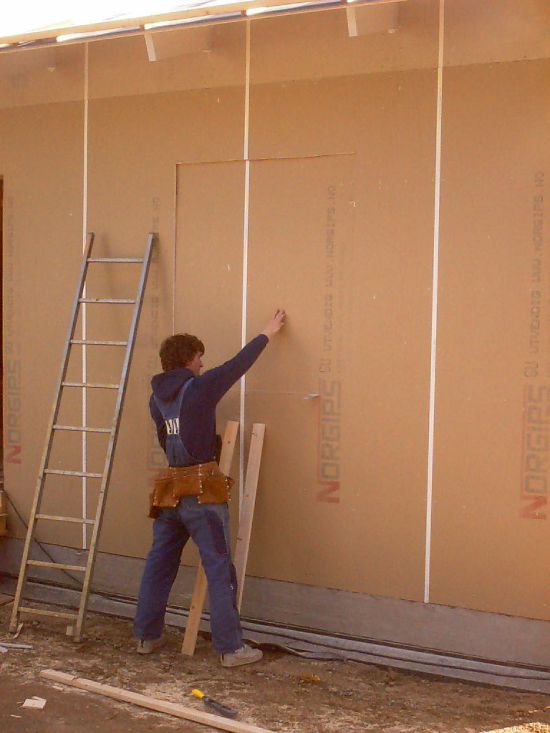
Saw external plasterboard:
http://www.familjenlindstrom.se/images/byggahus/stomme/vagg.jpg
Thanks, but this is about the inside!ByggaNytt said:
