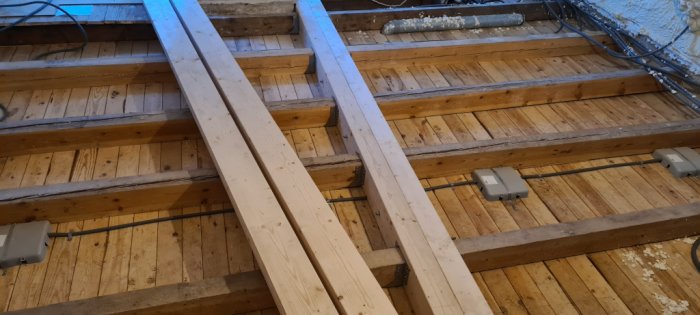
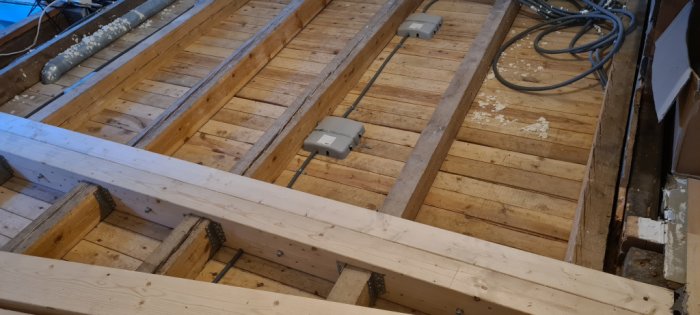
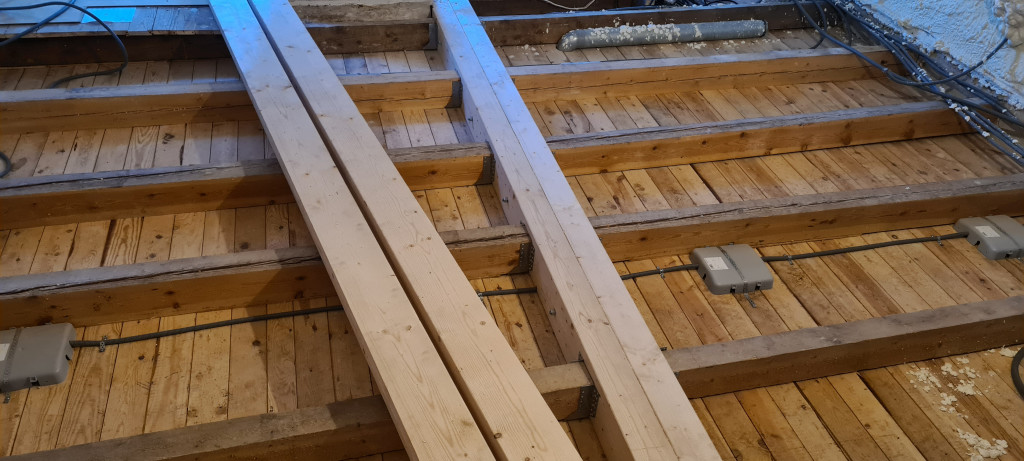
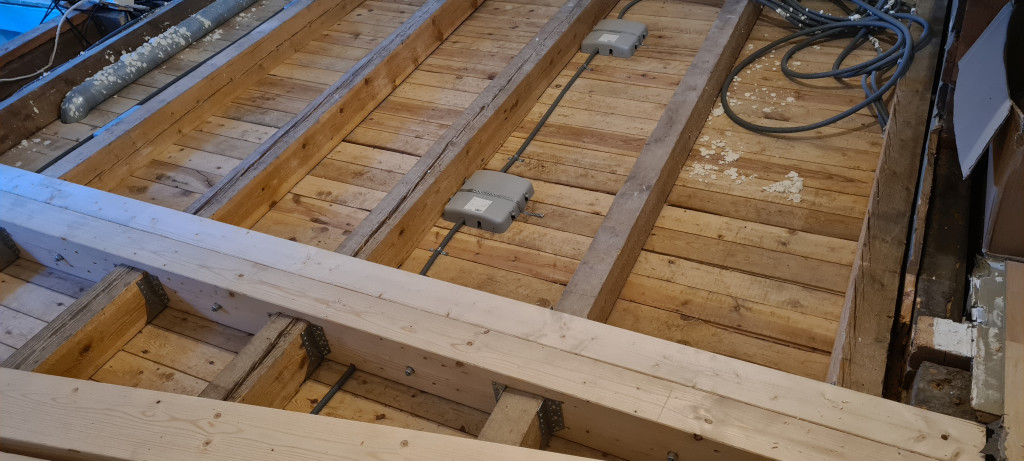
I am renovating a house partly built in the 50s and am currently working on the joists above the kitchen where there are no load-bearing interior walls.
It consists of beams 100x150mm, spaced between 600mm and 700mm, but unfortunately with a span of almost 5.3m. The outer walls are made of lightweight concrete and the ends of the beams are embedded in the concrete.
Unfortunately, I have very limited ceiling height and I don't want to damage the ceiling on the lower floor.
However, it is only about 3.3 meters long, so my idea was to prop up and cut all the beams across and attach them with joist hangers to a cross beam in the middle.
Glued laminated timber is available in 115x180mm, the question is if that would be enough or if I might need to use a steel beam instead? Or maybe there is another alternative?
After the intervention, the plan is to level the floor with 45x170 laminated and screwed to the side of the 100x150 beams.
I want to make the floor sturdy and not have to redo it in my lifetime.
Are there any all-knowing forces in the forum that can help?
It's difficult when you want to keep the height of the construction down. Steel is not a good solution in this situation. You have to make a hole in the outer wall and insert a beam so that the cut joists can sit on the flanges. And that can't be done without disturbing the ceiling of the floor below. I see two realistic possibilities: 1) Do as you planned but with a larger glulam dimension, 215x180. 2) Insert glulam 215x180 between the existing 100x150 joists and let the floor rest on the glulam beams. If you can accept 225 mm high glulam, 115x225 will suffice. You can also manufacture your own box beams, but that's starting to get more advanced.
To clarify, there are load-bearing inner walls on each side parallel to the floor joists. These walls are studded with 100x100, and I have access to reinforce with columns if needed. That's partly why I think I can place a beam across the joists since it's only about a 3.4m span in that direction.
If a single beam is too weak, I can place two with a gap, so the joists are divided into three parts.
To install a steel beam, I thought one could cut away about 75mm in width, use two UPE beams 160x70x5 that are inserted one by one in opposite directions, and then insert a joist that is 65mm wide between them and bolt everything together straight through.
It's difficult when you want to keep the height of the construction down. Steel is not a good solution in this situation. You have to make a hole in the outer wall and insert a beam so that the cut joists can rest on the flanges. And it can't be done without disturbing the roof of the floor below. I see two realistic options: 1) Do as you planned but with a bigger glulam dimension, 215x180. 2) Place 215x180 glulam between the existing 100x150 joists and let the floor rest on the glulam beams. If you can accept 225 mm high glulam, 115x225 will suffice. You can also make your own box beams, but then it starts becoming advanced.
Can I lay a 215x180 beam down so it builds 180 in height and get it stiff enough with that?
Justus, could it possibly be that two welded angle irons might be enough? Like an upside-down T. So propping, dividing the floor structure, raising the beam, and supporting on either side.
If I have even understood correctly…
Justus, could it possibly be that two welded angle irons might be enough? Like an upside-down T. That is, shore up, divide the floor structure, lift up the beam, post on each side.
If I've understood correctly...
I can't lift anything from below as I don't want to damage the ceiling underneath.
Ah, sorry, I probably didn't read enough. Are you going to insert the lying beam from above?
Yes, everything happens from above. I think my solution with laying down two U-beams would work fine, but it's probably both easier and cheaper to go with a 215x180 glulam beam and joist hangers.
Absolutely. The glue is the most important. Then pull it together with sturdy mounting screws or through bolts so that all the glue seeps out into the joints.
Absolutely. The glue is the most important. Then pull it together with sturdy construction screws or through bolts so that all the glue seeps into the joints.
Now it was done. I built pillars in the walls on the ground floor, made sure they rested on solid ground, and secured them properly to the frame. Then I hung the joists on both sides of where the beam would be and then sawed off the rafters. Then it was just a matter of putting in the joist hangers and placing the beam in the void. I laid a rule over the collar ties in the ceiling, wrapped a ratchet strap around it, hooked a timber tong to the strap, hooked the timber tong in the upper holes of the joist hanger, and hoisted the rafter to the desired height before screwing it in. Everything went pretty well but my body was moderately sore the day after.
Vi vill skicka notiser för ämnen du bevakar och händelser som berör dig.