
147,815 views ·
15 replies
148k views
15 replies
formula to calculate 90 degrees ?
Page 1 of 2

going to mark out for a stable we are going to set up on the property. and want to avoid building a huge angle to get 90 degrees so the house is right 
well, I know there's a "quick guide" but I've misplaced it..
there's a rule that basically says. 2m from each corner there should be Xm between these points....
hoping for your help...
/ Linus
well, I know there's a "quick guide" but I've misplaced it..
there's a rule that basically says. 2m from each corner there should be Xm between these points....
hoping for your help...
/ Linus
Here's what you can do:
If you imagine a plastic set square used for drawing, the proportions between the sides are 3 times X, 4 times X, and 5 times X.
That is, the short side can be, for example, 3 times 10 cm, the long side at a right angle to the short one is then 4 times 10 cm, and the diagonal becomes 5 times 10 cm.
You choose the factor to multiply 3, 4, and 5 by (probably based on a limiting real measure), then it's just a matter of calculating.
Good luck!
/Ronnie
If you imagine a plastic set square used for drawing, the proportions between the sides are 3 times X, 4 times X, and 5 times X.
That is, the short side can be, for example, 3 times 10 cm, the long side at a right angle to the short one is then 4 times 10 cm, and the diagonal becomes 5 times 10 cm.
You choose the factor to multiply 3, 4, and 5 by (probably based on a limiting real measure), then it's just a matter of calculating.
Good luck!
/Ronnie

Diversearbetare
· Göteborg
· 11 229 posts
Also called Egyptian triangle


No, Pythagoras came up with the same thing long after the Egyptians.... It happens sometimes, like for example the propeller, which is considered a Swedish invention, existed with the Egyptians much earlier.....
The numbers 3:4:5 are called an Egyptian triangle. Three numbers that form a right-angled triangle are called Pythagorean numbers and there are several such groups (an infinite number, in fact), e.g., 12:16:20 or 270:360:450. A triangle for angle measurement can naturally have any proportions, but then you need to use the Pythagorean theorem. If you make a triangle with the legs (the short sides) 1000 mm, the hypotenuse (the long side) should be 1414 mm.
Diversearbetare
· Göteborg
· 11 229 posts
Or to summarize it:RobertC said:
An Egyptian triangle (3:4:5) is an example of Pythagoras' theorem.
5:12:13, 8:15:17, and 7:24:25 are also examples of Pythagorean numbers.
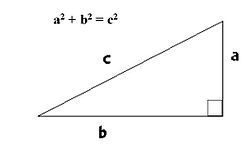
Source: Wikipedia
-----
Forum in all its glory, but surely we all digress from the topic many times.

You can measure anything for 90 degrees
Expl Mark out a side e.g. 4.25 meters = then it becomes 4.25X4.25 = 18.062
next e.g. 7.65 meters = then it becomes 7.65X7.65 = 58.52
18.062 + 58.52 = 77.14 and the square root of that (found on almost every calculator) = 8.78 which the diagonal should be, regarding
the measurements they can be anything, the longer the more accurate the 90-degree angle
As the German physicist said 3 + 4 = 5
Expl Mark out a side e.g. 4.25 meters = then it becomes 4.25X4.25 = 18.062
next e.g. 7.65 meters = then it becomes 7.65X7.65 = 58.52
18.062 + 58.52 = 77.14 and the square root of that (found on almost every calculator) = 8.78 which the diagonal should be, regarding
the measurements they can be anything, the longer the more accurate the 90-degree angle
As the German physicist said 3 + 4 = 5
Measure 120cm to one side and 160 to the other from the corner. Then you should have 2m between the marks.