patio planning in final stages
Considering the best way to build my posts for a fence that will be about 180cm high with 120cm between posts on 95x95.
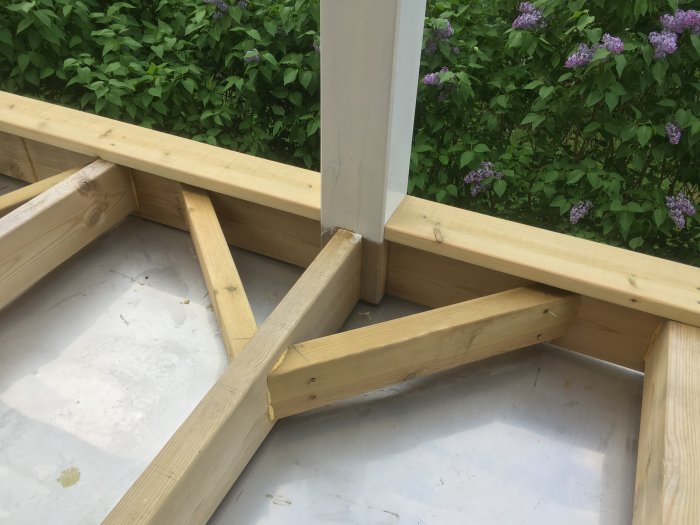
I'm planning to attach the post between two beams as shown in the picture.
What do you think about that? And what would be the best fastening method? French/coach bolt/common wood screw?
I know that 2 pieces of 45x95 (combined) where one rests on the beam can probably be more stable.
But then the post would be further out, and the fascia board would extend out over the edge which.
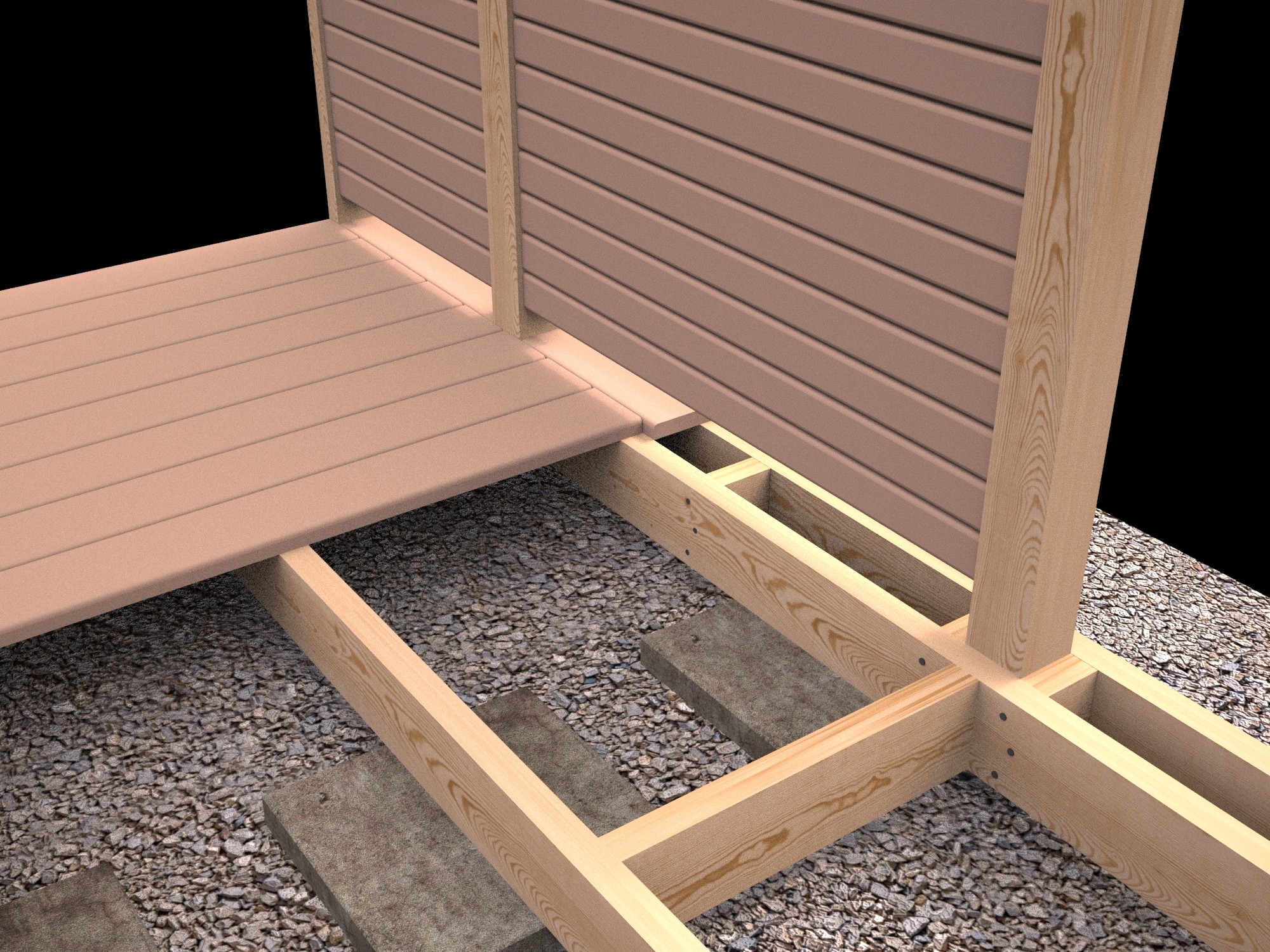
You need something to absorb the bending force perpendicular to the post in the horizontal plane. A simple short piece redirects the load inward to the next support beam. There will be quite large forces on the plank in windy conditions. This is how I've done it so the deck posts are generally stable. The post in my case straddles the support beam and is bolted/glued. As is the perpendicular support beam. The cross braces transfer the bending force to the middle of the short piece.
You need something that takes up the bending force perpendicular to the post in the horizontal plane. A simple short piece moves the load inward to the next bearer. There will be quite large forces on the plank during wind. This is how I have done it to make the deck posts stable in general. In my case, the post straddles the bearer and is bolted/glued. Likewise, the perpendicular bearer. The cross braces move the bending force out to the middle of the short piece.
Thanks for the reply.
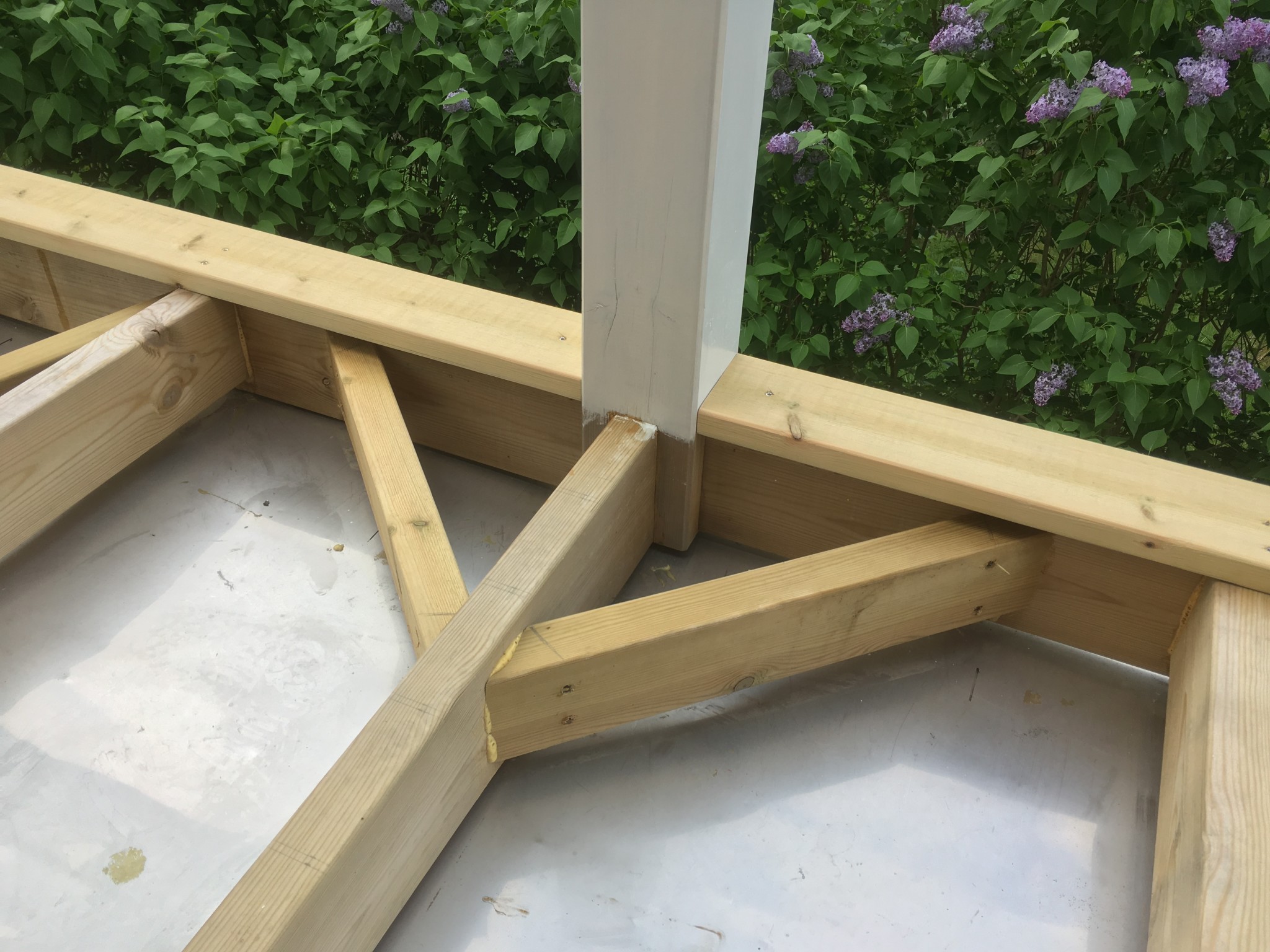
I’ve redrawn a bit
I've added extra small short nail joists around the post (needed anyway for the fascia board) and placed a short piece towards the next bearer. In sideways it shouldn't be needed as much, right? Having the post halfway over the bearer helps with that among other things, but this should be stable enough. Maybe I'll add a diagonal brace like you did while I'm at it.
At 1.8m high, there are very large forces if it storms properly when you only have 145-195mm (whatever the dimension of the support beams?) to attach to. I solved this by pulling them down 70-80 cm under the deck and then placing braces from the end up under the deck to get a longer lever arm on the attachment, but that's not possible here when the deck is at ground level.
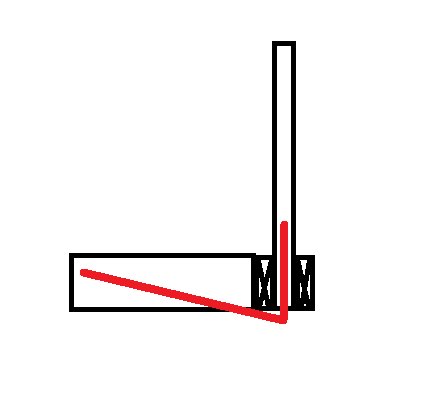
It may very well hold with one of the options in the pictures, but I would probably try to achieve some form of steel attachment with a plank that is 180cm. In the picture from post #3, for instance, one could consider fastening with two strong L-shaped flat irons (where one leg is maybe 30cm (attached to the post) and the other as long as the crosspiece allows), one on each side of the post that is bolted to the post and then goes under the support beam and in at 90 degrees (or a little less, say 70-80 degrees, so it comes up on the crosspiece (double crosspiece so you get the same width as the post) and can be attached to the crosspiece.
Maybe a bit fuzzy, made a clumsy principle sketch in paint
That being said, it doesn't mean it might not work to attach according to one of the principles above. Someone who has the time and/or is significantly more skilled in calculations is welcome to figure out what's actually needed for a 180cm plank cc120cm. But spontaneously I think it feels a bit weak to just attach to the support beams, but I also like to have belt and suspenders
Maybe a bit unclear, I made a clumsy principle sketch in paint
[image]
That being said, it may work to attach according to one of the principles above, someone who has time and/or is much more skilled in the calculations is welcome to figure out what is actually needed for a 180cm board cc120cm. But spontaneously, I think it feels a bit weak to only attach to the carrying beams, but I also like to have suspenders and a belt
I understand what you mean, my carrying beams are 145.
Your idea becomes difficult to execute when the pole is on one of the plates, then it is not possible to come under the carrying beam with a flat iron. Unless you start notching the carrying beam for the iron, of course, but I don't intend to have that much fun
Then I would rather reduce the CC measurement, but according to the book CC 120 should be more than enough.
The board will be about 6m wide and then 90 degrees and continue 120cm, so it has a little help at the ends, but in the middle of the board, I might have to reinforce it properly. It gets quite windy where we live.
...perhaps it should be added that the neighbors I have who put a fence on their patio only attached post shoes to the decking, which cannot be anywhere near what I'm planning here.
Ah, yes, the sides/angles will probably do quite well then, mostly the middle as you mention. No, if the pole is on the slab it becomes tricky, it looked on the drawing like they weren't doing that
Then it probably leans towards one of the options above
LinusW, what great renderings you have, is it Sketchup? If so, is it the free version or an upgrade? Good luck with the build!☺️
Glad you liked them, thanks It's not Sketchup; it's 3D Studio Max.
mrVoodoo said:
Ah, yes, the sides/angles will probably do quite well then, mostly the middle as you mentioned. No, if the post is on the slab, it becomes tricky; it looked on the drawing as if they didn't do that
Then it leans towards one of the above options
The slabs in the drawing don't align 100% with where they actually are, but the risk of a post ending up on/next to a slab is quite high. Additionally, the slab only sticks up maybe 1-2cm from the gravel since they're pounded down, etc., so everything fits. It will have to be secured with wood as best as possible.
Does anyone have input on the attachment? Lag screw/bolt/wood screw?
I've heard mixed things about all of them.
Anyone have input regarding the fastening? French screw/bolt/wood screw?
I've heard various things about all of them.
I have tried all three on different occasions and what seems to work best over time for me at least is a through bolt (screw is what it's technically called but yeah ) and nut, hot-dip galvanized, sturdy wood screw as a second, and French screw as the worst. I completely avoid using the French screw nowadays actually, at least for things that need to be fastened in wood.
Glad you liked them, thanks It's not SketchUp, it's 3D Studio Max.
The slabs in the drawing don't match 100% where they actually are, but the risk of a pole landing on/next to a slab is quite high. Then the slab only sticks up about 1-2cm from the gravel as they are pounded down, etc., so everything fits. I'll secure it with wood as best as I can.
Anyone have input on the fastening? French screw/bolt/wood screw?
I've heard a bit of this and that about all of them.
How did it turn out and was it good? Which construction did you choose and which screw was used? I'm working on a similar project and am wondering how best to attach 95x95 posts on 45x145 beams for a 180 cm high fence.
My considerations are both how to make it stable and how to make it straight? Often it can veer off a bit when you screw it, and it doesn't look good if the posts are standing crooked. How do you minimize that risk?
How did it turn out and was it good? Which construction did you choose and which screws were used? I'm working on a similar project and am wondering how best to attach 95x95 posts to 45x145 support beams for a 180 cm high fence.
My considerations are partly how to make it stable and partly how to make it straight? Often it can shift a bit when screwing and it won't look nice if the posts stand crooked. How do you minimize that risk?
I built my posts as an "L"
I attached a timber that was the same as the support beams as the foot in the L with regular screws, 180 or 200 long... can't remember. And some PU glue. The L construction itself became very stiff and solid.
The foot in the L went from the post to the next support beam where it was also attached.
The fence is now a couple of years old and stands very sturdily.
Align the L post carefully when you attach it to get a vertical post.
I built my posts in an "L" shape. I attached timber that was the same as the joists as the foot in the L with regular screws, either 180 or 200 long.. don't remember exactly. And a bit of PU glue. The L construction itself became very stiff and strong. The foot in the L went from the post to the next joist where it was also attached.
The fence is now a few years old and stands very firmly. Fit the L post carefully when you attach it to get a vertical post.
Thanks for the response, so you didn't follow the images above with the posts between two joists?
Vi vill skicka notiser för ämnen du bevakar och händelser som berör dig.




mrVoodoo said:
Maybe a bit unclear, I made a clumsy principle sketch in paintKasper i Malmö said:
LinusW said: