Sitting and planning the spring projects which involve setting up some trellis or fencing if you prefer. I've prepared with concreted post brackets placed at a distance of about 1500 mm (1400-1600 mm). The brackets are designed for 95 x 95 mm posts and have 10 mm bolt holes.
As a layman, you talk to friends and family who recommend bolts and nuts, i.e., something like 2 pcs M10 x 120 mm hot-dip galvanized for each post, while others say it's fine with coach screws, either 2 pcs 10 mm with a length of up to 90 mm (one from each side) or 4 pcs 50 mm screwed into each hole in the brackets.
As a layman, I think it seems a bit complicated to drill through the post perfectly straight for bolts. It feels like there's a big risk that it'll be a bit crooked, and if the hole is too big for the bolt, it's "game over."
In such a situation, coach screws feel a bit more convenient, but the question is whether a couple of "tiny" screws can hold up a 95 x 95 mm post, two beams at 70 x 45 mm, and vertical slats on 45 x 45 mm. I have (as everyone can tell) no knowledge in structural engineering or similar.
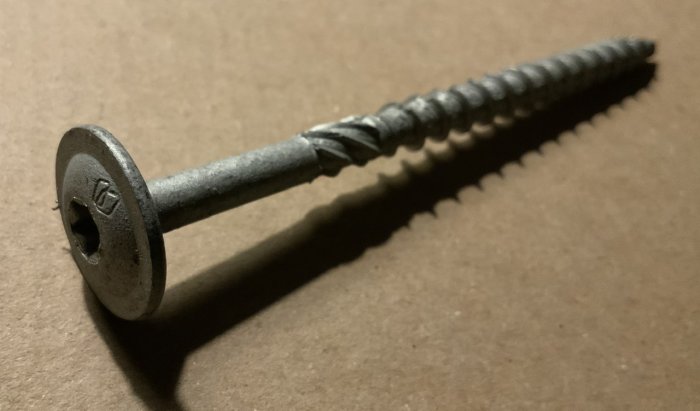
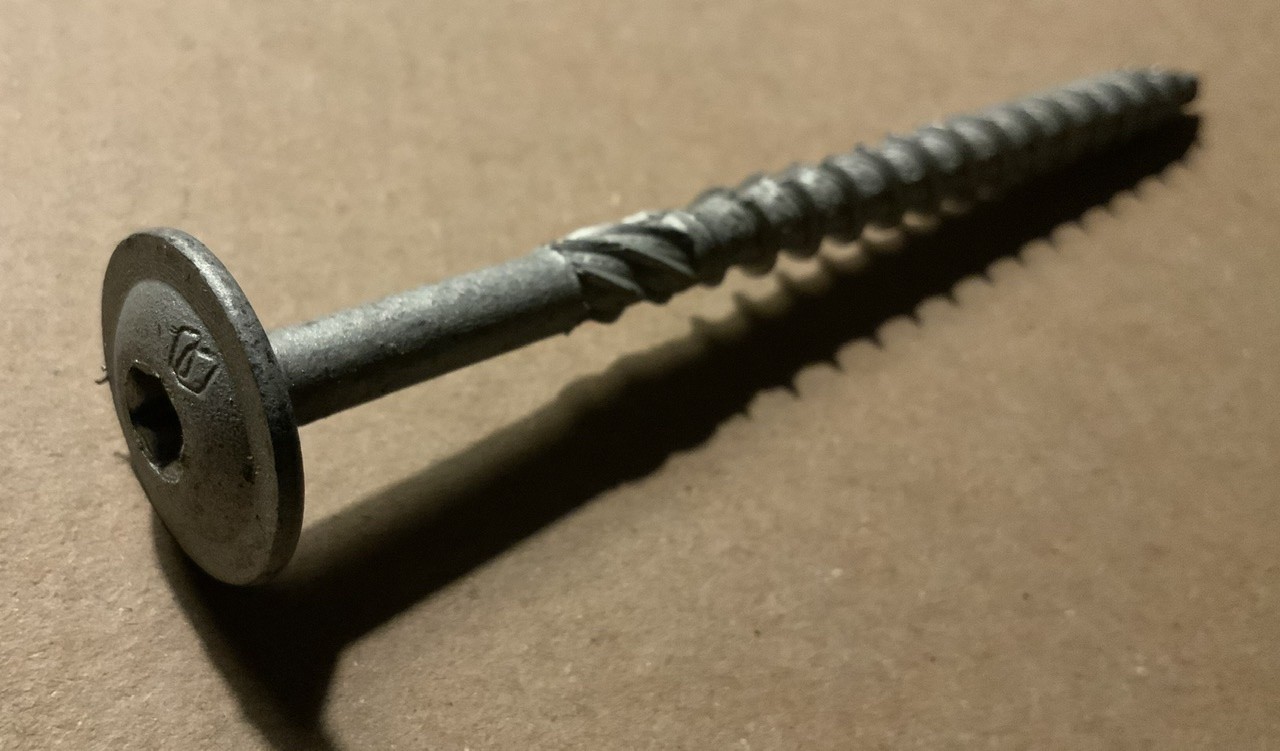
But if it's so that bolts and nuts are not mandatory for such a wooden structure, since drilling feels a bit risky and since 2 long or 4 shorter screws might do the job well enough, I recently heard about a screw called Big Dog that seemed interesting and convenient. It seems to be FAST Fastening that calls their screw that, which they market as a replacement for coach screws. After some Googling, it appears that Essve has something similar they call WAF.
Since the Big Dog (or WAF) screw seems both more aesthetically pleasing and easier to handle than both bolts and coach screws thanks to regular Torx bits and apparently no need to pre-drill, this seems like a perfect solution for me - but will it be enough? Is a Big Dog equivalent when it comes to keeping the posts and the whole construction up?
FAST seems to have 10 x 90 mm, and then I thought about using 2 pcs, one from each side, in each post. Then there's also 10 x 50 mm, which you ought to be able to set 4 pcs of (one in each hole) just like with coach screws.
Which is really better of these options?
Or is it perhaps a combination, like 2 pcs 10 x 70 mm and 2 pcs 10 x 30 mm (or 60 mm / 40 mm) if you angle the screws a bit?
If anyone is wondering how high the structure will be, it will probably be just over 1000 mm at the lowest and up to 1600 mm at the highest. The length between corner posts is approximately 15-18 meters I would guess. As I said, I strongly doubt that two "tiny" screws per post can hold up everything even if it will be an open structure, though on a wind-exposed plot.
I forgot to mention that we placed the post brackets so the holes run along the finished fence. The reason was to facilitate setting the posts straight in line when it's time. Maybe that was a big no-no?
Hard to believe that Big dog wouldn't be enough. They are better than the usual French ones in that the French ones tend to break at the head. French are really rubbish that shouldn't be sold. Regarding whether it's better to use 4 short ones or 2 longer ones, I have no idea, but I don't think you need to worry either way. I would probably have used 2 longer ones myself.
Best regards, Elias.
Hard to believe that Big dog wouldn't be enough. They are better than the regular French ones in the sense that the French ones tend to break at the head. French ones are actually rubbish that shouldn't be sold. As to whether it's better to use 4 short ones or 2 long ones, I have no idea, but I don't think you need to worry whichever way you go. I might have used 2 longer ones myself. Regards, Elias.
Thank you for the response!
Okay, we can agree then that French screws are out
But how can it be that a Big Dog, or equivalent, can hold together as well as a bolt would, while the French ones break at the head?
It feels instinctively like a Big Dog screw has more in common with a French one than it does with a bolt. Does it have something to do with the material of the screw, its design, or its treatment?
Regarding 2 long ones versus 4 short ones, it feels like it could go either way, as mentioned. However, I understand that the 90 mm long one from FAST has threads only up to 55 mm or something like that, while the shorter 50 mm variant has threads all the way. That results in 55 mm of thread on one screw versus two screws with a total of nearly 100 mm of thread. Sooo, might that make a difference, you think?
Take the 90mm long one, you don't need threads all the way. It's completely unnecessary, won't hold together better for that.
The big dog has coarser threads than the French, which makes it better.
Take the 90mm long one, you don't need threads all the way. It's completely unnecessary, won't hold together better for that. The Big Dog has coarser threads than the French, which makes it better.
Okay, then it's settled regarding which type of fastening to use; 2 Big Dog 10 x 90 mm will do the job for each post. Hope it holds......
Sitting in the same situation as the original poster. How has it gone? Noticed any difference or is it still sitting nicely after about two years?
Yes, thank you, the timber is still standing as intended.
As mentioned, I used 4 pieces of 10 x 60 Big Dog for each post. Pre-drilled a few centimeters with maybe a 5-6 mm drill just for an easier start and grip and to be able to steer/angle the screw slightly since they could theoretically collide.
The attachment process was relatively quick and smooth thanks to the screw's properties.
The wood has contracted as it dried, so we went over all the screws and tightened them again this spring.
During these two years, I've retightened a few posts earlier. But now we did all of them this year, and after that, I think it's stable again.
Previously, there were several posts that had shrunk enough that they were "hanging" somewhat.
In one case, the screw rotated without really holding. Probably it collided with its companion from the other side, which is not optimal, but the other three in the post held well.
Spoke to a carpenter who looked over it and suggested that if it loosens again in the future, one might need to consider drilling through and using a bolt instead. I'm a layman, so I have no idea about the likelihood of that in my case.
Overall, I am quite satisfied with the Big Dog screw. The only negative was that in the boxes I bought, there were too many defective heads for the bits, meaning the bits hole in the screw was so clogged that it was completely unusable. So it was lucky I didn't order an exact amount.
Yes, thank you, the timber is still standing as intended.
As mentioned, I used 4 pieces of 10 x 60 Big Dog in each post. I pre-drilled a few centimeters with maybe a 5-6 mm drill just for an easier start and grip and to be able to steer/angle the screw slightly since they could theoretically have collided.
The fastening went relatively quickly and smoothly thanks to the screw's properties.
The wood has contracted as it dried, so we went over all the screws and tightened them up this spring.
Over the past two years, I've retightened a few posts earlier. But we did all of them this year, and after that, I think it feels stable again.
Previously, several posts had shrunk to the extent that they were slightly "hanging."
In some cases, the screw rotated without a proper hold. It probably collided with a companion from the other side, which isn't optimal, but the other three in the post held well.
I talked to a carpenter who looked it over and suggested that we'll see if it loosens again in the future, in which case you might need to consider drilling through and adding bolts instead. I'm a layman, so I have no idea about the likelihood of that in my case.
Overall, I'm quite satisfied with the Big Dog screw. The only negative was that in the boxes I bought, there were too many faulty heads for the bits, meaning the bit hole in the screw was so clogged that it was completely unusable. So it was lucky not to order an exact number.
Hope this was an answer to your question
Thank you very much for a detailed and factual response.
There are thousands and thousands of different options and methods, so like you, I (a layman) also get quite puzzled. The method you are using sounds good. Also good that if it starts to loosen after a few years, you can drill out and tighten with bolts. By then, everything has settled, and no major ground corrections are expected to come.
I had planned to set our fence with French wood screws but this thread got me thinking better!
Wow, such nice screws, fantastic with T-40 which turned out to be really durable. Drove the screws with a Hilti TE2-M on gear 1, namely absolutely extremely strong torque until the clutch slips if you encounter extreme resistance (a safety mechanism so that you don't break your arms if you hit a nail with a large wood drill).
In that situation, I just continued to hammer on with a really strong Milwaukee M12 FIWF12 impact wrench with a bit adapter, well over 300+ Nm but it was only on a few screws that it was needed (like if you're screwing into an old nail). Completely amazed by how much power the screws can withstand without anything in the power chain breaking down, drove 40 pcs 8x120mm Big Dog and even the bit set from Biltema held together which was the biggest surprise.
The only small issue was that one of the screws broke at the tip when it was too heavy, but it's forgiven considering the insanely high torque I applied. Hardly believable that T40 can handle such high torque!
Fun to hear!
Big dog seems to be an appreciated product.
You seem to have access to a nice "maskinpark" too.
I am going to buy plint with two holes in each plintjärn, the post is 70x70. I can't decide if I should use a longer one from each direction (2 per plint) or two shorter ones from each direction (4 per plint)?
For the attachment of wooden posts in post shoes, I can indeed imagine that French wood screws in a coarse dimension that matches the holes in the post shoe can work excellently. I've installed similar ones before and just used a couple of long coarse French wood screws; the construction allows the load to be taken up by the screws over time rather than the moment you tightened them during installation (the timber shrinks over time, etc.). Sure, you can retighten them, but it hardly makes any difference. I see no point in using through bolt connections with nuts, etc.
These "Big Dog" I used last time, 8 x 120 mm, are actually only 6 mm thick including the thread they become 8 mm in diameter. The function of the screws for my application was to clamp tightly against the underlying joists; it was not for vertical load to rest against the screws as when attaching load-bearing posts to post shoes.
I am definitely not an expert in constructions, just sharing how I think about this. I will continue using French wood screws for things like setting posts in post shoes.
One advantage of regular French wood screws is that you only need a suitable socket and a ratchet; although you often need to pre-drill as well, it is overall very simple. I've never experienced a French wood screw breaking at the head (but then again, I haven't used a nut driver that might be able to achieve that).
Nice to hear!
Big dog seems to be an appreciated product.
You seem to have access to a fine "machine park" as well.
I will buy brackets with two holes in each bracket iron, the post is 70x70. Can't decide if I should use one longer from each side (2 per bracket) or two shorter from each side (4 per bracket)?
In your place, I would probably choose 2 longer ones, one from each side. I think the screws will be too short if you use 4 shorter ones. I thought my 60 mm felt a bit short (especially for 95 mm posts).
You can probably use 10 mm thick Big Dog for your bracket irons. So maybe you should choose the same as I did, i.e., 10 x 60 mm for your 70 mm posts?
I can add that I ran out of my Big Dog 8x120 mm, found screws that looked identical at Byggmax except they were a bit shinier in the surface treatment and a tad rougher in the finish of the material. The price per screw was about the same, here it was a different brand "InFe". I will do a substantial torture test similar to the one I already did on the original "Big Dog" from the manufacturer FAST, interesting to see if the copy can handle really strong torque or if it just breaks when it gets tougher. Will return with results around tomorrow.
Vi vill skicka notiser för ämnen du bevakar och händelser som berör dig.