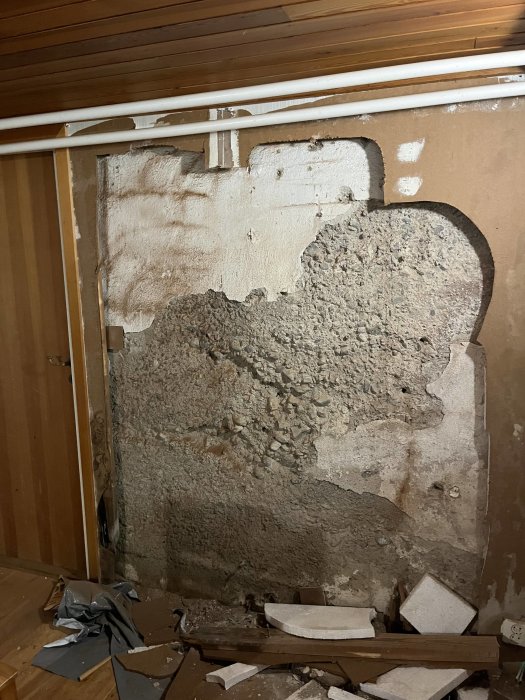
I have demolished a moisture-damaged framed wall in my basement (wooden studs, styrofoam, masonite, wallpaper). The result can be seen below:
There is still some demolition left to do. The crossbeam at the top is a bit difficult to reach due to the water pipes, and on the right, there is an electrical wire behind the masonite.
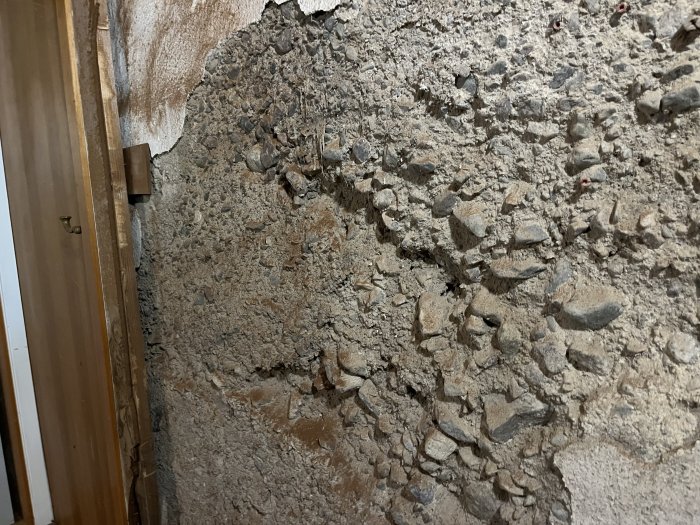
What I'm wondering about now is the concrete behind:
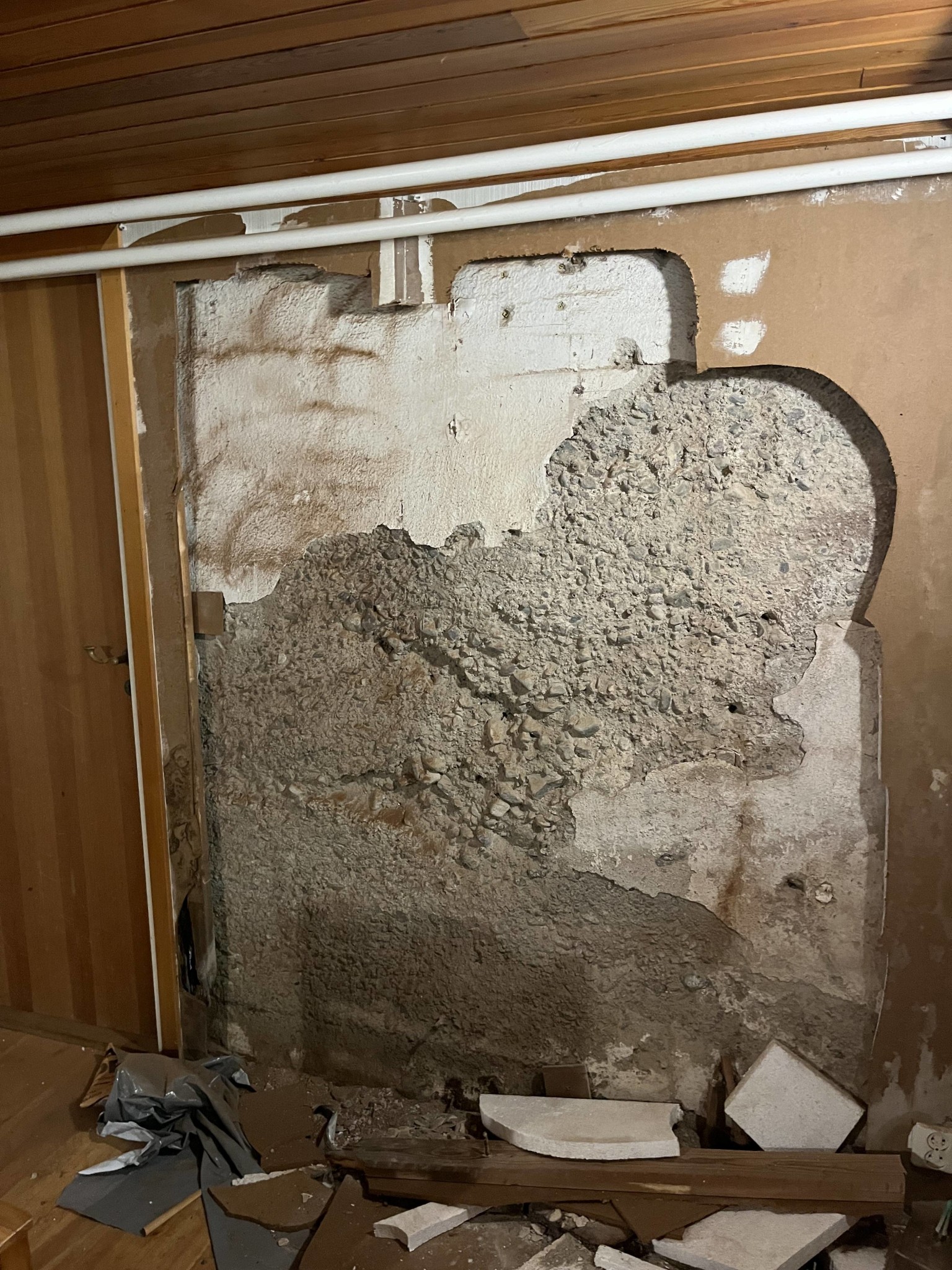
It is very uneven, and much of it seems to have crumbled behind the framed interior wall. If you scrape the surface, more of the cement falls off.
Should I be worried? Do I need to do something, like apply some kind of mortar? It's also worth noting that the wall might still be damp and needs to dry.
It will never dry if you don't address the problem of why it's damp. The way it looks is due to it being constantly damp and basically crumbling apart.
it will never dry if you don't address the problem of why it is damp. The reason it looks like it does is because it is constantly damp and is basically crumbling apart.
I assumed it was damp because it was enclosed behind the wall and couldn't breathe? Beyond that, I'm not really sure what the cause could be. It's an interior wall and the house is drained. Ground moisture is probably present, but there's not much that can be done about it, is there?
The minimum is probably to go ahead and tear out all the wood from the basement. If it needs to be built, you should probably use metal studs and skip the insulation. If the floor is directly on the concrete slab, it probably needs to be replaced with tiles or a ventilated floor. The moisture comes from below and can travel quite far through capillary action. If you want insulation in the basement, it's better to install it from the outside, i.e. drainage work.
I assumed it was damp as it was enclosed behind the erect wall and couldn't breathe? Besides that, I'm not quite sure what the cause could be. It is an interior wall and the house is drained. Ground moisture likely exists, though, but there's not much to do about it?
If what you tore down was damaged by moisture and the wall looks like that, you can probably assume it's damp there, and it won't stop being damp just because you cover it up again. The cause must be eliminated. There could be many causes. Drainage can mean many things and it depends a bit on what type is meant. In this case, perhaps one needs to seal the wall and have Platon mat or something similar.
I do not intend to cover the wall again, except with plaster and permeable paint. But before this becomes relevant, I want to make sure that the wall is okay. When I first opened the bottom, it was clearly wet where the framing was obviously damaged, but now, a few weeks later, it is significantly drier.
Of course, it can get better if you remove a dense wall, but it will never be great. You will likely get plaster peeling and paint curling later on as well. No paint is so open that it can handle such problems.
Sure, it can get better if you remove a dense wall, but it will never be good. You'll probably get plaster release and paint curling afterward too. No paint is open enough to handle such problems.
OK. In that case, I don't really know what I can do. Drainage probably doesn't help against ground moisture, if that's the problem. However, I suspect that the problem might originate from the time before the drainage was done properly, and if so, maybe it's just a matter of letting the wall dry out now?
Yes, but where is it made? What type of house is it? How old is it? What type of drainage is there? The older your house, the more the possibility of draining away such problems decreases.
OK. In that case, I'm not quite sure what I can do. Drainage probably doesn't help against ground moisture, if that's the issue. However, I suspect the problem might stem from the time before the drainage was properly done, and if so, maybe it's just a matter of letting the wall dry out now?
I had something similar on a basement wall that was framed. I tore everything down, removed loose plaster on the wall, replastered the wall, and painted with silicate paint. This was before we drained, and after that, I had a slight issue with calcium deposits on the bottom of the wall. After we drained, that problem disappeared so after touching up the paint at the previous deposits, it hasn't returned.
You need to distinguish between drainage and protecting the facade from penetrating ground moisture.
Drainage:
Aims to keep down the water level so that water does not stand higher than the base of the basement. This prevents moisture from rising or being drawn up through the slab or through the walls of the basement.
Facade protection:
Water from above (rain/roof water/snow) that finds its way down to the drainage can instead go into the facade. In that case, the facade needs protection. In the past, tar pitch was applied to the basement walls, making it difficult for moisture to enter. The asphalt has a best-before date as it becomes worse over time, reducing its protective function. Newer solutions include Platon sheet (there are other brands) and insulation boards that are placed to prevent moisture from reaching the facade and instead direct it straight to the drainage.
So if previous owners have done drainage, it doesn't mean that the basement is protected from penetrating water. To prevent the basement from getting worse, the exterior also needs to be reviewed!
On the inside, it is undoubtedly good to remove organic material to air and dry the wall.
You're saying it's an interior wall? Is that really so, then is there another room behind the concrete?
It's quite strange to have that level of moisture. I find it hard to believe that so much could be drawn up from the base plate. Are you sure it's not, for example, a pipe leak causing the moisture?


AJ82 said:
