
5,675 views ·
20 replies
6k views
20 replies
Exterior walls construction in Germany
In Germany, when building single-family homes or multi-family houses, they have completely different exterior walls compared to Sweden, see attached image. The exterior wall from ground level up to the 4th floor or higher. They glue Rockwool boards (thermal insulation) directly onto the brick walls. These are hard Rockwool boards. Then they apply plaster directly onto the Rockwool boards. Afterwards, the interior walls are plastered with mortar.
There seems to be no vapor barrier. In Sweden, they use plastic film inside the drywall as a moisture barrier, so water vapor cannot pass through the wall. In Germany, they don't use drywall at all; instead, all walls are plastered on the inside. They have no wallpapers; the walls are like sandpaper and always white.
They build by laying bricks, not with timber like in Sweden.
One might think about moisture problems with such a construction without a vapor barrier. What are your opinions? Apparently, the German exterior walls work, otherwise they wouldn't continue.
Could it be done similarly in Sweden as well?
There seems to be no vapor barrier. In Sweden, they use plastic film inside the drywall as a moisture barrier, so water vapor cannot pass through the wall. In Germany, they don't use drywall at all; instead, all walls are plastered on the inside. They have no wallpapers; the walls are like sandpaper and always white.
They build by laying bricks, not with timber like in Sweden.
One might think about moisture problems with such a construction without a vapor barrier. What are your opinions? Apparently, the German exterior walls work, otherwise they wouldn't continue.
Could it be done similarly in Sweden as well?
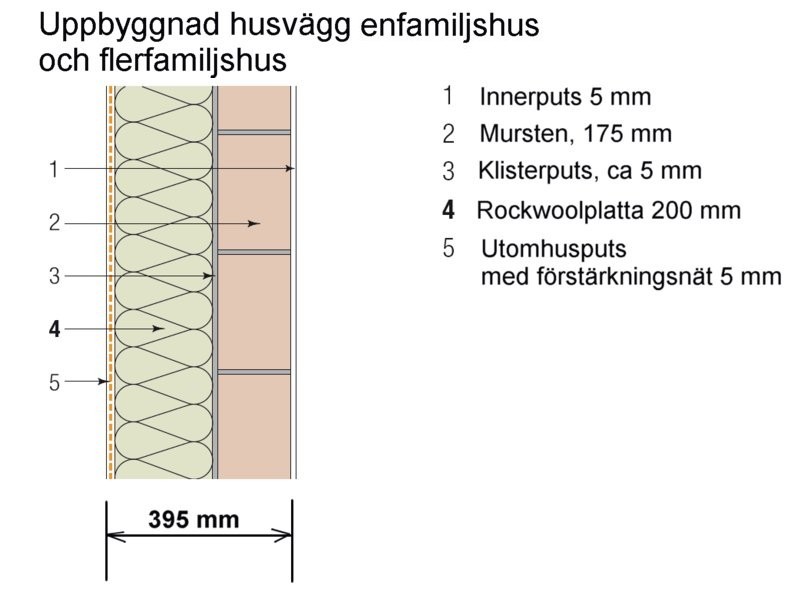
Last edited:



As Huggen writes, in Germany they plaster the inside of the wall (not coat it, as I wrote), which becomes the wall you hang paintings on. The profession that does this work is even called plasterers. But they have some kind of plaster mass that they apply and smooth out on the walls.
What I find suspicious is that they apply outdoor plaster directly to the Rockwool boards.
They state that water can diffuse through the wall. Then you would think that if it is, say, -10 degrees outside and 20 degrees inside, then the water vapor passes through the wall to the outside, it must encounter its condensation temperature. It's just a question of how far into the wall, but it must be somewhere in the outermost Rockwool board, and there the condensation water accumulates.
Another thing: how do they attach details to the facade with such a construction? For example, lamps. Screws in the thin plaster and Rockwool board?
I am not a construction engineer and do not know how a wall should be properly constructed, but I just have an idea of how it's done in Sweden.
It seems like they never build the walls of a single-family house with timber as in Sweden, but the walls are always built with masonry. Is it that masonry walls are superior to timber walls, or why do they do so?
What I find suspicious is that they apply outdoor plaster directly to the Rockwool boards.
They state that water can diffuse through the wall. Then you would think that if it is, say, -10 degrees outside and 20 degrees inside, then the water vapor passes through the wall to the outside, it must encounter its condensation temperature. It's just a question of how far into the wall, but it must be somewhere in the outermost Rockwool board, and there the condensation water accumulates.
Another thing: how do they attach details to the facade with such a construction? For example, lamps. Screws in the thin plaster and Rockwool board?
I am not a construction engineer and do not know how a wall should be properly constructed, but I just have an idea of how it's done in Sweden.
It seems like they never build the walls of a single-family house with timber as in Sweden, but the walls are always built with masonry. Is it that masonry walls are superior to timber walls, or why do they do so?
Last edited:



In the wall I show in the picture, there is nothing organic. It might not mold even if there is water in the rock wool or in the bricks. Do bricks mold? They say the wall breathes.
I don't know what kind of ventilation system they have.
Thanks for all the opinions.
I don't know what kind of ventilation system they have.
Thanks for all the opinions.
This principle is used in many apartment buildings in Sweden, but we rarely use bricks and instead usually use concrete. Sometimes lightweight concrete. When we renovate old brick houses, we often have this material combination. It is a moisture-proof construction.


Yes, this is the origin of the single-stage sealed facades that were imported to Sweden. However, the Swedish industry did not understand that there is a difference between wood and paper in walls and masonry/cast walls.useless said:
Last edited:
I assume they have ventilation in new buildings, but in older houses, ventilation is just opening the window. The bathroom used to have a controlled fan that went straight outside. We were very early with ventilation in Sweden.A Arnodt said:
Moisture can travel through these walls, and indeed it sometimes condenses and forms mold. Especially since German houses (at least in Bavaria) are built without ventilation. Germans are used to ventilate by opening windows.
Perhaps not the most modern construction, but that's the traditional way of building here. A plastered stone house is considered robust, solid - simply a proper house. Wooden houses have lower status - cheaper, not as good as stone. Therefore, fewer people want to build with wood.
Perhaps not the most modern construction, but that's the traditional way of building here. A plastered stone house is considered robust, solid - simply a proper house. Wooden houses have lower status - cheaper, not as good as stone. Therefore, fewer people want to build with wood.
Last edited: