
2,478 views ·
10 replies
2k views
10 replies
Do you build load-bearing on existing floor?
Hello, hello!
We have bought the rental apartment we've lived in for a couple of years and have long been annoyed by a wall in our kitchen.
The wall results in a small mini-hall whose only purpose seems to be to lead to the door to the attic. The hall steals a lot of light and with the wall gone, we would get an almost normal kitchen that suits us in size. The wall we want to tear down stands parallel to a thicker wall and it's only 130cm between these.
We have poked a bit into the drywall and found it's a plank wall with a frame around the doorframe, the frame is just over 2" thick and almost 4" wide, the wall including 13mm drywall on each side gives a wall thickness of 8cm.
We live at the top of a three-story wooden building (built around 1925) and all three apartments in our stairwell look the same from top to bottom, except we have sloped ceilings (with attic) and smaller interior dimensions than the floors below us...as well as this odd thin wall we want to tear down.
What makes us think it's not load-bearing is precisely that the wall doesn't exist on the floors below us, nor above us in the entirely empty attic that spans over 9 meters. No roof trusses or supports...just thick beams along the ceiling.
The attic floor indicates that our wall lies along the framework and if one is satisfied with that, it seems like we could just tear it down.
Adding to the mystery, we see original fir flooring with varnish under the bottom frame that the planks stand against. Did they build load-bearing like that back then? Lay flooring and varnish it only to then put up a load-bearing wall?
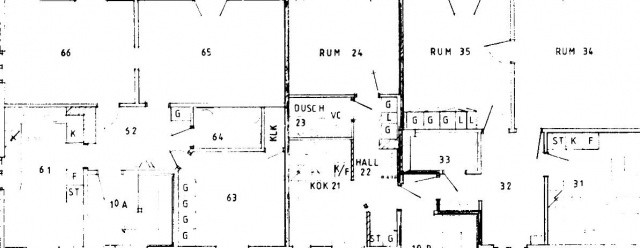
The house lacks construction drawings and the municipality only had floor plans that I am attaching, where the walls in question can be seen on the ground floor, first floor, and our floor.
Would any kind soul like to express an opinion and give us advice? Is it just a matter of starting the saw on the wall and going for it?
Or who in Karlstad Municipality do you talk to to sort this out?
Very grateful for help
We have bought the rental apartment we've lived in for a couple of years and have long been annoyed by a wall in our kitchen.
The wall results in a small mini-hall whose only purpose seems to be to lead to the door to the attic. The hall steals a lot of light and with the wall gone, we would get an almost normal kitchen that suits us in size. The wall we want to tear down stands parallel to a thicker wall and it's only 130cm between these.
We have poked a bit into the drywall and found it's a plank wall with a frame around the doorframe, the frame is just over 2" thick and almost 4" wide, the wall including 13mm drywall on each side gives a wall thickness of 8cm.
We live at the top of a three-story wooden building (built around 1925) and all three apartments in our stairwell look the same from top to bottom, except we have sloped ceilings (with attic) and smaller interior dimensions than the floors below us...as well as this odd thin wall we want to tear down.
What makes us think it's not load-bearing is precisely that the wall doesn't exist on the floors below us, nor above us in the entirely empty attic that spans over 9 meters. No roof trusses or supports...just thick beams along the ceiling.
The attic floor indicates that our wall lies along the framework and if one is satisfied with that, it seems like we could just tear it down.
Adding to the mystery, we see original fir flooring with varnish under the bottom frame that the planks stand against. Did they build load-bearing like that back then? Lay flooring and varnish it only to then put up a load-bearing wall?
The house lacks construction drawings and the municipality only had floor plans that I am attaching, where the walls in question can be seen on the ground floor, first floor, and our floor.
Would any kind soul like to express an opinion and give us advice? Is it just a matter of starting the saw on the wall and going for it?
Or who in Karlstad Municipality do you talk to to sort this out?
Very grateful for help

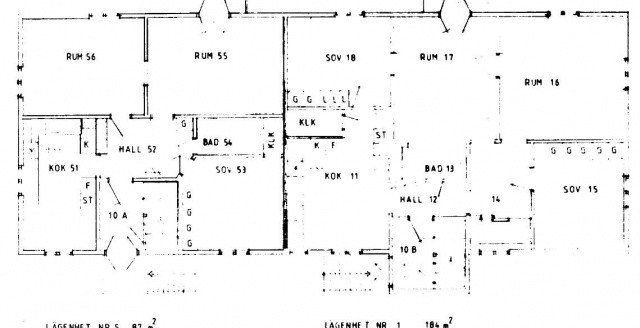
Even if a wall is not load-bearing, it can be stabilizing - with such an old house, you can't really know. It was also common to use short lengths of wood, and it may be spliced right at your wall, making "putting the saw in the wall" potentially life-threatening for you or any of your neighbors below.
The floor may have been laid before the interior walls were built - it's unlikely, as it's incorrect to prevent a wooden floor from moving. It's more likely that someone thought the plank subfloor was the surface and wanted to "save" it - in that case, the walls are probably not load-bearing anyway.
Normally, you would have a contractor who knows old buildings take a look to be sure if the walls serve a function. You usually need the approval of the housing association for renovations that affect the load-bearing structure. Once you start building, you brace it up and check for settling when you begin to saw.
The floor may have been laid before the interior walls were built - it's unlikely, as it's incorrect to prevent a wooden floor from moving. It's more likely that someone thought the plank subfloor was the surface and wanted to "save" it - in that case, the walls are probably not load-bearing anyway.
Normally, you would have a contractor who knows old buildings take a look to be sure if the walls serve a function. You usually need the approval of the housing association for renovations that affect the load-bearing structure. Once you start building, you brace it up and check for settling when you begin to saw.
We have just converted the property to a BRF and it consists of 8 apartments, 3 in our entrance and 5 in the other. My requirement to buy the apartment was precisely that we should be able to remove the wall, so the board is aware and I myself am the chairman. So it is well rooted.
Trying to understand what function the wall would have when it doesn't bear a load on the attic or the floor below. Specifically, the wall in question is the thinnest in the apartment, along with the wall that separates what is the kitchen on the ground and first floor. The absence of blueprints is a bit unsettling :-/
Trying to understand what function the wall would have when it doesn't bear a load on the attic or the floor below. Specifically, the wall in question is the thinnest in the apartment, along with the wall that separates what is the kitchen on the ground and first floor. The absence of blueprints is a bit unsettling :-/
Maybe there's something inside the wall?
Pipes?
Wires?
Secret passages
/ Fredrik
Pipes?
Wires?
Secret passages
/ Fredrik
Two companies, former property owners, and dozens of tips and ideas later, we just removed a part of the wall and kept about 50 cm on each side. It turned out quite okay, and we've managed to channel the light deeper into the apartment. Visually, the kitchen and the appendix hall now form a single unit.
The advice we received from the companies was to reinforce the roof structure, which would have been too large a project for us.
The wall we tackled, or rather the opening, wasn’t at all framed with 2"4... but instead partially chainsawed and hand-chiseled standing grooved planks at 2"7. It seemed like scraps because it was jointed here and there and nailed together. The opening was constructed by first building the plank and then cutting out the opening, so the 2"4 I saw was just random saw cuts.
I might as well say how the kitchen construction went.
The kitchen wall was 3.27 long and 2.45 high. The level line dropped 4 cm over that stretch, and from floor to ceiling, the wall leaned in about 2.5 cm...except in the middle, where it bulged out 1.5 cm. I guess the old planks had twisted over the years. In several places, there was a gap between the gypsum and the planks, so I laid a 2"4 on edge above the upper cabinets so the IKEA frames could be attached at more points (2 attachment points on IKEA frames).
In essence:
For me, who has never built or assembled anything of this magnitude, it took an awfully long time, almost 6 weeks. I had no idea that all the crooked and skewed elements would be such a problem and headache. But it ended up being incredibly cheap and really stylish. Some filler pieces, a skirting board, and some molding are still missing (probably take about three years or so).
We're considering whether it wouldn't have been better, despite the costs, to have hired people, handed over the key, and come home to a finished project.
The advice we received from the companies was to reinforce the roof structure, which would have been too large a project for us.
The wall we tackled, or rather the opening, wasn’t at all framed with 2"4... but instead partially chainsawed and hand-chiseled standing grooved planks at 2"7. It seemed like scraps because it was jointed here and there and nailed together. The opening was constructed by first building the plank and then cutting out the opening, so the 2"4 I saw was just random saw cuts.
I might as well say how the kitchen construction went.
The kitchen wall was 3.27 long and 2.45 high. The level line dropped 4 cm over that stretch, and from floor to ceiling, the wall leaned in about 2.5 cm...except in the middle, where it bulged out 1.5 cm. I guess the old planks had twisted over the years. In several places, there was a gap between the gypsum and the planks, so I laid a 2"4 on edge above the upper cabinets so the IKEA frames could be attached at more points (2 attachment points on IKEA frames).
In essence:
For me, who has never built or assembled anything of this magnitude, it took an awfully long time, almost 6 weeks. I had no idea that all the crooked and skewed elements would be such a problem and headache. But it ended up being incredibly cheap and really stylish. Some filler pieces, a skirting board, and some molding are still missing (probably take about three years or so).
We're considering whether it wouldn't have been better, despite the costs, to have hired people, handed over the key, and come home to a finished project.
That is an important lesson for us amateurs renovating old houses. When you're a beginner, as I was when we moved into ours, you can be shocked at how much extra time all the crooked and tilted aspects take away from you. And if it has been renovated and redone a number of times with varying results... I've easily spent more time compensating for crookedness and correcting old mistakes than making it look good...Pon said:
Click here to reply
Similar threads
-
Hur bygger man ut i vinkel utan att ändra bärande konstruktion?
Utbyggnad och tillbyggnad -
Golvvärme på befintligt bärande underlag.
Värme allmänt -
How do I build a non-load-bearing interior wall with a sliding door.
Building Materials and Construction Technology -
How to attach rafters to existing roof when extending at an angle?
Building Materials and Construction Technology -
Hur bygger jag ett bärande regelvärk
Utbyggnad och tillbyggnad