3,502 views ·
22 replies
4k views
22 replies
Defective concrete floor, hidden defect?
We have a garage with a storage room in the same building (separate doors) that has been built with a "basement" underneath. It is terribly damp in the space below, probably because the area under the storage room consists of an earthen floor. I discovered salt deposits on the storage room floor (concrete), and the garage floor sounds hollow in several places, with pieces coming loose in some spots.
I don't know how to check the load-bearing capacity of the floor to ensure that the car won't suddenly fall through one day.
But a thought occurred to me, could the floor be considered a latent defect if it is deemed too unstable?
I don't know how to check the load-bearing capacity of the floor to ensure that the car won't suddenly fall through one day.
But a thought occurred to me, could the floor be considered a latent defect if it is deemed too unstable?

Doesn't sound particularly hidden?

It sounds like virtually all the symptoms you're describing are things that could have easily been noticed even during a normal viewing, so you can absolutely forget about it being a hidden defect and focus on dealing with the issue instead.
The floor that leaks salt deposits was covered with a wooden floor, so it couldn't have been visible during an inspection. As far as I know, nothing is clearly visible when looking at the floor from underneath either. The wooden floor was torn up after we moved in, and we saw no issues with the knowledge we had at that time.Dowser4711 said:
That you didn't see any problems with the knowledge you had at that time unfortunately doesn't affect whether a defect is hidden or not.K kattparet said:The floor that is leaking salt deposits was covered with wood flooring, so it couldn't have been seen during an inspection. As far as I know, nothing is visibly apparent when looking at the floor from underneath either. The wood floor was torn up after we moved in and we saw no problems with the knowledge we had at the time.
Nor does an inspection. (It provides you with knowledge before a purchase and *possibly* protection where you can turn against the inspector if they missed a defect that should have been discovered.)
You mention that parts of the garage floor sound hollow. That's a strong warning flag indicating that a more thorough investigation should have been conducted regardless of anything in the storage room.
A suggestion is to contact your insurance company; they may not be able to help you financially, but they often inspect water damage, recommend measures, and usually have good contacts with local craftsmen.

Before hiring craftsmen, do some research first. It might need to be ventilated, drained, heated, or have a proper floor made in the basement. Post some pictures, and maybe we can help better.
It got a bit confusing. The concrete floor that hasn't been covered with wood flooring sounds hollow in some places. I haven't managed to hear anything on the other floor.The fact that you didn't see any problems with the knowledge you had at the time unfortunately doesn't affect whether a fault is hidden or not.
Nor does an inspection. (It provides you with knowledge before a purchase and *potentially* protection where you can turn to the inspector if they missed a fault that should have been detected.)
You mention that parts of the garage floor sound hollow. That is a strong warning flag that indicates a deeper investigation should have been conducted regardless of anything in the storage.
A suggestion is to contact your insurance company, they may not be able to help you financially, but they often both inspect moisture damage and recommend measures and often have good contacts with local craftsmen.
I am not completely familiar with what hidden defects can be, but I tried to get some clarity on whether it is something one should get compensation for or not, such as construction deficiencies, etc.
Unfortunately, I was never present at the inspection but trusted my wife and in-laws who were there and fully trusted them at the time.
So the insurance company should be the first step, in other words?
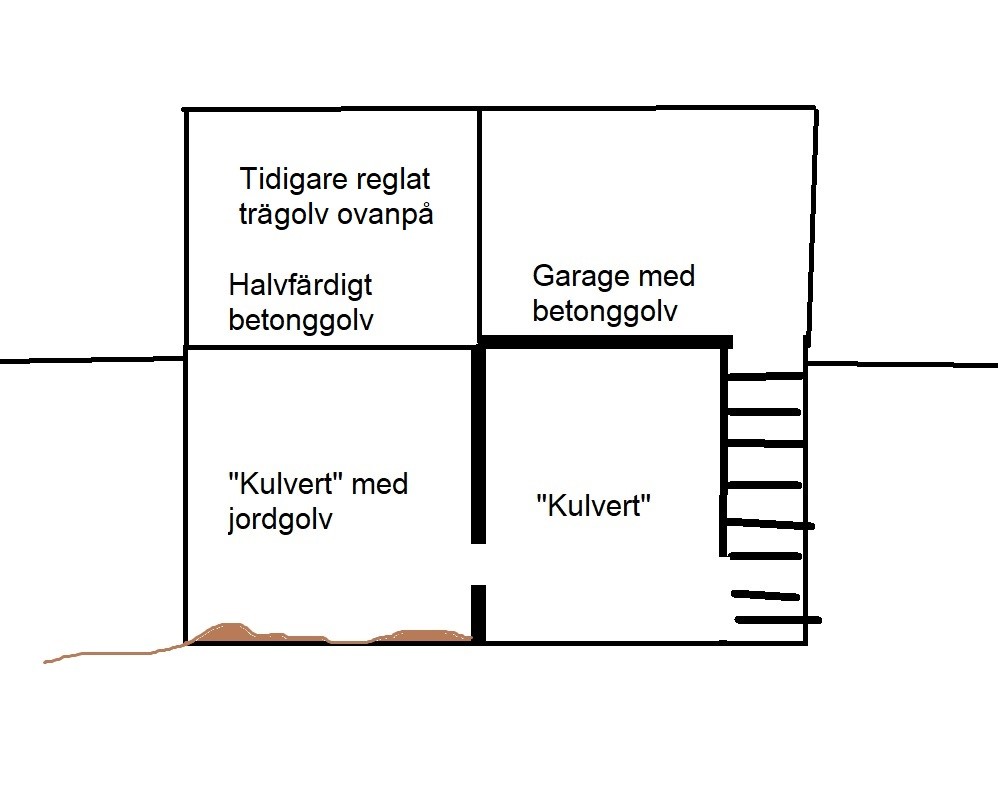
Will take pictures when I get back home. I made a quick sketch, if anyone can make sense of this.
For the left room, we have contacted a few companies (including Miljönären) for quotes to pour concrete, as that's where salt efflorescence has appeared on a specific area. This was before I noticed the salt efflorescence.
The right room has thicker concrete, but that's where I've heard it sounds hollow (I heard it when I dropped tools during tire replacement last spring). Underneath, some concrete has come loose around the drainage pipe.
It's likely pretty damp underneath, the air doesn't feel pleasant anyway. I had thoughts of filling in the culvert with the earth floor.
For the left room, we have contacted a few companies (including Miljönären) for quotes to pour concrete, as that's where salt efflorescence has appeared on a specific area. This was before I noticed the salt efflorescence.
The right room has thicker concrete, but that's where I've heard it sounds hollow (I heard it when I dropped tools during tire replacement last spring). Underneath, some concrete has come loose around the drainage pipe.
It's likely pretty damp underneath, the air doesn't feel pleasant anyway. I had thoughts of filling in the culvert with the earth floor.