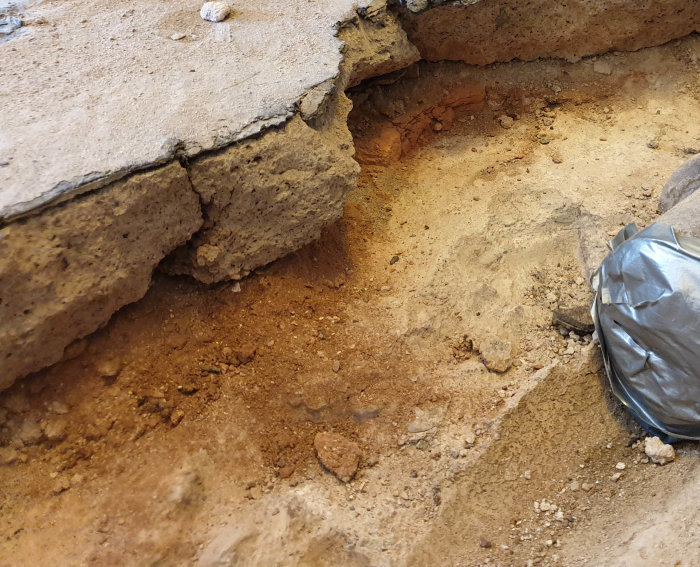
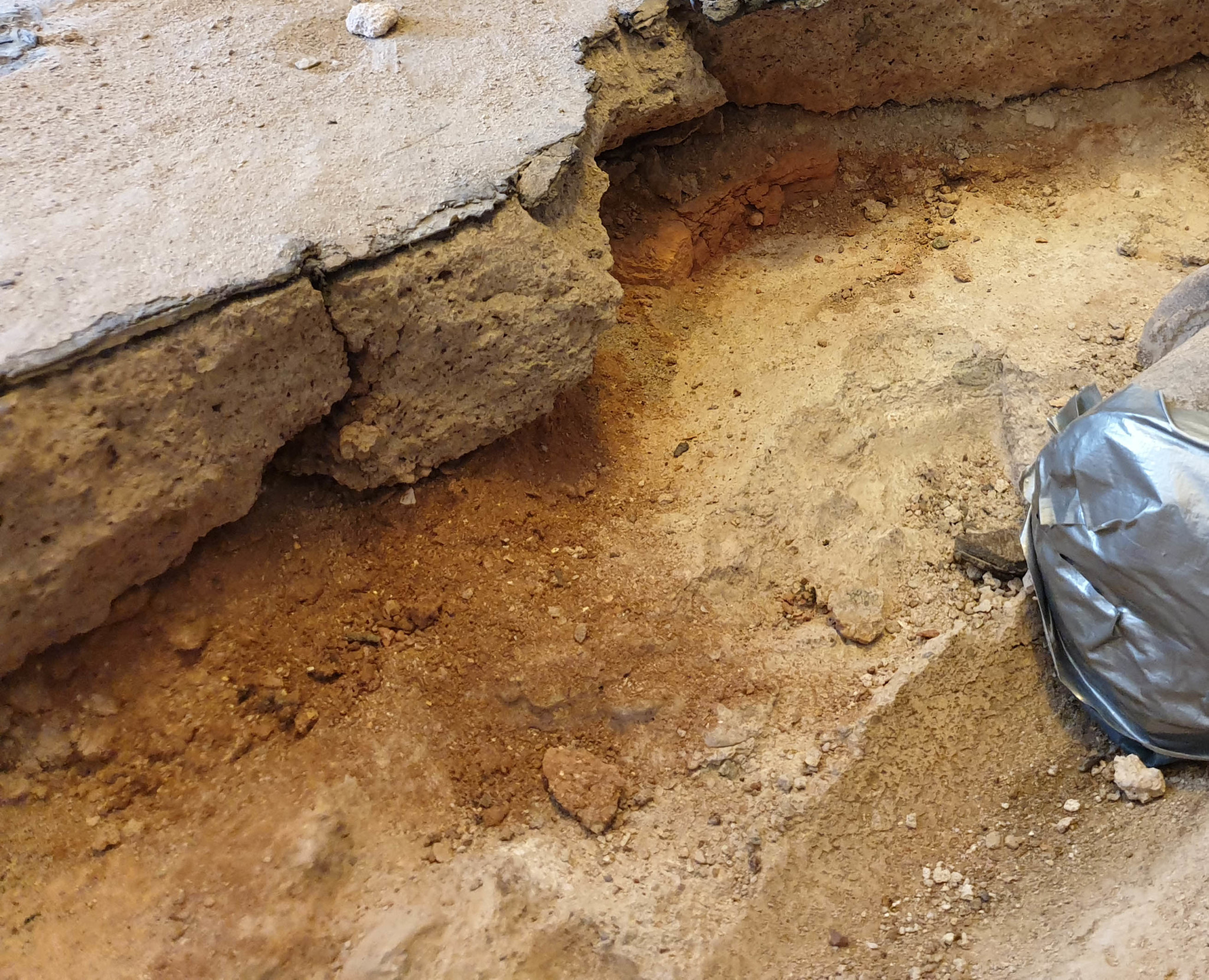
I am renovating a condominium from the late 50s. I have had the bathroom floor and part of the kitchen floor broken up for the replacement of the sewage pipes. Now before refilling, I am considering which materials to use. The construction looks like this:
At the bottom, there is cast reinforced concrete (between floor slabs), which I haven’t needed to break into, so it is intact. On top of this, there is about 10 cm of something that looks like plaster mortar, or some cement/sand mixture that might even be looser. It was easy to break into and when a lump is chipped away, it is quite easy to break into smaller pieces. It is in this mixture that the sewage pipes are located (the lower part of the pipes is slightly embedded in the concrete but could be removed without chiseling).
On top, in the kitchen, there is a thinner (about 2 cm) layer of what looks like concrete, laid as a large slab, with cardboard spacers against the walls - perhaps to handle thermal movements. In the bathroom, there is instead a bitumen mat, on top of which tiles have been laid in a thick layer of cement or adhesive.
When I now refill the floors, I would like it to be as similar as possible, especially regarding the 10 cm mortar that lies on the concrete. I would like the new pipes to be in a material that allows for any future exposure of the pipes to be as smooth as it went now. That is, I do not want to use a hard concrete, but rather a material that works well to build up about 10 cm, and on which a thin layer of concrete or self-leveling compound can be laid before laying the floor covering.
I hope there is someone on this excellent forum who has experience with this type of floor construction and who can give some tips on good materials to use.
I am attaching a picture from the bathroom showing the concrete slab, mortar layer, and bitumen mat. Maybe it can provide some additional info.
thanks for the tip. I looked up descriptions of EPSCement. And it seems to be a modern variant to build up a layer on top of the concrete. Additionally, it seems to provide a bit of extra step insulation, which the neighbor below might appreciate. I will read up a bit more - but as mentioned, it seems promising.
I have checked with both the board and the manager, they have approved the work, but they had no information about the material. They also didn't have any construction drawings that could provide any information and referred to the city planning department. And there I retrieved what was available, but there was no information there either. That's why I thought someone here might have experience with this type of construction and know what to use.
Best regards,
Håkan
I've been googling further into how floors were historically constructed on concrete slabs, but haven't found any really good information. The tip about EPSCement seems good, but at the same time, I'm a bit concerned if it has the same properties as the existing fill material. A possible alternative I found was with weber, something called dolomite crush. Uppbyggnad med Weber dolomitkross (se.weber) weber dolomitkross 3-5mm (se.weber)
According to the description, it can be used "for the construction of floor structures primarily in wet rooms or other smaller spaces." That sounds just like what I'm looking for. What seems to differ is that it doesn't harden together like the mortar-like filling that is there today.