
26,901 views ·
17 replies
27k views
17 replies
Circular saw, how do you cut!?
Page 1 of 2
Hi! I just got a Ryobi brand circular saw from my dad for my birthday because he's tired of lending out his Festool plunge saw with a guide rail all the time. We don't live in the same city, so there's a lot of traveling back and forth.
Anyway...
How do you saw? Guide rail? Saw table!? Freehand?
I saw that Jula had a guide rail discussed in other threads that seemed good, but I also saw that Biltema had this:
http://www.biltema.se/sv/Verktyg/Arbetsbank-och-forvaring/Arbetsbank/Hopfallbar-arbetsbank-20645/
Right now, I'm just putting out some scrap pieces and sawing on them as a base. Not optimal!
Give me tips on how you saw with your circular saws!
/Jocke
Anyway...
How do you saw? Guide rail? Saw table!? Freehand?
I saw that Jula had a guide rail discussed in other threads that seemed good, but I also saw that Biltema had this:
http://www.biltema.se/sv/Verktyg/Arbetsbank-och-forvaring/Arbetsbank/Hopfallbar-arbetsbank-20645/
Right now, I'm just putting out some scrap pieces and sawing on them as a base. Not optimal!
Give me tips on how you saw with your circular saws!
/Jocke


Since I bought a miter saw, the circular saw is used very little.
Talk a bit with dad and maybe you'll get one too
Talk a bit with dad and maybe you'll get one too
There's quite a big difference in how I use the hand circular saw compared to the plunge saw.
When cutting a beam/board, I make a line with the square and then hold the wood with my left hand and stick out my thumb so I start the sawing at the right angle by supporting the saw's base plate against this thumb.
In cases where I've used the hand circular saw for boards, it's been necessary to have them on a couple of beams on sawhorses, attaching a straight board on top with clamps so that the measurement is correct when the saw slides along the board. Time-consuming compared to the plunge saw with the rail, but it works.
When cutting a beam/board, I make a line with the square and then hold the wood with my left hand and stick out my thumb so I start the sawing at the right angle by supporting the saw's base plate against this thumb.
In cases where I've used the hand circular saw for boards, it's been necessary to have them on a couple of beams on sawhorses, attaching a straight board on top with clamps so that the measurement is correct when the saw slides along the board. Time-consuming compared to the plunge saw with the rail, but it works.
It depends on what needs to be cut and how precise it needs to be. A line, and then cutting it freehand is probably the simplest way. If it requires more precision, I attach a straightedge to guide the cut. If you're going to split something at a specific distance from an edge, the fence is useful.
Member
· Södermanland
· 371 posts
Here's how I did it when I was cutting off the decking to set my border.
I measured and drew a straight line, then attached a decking board along it and screwed it in place. Then I ran the circular saw along the board. This method only works if you're only going to use one side of the cut section.
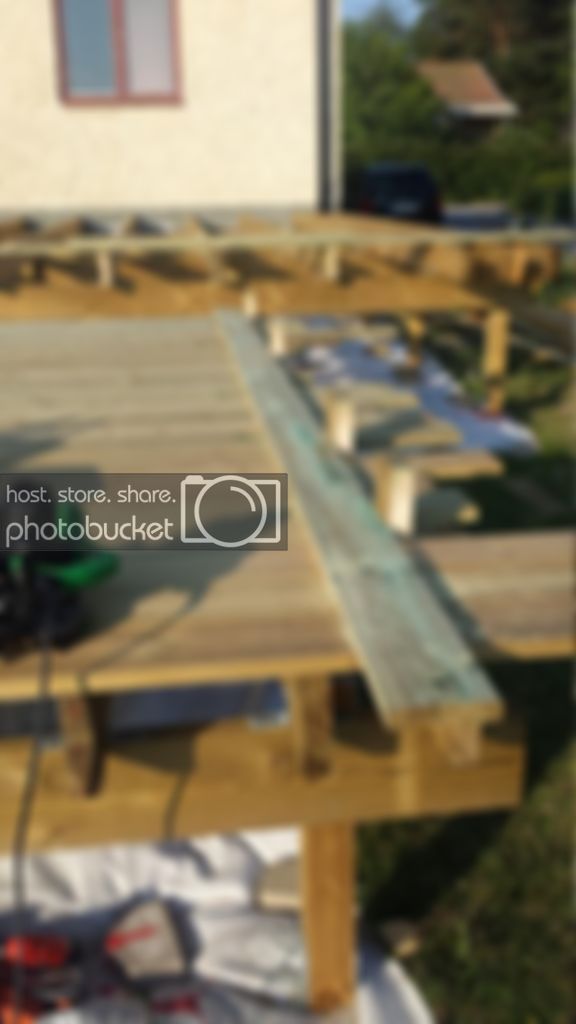

I measured and drew a straight line, then attached a decking board along it and screwed it in place. Then I ran the circular saw along the board. This method only works if you're only going to use one side of the cut section.


Previous tips on the forum:
http://www.byggahus.se/forum/verktyg-maskiner-fordon/18811-saga-rakt-med-handcirkelsag.html
http://www.byggahus.se/forum/verktyg-maskiner-fordon/18811-saga-rakt-med-handcirkelsag.html


99% with a guide rail on the hand saw and 100% with a guide rail on the plunge saw. Would never trust dowels and discs.
Then you also have the splinter guard in the rail that you miss with homemade things.
Then you also have the splinter guard in the rail that you miss with homemade things.
Last edited:

I rarely use a circular saw, but when I do, it's usually on the saw bed or on an insulating board acquired for the purpose. I use a straightedge, stop, rail, or similar as a guide for long cuts.
For cuts, I use the quick square as an aid.
I haven't touched the plunge saw since I got a cordless circular saw.
For cuts, I use the quick square as an aid.
I haven't touched the plunge saw since I got a cordless circular saw.
Depending on what I'm cutting, I have different procedures. If I'm cutting flooring chipboard or something that doesn't need to be precise to the millimeter, I just follow a line.
If I'm cutting something like MDF, I use a 3-meter straightedge as a guide. My saw has an exact offset of 30mm, so it's simple to take the measurement, add 30 to it, and fasten the straightedge as a guide.
And if the material is upside down, it doesn't matter if there are small splinters. I've also successfully used double layers of masking tape on the "finished side" and upside down to prevent splinters on a countertop.
If I'm cutting something like MDF, I use a 3-meter straightedge as a guide. My saw has an exact offset of 30mm, so it's simple to take the measurement, add 30 to it, and fasten the straightedge as a guide.
And if the material is upside down, it doesn't matter if there are small splinters. I've also successfully used double layers of masking tape on the "finished side" and upside down to prevent splinters on a countertop.
I know this is an old thread - but no one has addressed the question of how to best set the depth on a circular saw when cutting on the back side of a board to minimize edge chipping on the front side? Should I set the saw depth to the board's thickness plus a minimal few millimeters extra, or can I go all the way with full depth - i.e., the circular saw set to maximum depth?
PS - thanks for the tip about putting masking tape on the front side! I knew this but had forgotten that trick. Which type of tape works best is, of course, the next nerd question...ha ha.
PS - thanks for the tip about putting masking tape on the front side! I knew this but had forgotten that trick. Which type of tape works best is, of course, the next nerd question...ha ha.
By the way, it is this board that I will make long cuts in - it is constructed with extra hard, dense plywood with a thin layer of the color and pattern-bearing surface layer of high-pressure laminate - total thickness 10 mm. I therefore want to achieve a nice and smooth cut in the gray surface layer - hence my question above.
https://byggvaror.byggmentor.se/vag...erryalloc-kitchen-wall-cement-slat.m74775.htm
https://byggvaror.byggmentor.se/vag...erryalloc-kitchen-wall-cement-slat.m74775.htm
I sawed that board on the radial arm saw well-taped... With a sharp blade, it goes surprisingly well. Blade depth... I seem to remember that I raised the blade quite high.MickanV said:
Moreover, it is this board that I will saw long cuts in - it is constructed with extra hard, dense plywood with a thin layer of the color and pattern-bearing surface of high-pressure laminate - total thickness 10 mm. I want to get a fine and smooth cut in the gray surface layer - hence my question above.
[link]