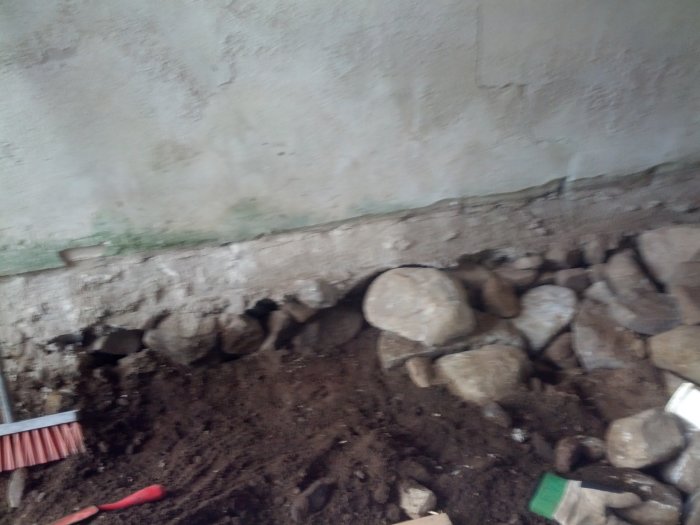
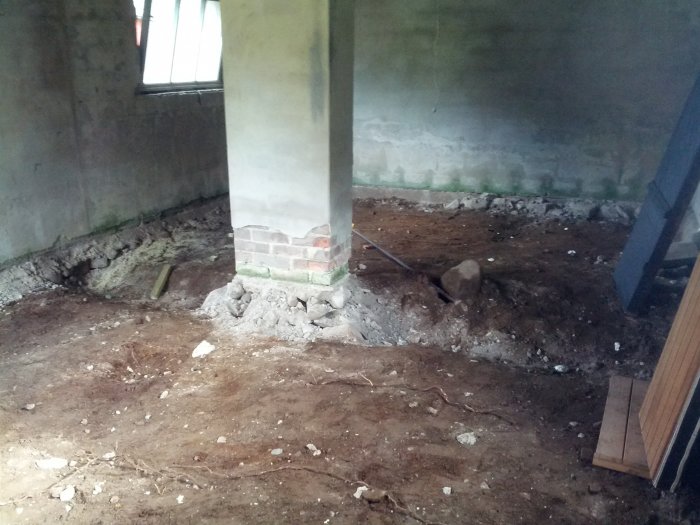
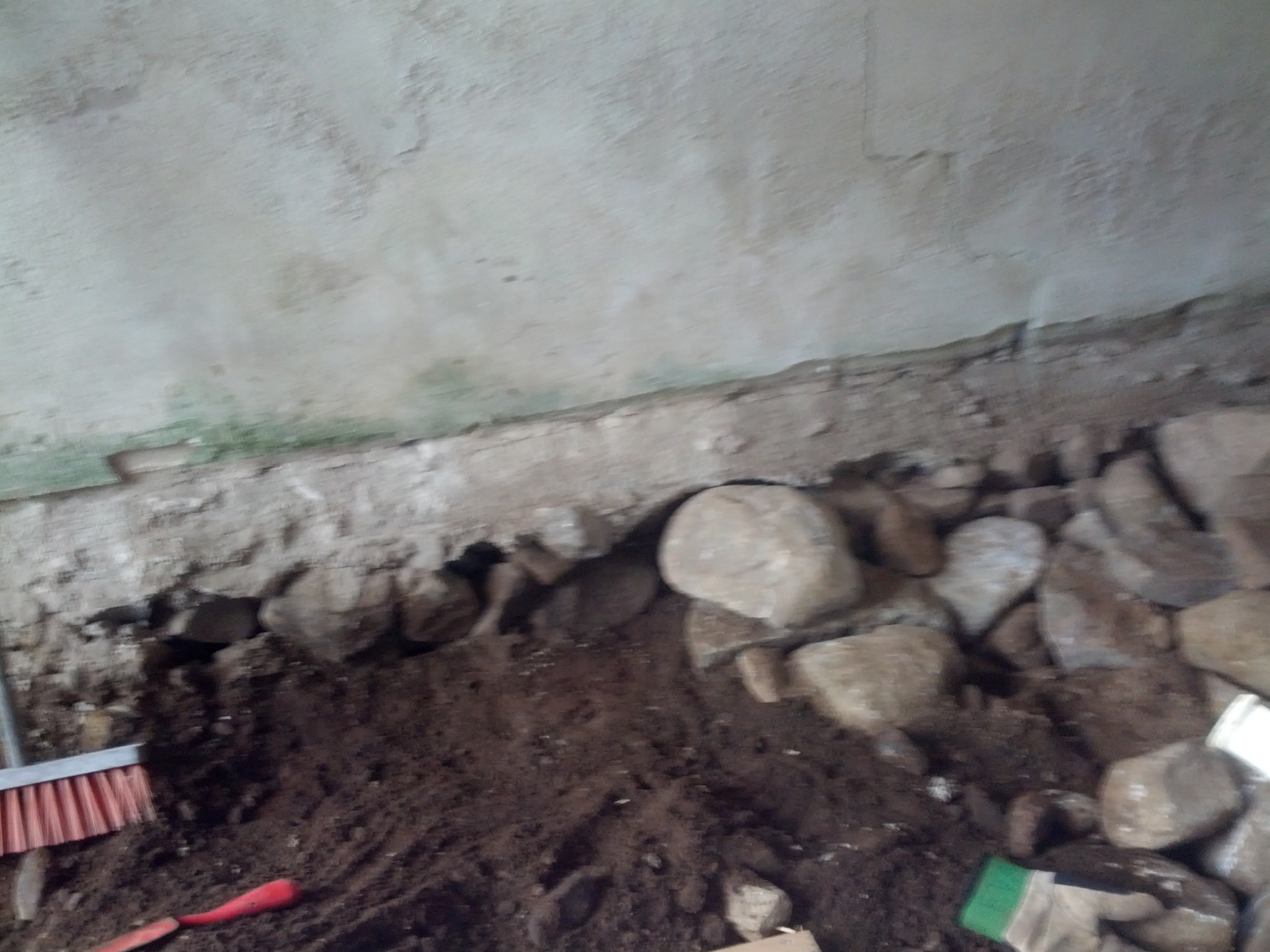
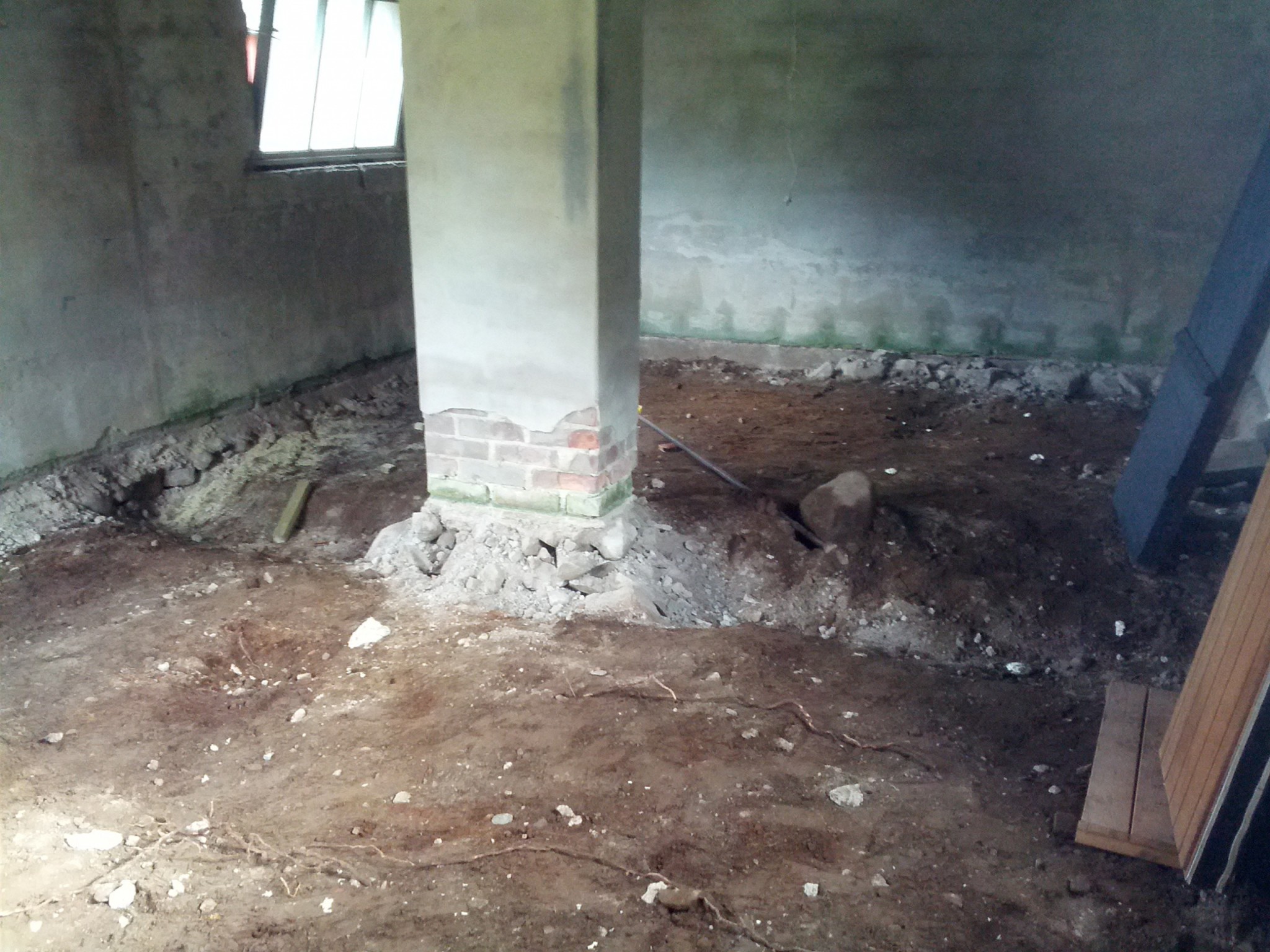
Made the decision to dig up the stone floor and shovel out all the soil underneath, which was right up to the concrete base. Now you can clearly see that the frame was cast first (1950s?). They might have dug a square ditch, thrown a bunch of stones in, then placed a wooden frame on top and poured concrete in it. Then they built the walls with concrete hollow blocks. Finally, they poured some stone-mixed concrete on the dirt floor inside to have a nice floor :x No wonder the house was drawing moisture from underneath! But now it's done, and the house stands firm, no settling so far. And in this case, I can pretty safely say that the floor was NOT load-bearing... phew. Now I'm going to lay fiber cloth, gravel, and maybe some styrofoam or isodrain boards? and then pour a new floor. And some nice tiles afterwards. Perhaps I should also reinforce the new floor to the foundation? I thought you might want to know the continuation of my project, so I'm attaching some pictures here from the "excavation."
Yes, there was also quite a bit of drainage done around the house. Belt and suspenders.
Arm the new floor in the base doesn't sound right, let it float. Consider if you should have some plastic for radon sealing. Normally, 20cm of cellplast is used, and 8-10cm of concrete with 6150 mesh.
I poured a new concrete floor on compacted ground in the basement last spring. The company drilled reinforcing rods into the foundation around it and used rebar mesh and everything. Turned out great, but small cracks appeared around the pillars (instructions).
If you pour over an old edge/foundation, make sure the layer thickness above it is not too thin, otherwise it will crack there too.
Radon? can it be there? in the soil? thought it was only on bedrock.. floating concrete floor? won't it be wobbly with the styrofoam underneath? was thinking of having a maximum of 10 cm of styrofoam.
I have in order.. the soil, the fiber cloth, 20 cm gravel.. to date. I was thinking of starting with the Styrofoam now.. but maybe I should check the radon issue first?
Determine if there is ground radon in your area, as it exists in varying amounts everywhere.
Floating concrete floors are the standard method on top of cell plastic. The insulation and your gravel always settle a bit over time, and then you get nice cracks in the floor along the walls. IF the slab is attached to the wall...
Search for "källarprojekt" on the forum, and you'll find several project threads showing how it's done.
but if you are going to have a floating concrete floor and do not reinforce it to the wall/base, there will likely be a gap where radon might come up? I've been searching for "floating concrete floor" - what it is and how to do it.. can someone send me a direct link? it also seems that radon measurement can't be done now and must wait until the floor is fully poured and dried. the measurement is apparently done in the winter when the house is warmer and more sealed. however, I will actually check with the gravel pit where I bought the single, if they have any guarantee that it does not contain radon. thanks for all the answers and tips.
1. Your gravel does not contain radon. It comes out of the ground in gaseous form. No building material sold today contains radon.
2. To seal between the slab and the wall, use soft joints, e.g., Sika has several variations intended for sealing between building components.
3. Floating: you don't need to do anything other than refrain from anchoring it to the wall. I had a thin foam board between the wall and the slab to prevent the slab from sticking to the base, but one could just as easily have pulled up the ground cloth or plastic to achieve the same thing.
1. Your gravel does not contain radon. It emerges from the ground in gas form. No building material sold today contains radon.
2. To seal between the slab and the wall, you use elastic joints, for example, Sika has several options intended for sealing between building components.
3. Floating: you don't need to do anything other than avoiding anchoring it to the wall. I had a thin styrofoam sheet between the wall and the slab to prevent the slab from sticking to the base, but one could just as well pull up the geotextile fabric or plastic to achieve the same thing.
Thanks for the answers! Just one question, did you reinforce the floating floor?
When I did the same type of job, I also placed thin foam (1 cm) against the walls before casting, afterwards I cut it to the height of the floor, scratched away about 1 cm deep, and filled with soft sealant to block the radon. Additionally, plastic foil under the floor as previously mentioned.
Vi vill skicka notiser för ämnen du bevakar och händelser som berör dig.