13,227 views ·
22 replies
13k views
22 replies
Casting a slab for air/water heat pump
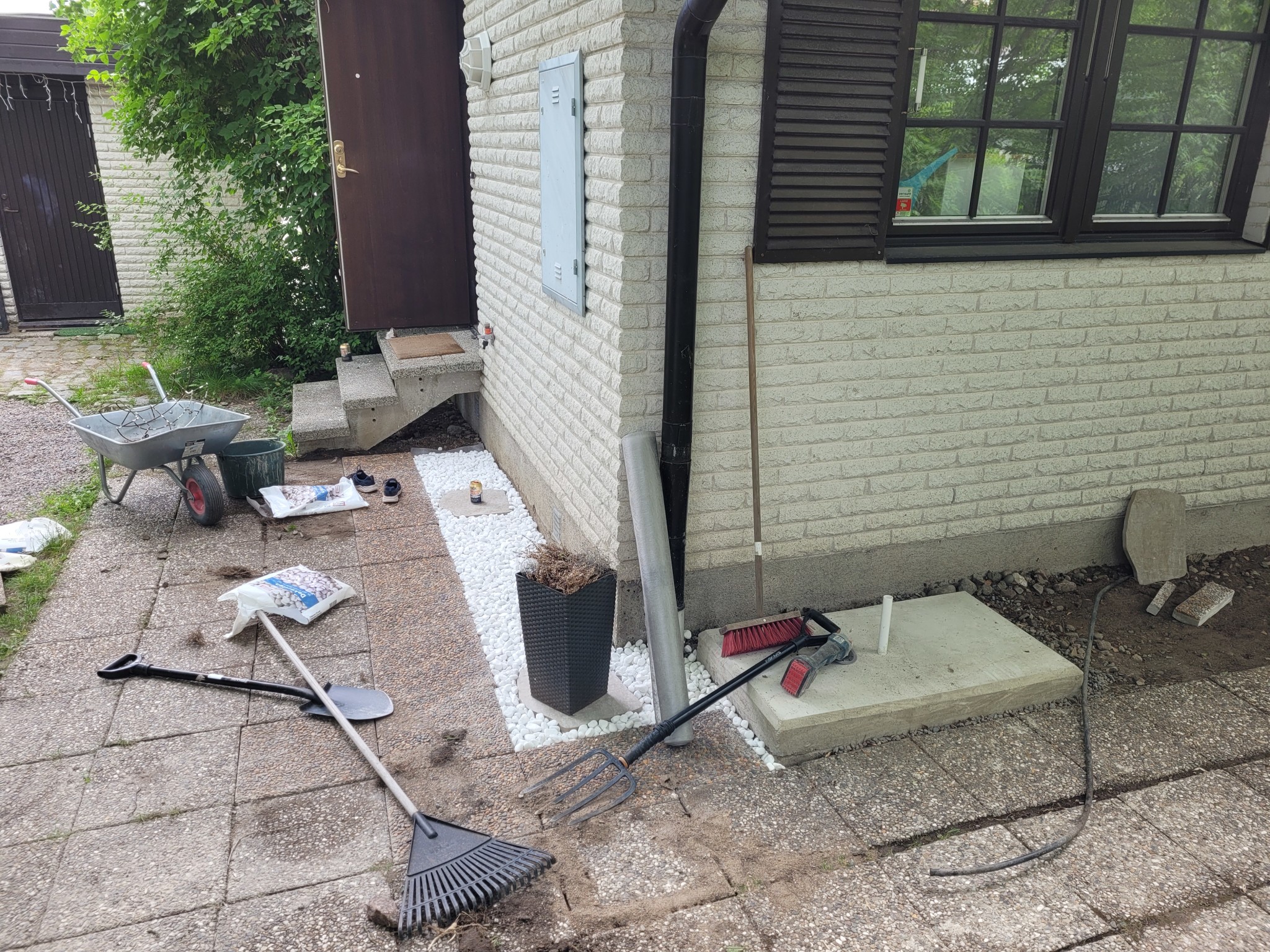
I am going to cast a slab for a heat pump type CTC EcoAir 614M and found some tips on variations in the forum. Someone suggests casting pipes/slab, someone else a thicker slab. I was thinking of the version with digging out about 40 cm, laying about 20 cm of 8-16 macadam and 19 cm of concrete with reinforcing mesh in a 130x70 cm frame. Are these unnecessarily thick layers? Any other tips, thoughts, or advice from someone who has done similar?
It really felt like overkill to use such a thick slab for a heat pump; I would add more gravel and just cast 10cm, which is strong enough for the outdoor unit.
If you dig out properly and fill with gravel, you'll also have a stenkista for condensation.
If you dig out properly and fill with gravel, you'll also have a stenkista for condensation.
In comparison, I cast a 12cm slab for our sauna, it became that thick because of clay, so I wanted a stable slab if it was going to heave due to frost.
So, if you dig out 40cm and fill with 30-35cm of 8-16 and cast a 10cm slab there, it will be great.
At least dig an extra 20cm around the perimeter that you fill with gravel.
You could probably have gotten away with just removing the turf and casting a slab, but a bit more work with digging isn't so bad, and it's harder to fix afterwards.
So, if you dig out 40cm and fill with 30-35cm of 8-16 and cast a 10cm slab there, it will be great.
At least dig an extra 20cm around the perimeter that you fill with gravel.
You could probably have gotten away with just removing the turf and casting a slab, but a bit more work with digging isn't so bad, and it's harder to fix afterwards.
Clay is very sensitive to deep frost, a wet autumn followed by cold without snow can cause it to shift.
The larger the area around the slab that is excavated and replaced with gravel, the better.
I don't know where you live, but I don't think you need to worry about it shifting if you follow the above description.
If you're still worried, you can always insulate the slab so the frost doesn't penetrate as deeply.
Then you replace 10cm of gravel with polystyrene or dig 10cm deeper. So when you have excavated for the slab, you fill with gravel until you are 15cm below ground level and then insulate the entire graveled area. Build the form on the polystyrene and pour the concrete.
The slab will end up 5cm above ground level, and you can place the soil with a slight slope from the slab and cover the polystyrene beneath.
I let the polystyrene extend only 30cm beyond the slab for the sauna.
It's only your ambitions that set the limits, you can certainly complicate it more if you want. But I don't think you should overthink it so much.
The larger the area around the slab that is excavated and replaced with gravel, the better.
I don't know where you live, but I don't think you need to worry about it shifting if you follow the above description.
If you're still worried, you can always insulate the slab so the frost doesn't penetrate as deeply.
Then you replace 10cm of gravel with polystyrene or dig 10cm deeper. So when you have excavated for the slab, you fill with gravel until you are 15cm below ground level and then insulate the entire graveled area. Build the form on the polystyrene and pour the concrete.
The slab will end up 5cm above ground level, and you can place the soil with a slight slope from the slab and cover the polystyrene beneath.
I let the polystyrene extend only 30cm beyond the slab for the sauna.
It's only your ambitions that set the limits, you can certainly complicate it more if you want. But I don't think you should overthink it so much.
I think I poured about 7cm for my air-to-water heat pump. It weighed around 160kg. No problems.
The neighbor's air-to-water heat pump of the same size was placed on a couple of garden slabs.
It might be good to consider condensation water, so you don't create an ice rink. Stockholm often has above freezing temperatures during winter, so maybe you don't have to overdo it too much, but there will be quite a bit of ice if it's below freezing for a few consecutive weeks.
The neighbor's air-to-water heat pump of the same size was placed on a couple of garden slabs.
It might be good to consider condensation water, so you don't create an ice rink. Stockholm often has above freezing temperatures during winter, so maybe you don't have to overdo it too much, but there will be quite a bit of ice if it's below freezing for a few consecutive weeks.
An acquaintance previously worked with foundations in the Stockholm area and poured slabs for storage and similar structures. They simply removed the top layer, then insulated with 10 cm and poured on top of that. They never had to redo any jobs because of this.
Remember to have runoff from the foundation for stormwater or similar.
I cast in a drainage pipe that I connected to stormwater.
I cast in a drainage pipe that I connected to stormwater.