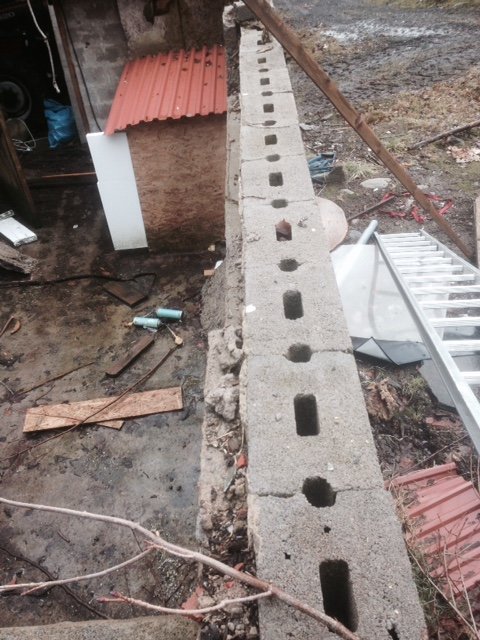
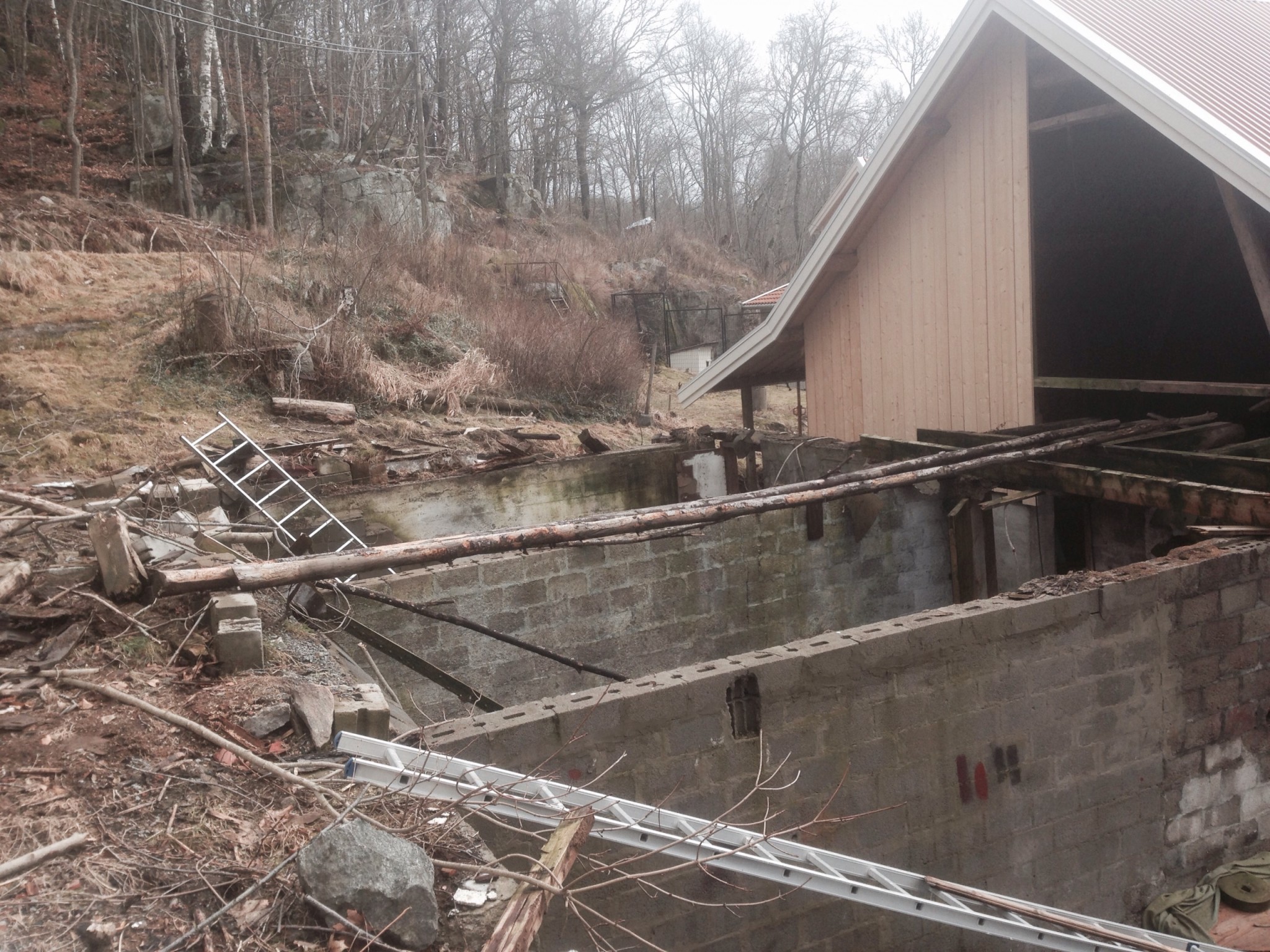
Torn down an old part of the barn that I now plan to rebuild. The picture shows the existing wall. The idea is to add one or two more layers of leca to get a slightly higher wall, and then set the sill log (I will build with logs as it was previously).
A bit unsure about how to fix this. Can I add a couple of layers of leca blocks around, do you think? And fill with mortar so it levels out?
No one who can hint at how to build on this wall..? I thought for a while about building a mold and casting around it so everything is level, and then proceeding with 2-3 layers of Leca. But we're talking about a 23-meter foundation wall => 10 cm of mortar on that, and you end up with 40 bags of concrete
A bit unsure about the condition of this old wall too... can you reinforce and fill the holes in the blocks to stabilize it, perhaps?
I think laying concrete to level it is pointless. If you want to continue building, I would have added a couple of layers of leca and made sure it was level after that.
The crucial question is how the existing wall is doing?
In my opinion, the risk of settlement is greater if you tear everything down and start over. I would dare to go ahead.
I guess I dare to go for it... but you mean that you adjust the level while laying a few layers of leca? How easy is that if it differs by x number of cm? It feels like it can only be adjusted minimally (I don't know how uneven it is, but I guess it's uneven...). You could start cutting the lecablock as well to increase the adjustment possibilities...
Tearing down and building up a 7.5x7.5 meter wall with 3 sides (the 4th side faces an existing barn and should be open), 2.5m high doesn't seem very appealing...
It can be adjusted if it's a matter of 1-2 cm, more than that becomes unsteady to raise, then you can instead place a small mold at the end and cast so it's level.
I want to come up more above ground on one side. The barn is on a slope and I'm standing on the ground behind the barn and taking pictures where the back wall is in line with the lawn.
Sure, I agree that I can increase the amount of mortar under the blocks but that can probably only adjust a few cm... maybe that's enough though
nice! yeah, that's what I was thinking too + but it does require a heck of a lot of bruk if you want to have some minimum thickness on what you're applying. Maybe it's not needed though?