I would need some tips on a not too expensive rotary hammer (from what I understand, they are better than impact drills?)
My partner and I are going to break up a small concrete floor, more or less the entire floor.
The floor has a ledge of about 1 square meter, 5 cm high, which needs to be completely removed. Then there are some cracks in the floor, so we need to break it up to then pour a new slab.
The room is about 2 square meters in size, so not very big.
What machines do we need to buy? And does anyone have tips on a good, but not too expensive option that can do the job?
I have actually never done it myself, but after seeing some tips, I definitely think it could be an option to rent good and sensible machines for the purpose (machines that you don't invest in as a happy hobby fixer). It's a bit different if you feel that you will benefit from the machines in the future.
It is certainly feasible to chip away at the things you mention with a regular rotary hammer, but it will be tiring and take a lot of time. For the same amount of money that you would spend on a basic rotary hammer at Jula, you can rent a real professional machine that will do the job in an hour and it will be fun all the way through. With a regular rotary hammer, it might take 1-3 days and if you're unlucky.
2 square meters, I would rent a specific demolition hammer - Completely disregard the term "borrhammare" as it is only for drilling and nothing else just as a bilhammare is only for demolition. There are drill hammers with a demolition function, but to take 2 square meters of floor with one of those would, I would say, result in a broken back and enormous frustration.
A Hilti TE-700 or a higher number (800-900-1000-1500) would do the job perfectly; it's just a question of whether you want to kneel with a 700/800 or if you want to stand with a 1000/1500.
I personally own a Bosch GSH16-28, which I think every serious homeowner with a basement should have in their arsenal!
I have used cheap rotary hammers for similar jobs at home a couple of times. The difference between an expensive and a (well-chosen) cheap one is mainly the lifespan. I demolished a floor of about 2.5 square meters with a 300 kr rotary hammer from Biltema. It took an afternoon. It later died when I drilled 300 holes for nail plugs in a concrete slab. I then urgently bought a Cohtech from ClasOhlsson (they are open until 21:00 in Kista). It was good enough for drilling, but worthless for chiseling. Later got a Bauhaus machine for about 700 kr.
What you should look for when buying is the specified impact energy. It is measured in Joules. A decent rotary hammer for chiseling should have an impact energy of more than 4 J. The really powerful ones are often up to 10 J. A machine suitable for chiseling away rock is around 50 J.
Concrete can vary greatly in hardness. So it can be difficult to know if a 4 J machine can handle the job. Personally, I would try to buy a cheap or moderately priced machine at 4 - 6 J (400 - 900 kr). It's cheaper than renting a more professional machine. If the cheap machine can't do the job, I would rent a robust professional machine, expecting a rental fee of maybe 1000 - 1500 kr over a weekend; such a machine costs about 10 - 15,000 to buy.
Both Jula and Biltema have a quite wide range of budget machines in different sizes. Jula also sells, for example, Dewalt, which is a professional machine, but the one they sell is around 2 J, not suitable for chiseling.
How much of the floor are you planning to recast?
If the rest of the floor is in good condition, it might be more sensible to cut grooves with an angle grinder in the ledge and then chisel away that part. It's an easier job for the combination hammer as well.
But rent the angle grinder and a dust extractor, it will get incredibly dusty.
For once , I don't agree with hempularen here. Rent a machine for this job; they are more efficient and, above all, much nicer to work with, with less vibration and better ergonomics.
You can easily finish in a workday; at my local rental firm, a HILTI TE-1500 (31J impact energy) including a pick costs under 500 for a day.
Corre: There are some cracks etc. throughout the floor, so it probably needs a bit of touch-up. From what I understand, you have to jackhammer up and pour a new layer of floor so that it becomes smooth and complete.
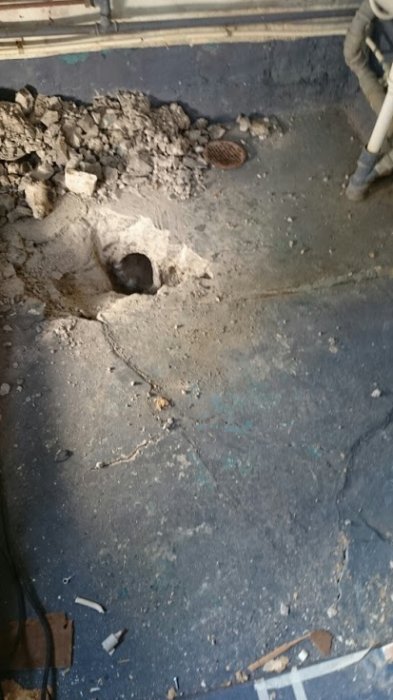
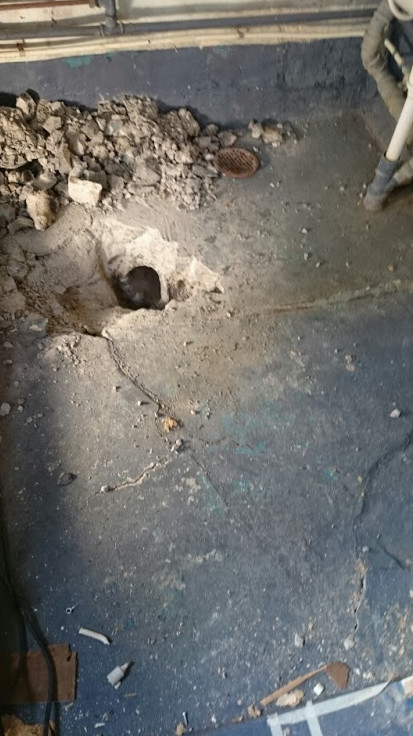
Attached is a picture that our plumber sent. He is replacing the floor drain and fixing pipes etc.
What type of machine should I rent in that case? Is it a hammer drill too?
Thanks for all the tips!
Call a local rental company and tell them what you are going to do, and they will provide you with a suitable machine. I have rented a demolition hammer on a couple of occasions, and I have never concerned myself with what the model is called, but have completely trusted the staff's expertise. When I look at a list of the demolition hammers that Cramo rents out, I would guess it is a Hilti TE1000 that I have rented. Heavy and efficient.
Corre: There are some cracks etc. throughout the floor so it probably needs to be tidied up a bit. From what I understand, you have to break up and cast a new layer of floor so that it becomes smooth and complete.
Attached is a picture our plumber sent. He is replacing the floor drain and fixing pipes etc.
[image]
Boiler room? Are you planning to have underfloor heating and an extra bathroom or something similar there? What kind of finish do you want? Otherwise, it's enough to level the floor with liquid screed or rapid-set screed after you've finished breaking up, so you don't have to rip out the entire floor. Of course, it depends a bit on the final height of the floor.
We will have a small bathroom.
- tiles on the floor, no underfloor heating
- build up the wall and install fibo trespo panels (tiling is not possible, the house is from the 1700s and the walls move)
- shower, sink, and incineration toilet.
We want to make it as simple as possible, but as good as possible!
Jula's red demolition hammer is really good value. It is a bit noisy and heavy compared to more expensive machines, but for chiseling it works excellently. Buy one and try it. If it's too weak and takes too long, it's time to rent something significantly larger, but the demolition hammer is still good to have for precision work in corners and around drain pipes.
Vi vill skicka notiser för ämnen du bevakar och händelser som berör dig.