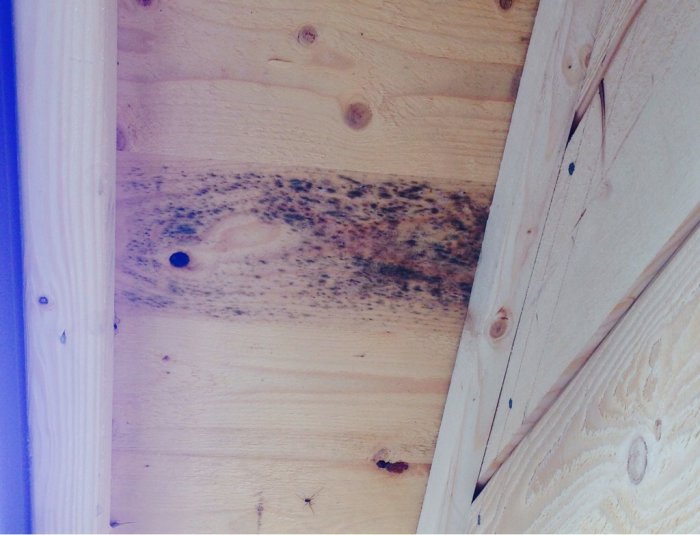
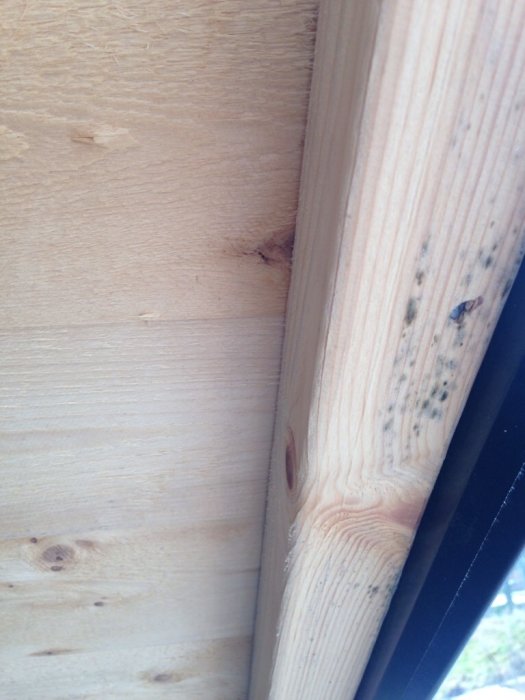
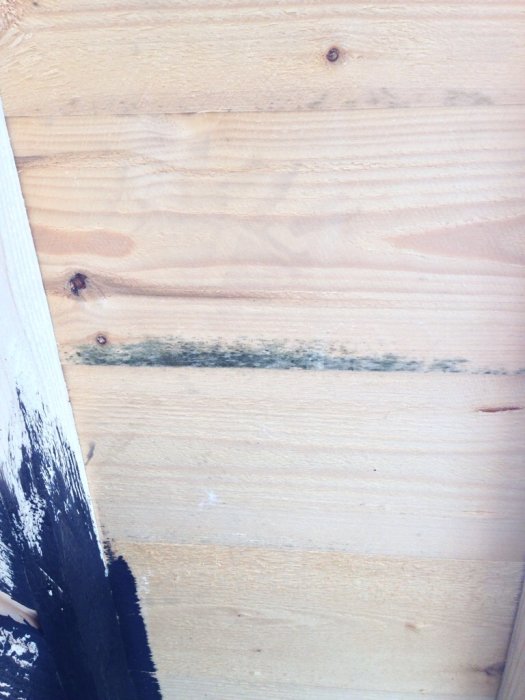
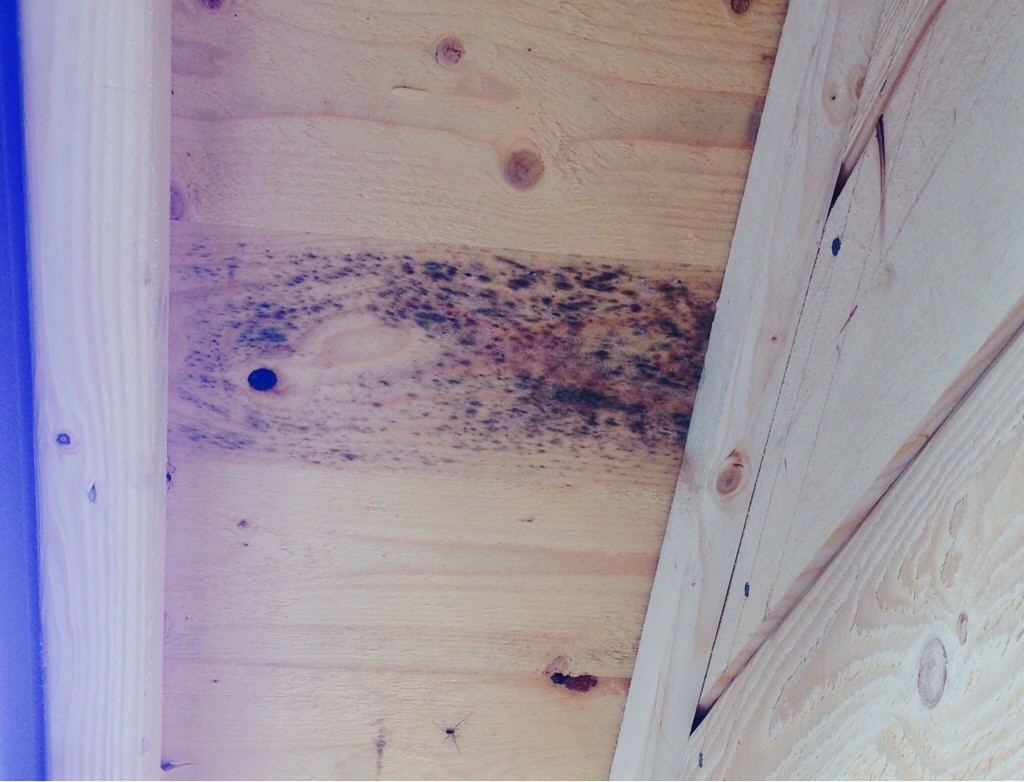
Pitched up an outbuilding late summer here. So it's ultra-newly built and yet I discovered quite a bit of mold when I was about to black paint the house.
How on earth did it arrive so quickly? 2 months? There's some fuzz in the worst spot.
And what is it a sign of, and I assume I can't just paint over it? The roof was installed in dry weather and looks fine inside, so the black doesn't continue inside the house.
As you can see, only certain boards have become moldy, which suggests that they were poorly stored at the building market (or since you brought them home but before you nailed them up). Probably it is enough to sand away the infestations and brush on Boracol or similar mold-killing agent.
The tongue and groove boards were probably damp upon delivery.
I discussed the same problem with a lumberyard rep the other day, and according to him, it's the tongue and groove boards that have the most complaints. He believed this is because tongue and groove boards are a cheap product and are cut from lower-quality wood. There might be negligence with moisture content/drying at the sawmills because of this. Conclusion: You should therefore measure the moisture content yourself before purchase.
This naturally raises the question; What moisture content should be considered acceptable, and which "cheap" meter can be trusted? Suggestions?
I have had the same problem several times, it's always individual boards and not an area. Have painted over it, and it hasn't come through. Unfortunately, it seems to be something that doesn't have a reasonable explanation so far.
For example, there have been similar problems with paint without anyone being able to explain. But it doesn't necessarily have to be related at all.
If I were to be pragmatic, I would do as b8q, as I have rebuilt parts after this type of attack, I haven't seen problems compared to "healthy" boards.
Ok, however, it is also black on the rafters which should be fine wood. I was surprised by:
1) That the board is exposed to wetness (under the eave)
2) And that despite this, it developed fuzzy mold in just 2 months.
I believe it's a combination of, already in delivery, some planks being too moist, and when you then lay the roofing felt it becomes completely sealed.
Since you also have "construction moisture" in other building parts, it condenses against the roof sheathing.
The load on the already too moist parts then reaches such levels that it molds.
I have experienced exactly the same thing. On my boards, you could clearly see where the zip ties that held the lumber stack had been. There was no mold there.
Probably the wood was handled carelessly during transport and storage before it came to me.
Same thing with me, but since the raw plank was installed & allowed to dry properly, there has been no more growth.
Since my raw plank is not in the living space, I haven't done anything about it.
Functionally, I believe it doesn't matter if you leave the black mold?
As long as the cause of the growth (too high moisture content) has been addressed.
-If it's in a living space, however, you should remove the mold because it's carcinogenic.
So you mean that the sawmill has a system to not dry down "individual" boards in order to make a buck?
Well, he probably means that they are careless and are just on the borderline. Individual boards with lower quality than the "standard" then become moldy.
I don't have in-depth knowledge in the area, but I talked a bit with technicians at Jape about this when my own attic had a few cubic meters of white fluff more than I had installed there.
Mögelfri is intended for the treatment of surface attacks, and the active component remains on the surface where the biomass is. Boracol, on the other hand, is meant to stop deeper damage, such as rot, but the problem is that in unfavorable cases, (nitrates?) substances are left on the surface, acting as a fertilizer, meaning for surface attacks, Boracol can be like candy for mold. I understand that this is quite uncommon, but since there is a difference, one can use the right agent.
Moreover, Mögelfri is, I believe, much weaker than Boracol, which is actually quite a nasty pesticide.
Click here to reply
Vi vill skicka notiser för ämnen du bevakar och händelser som berör dig.