
5,194 views ·
16 replies
5k views
16 replies
Floor structure bathroom free span 2.4m
U
Utsliten och utdömd
Building conservationist
· 2 829 posts
Utsliten och utdömd
Building conservationist
- 2,829 posts
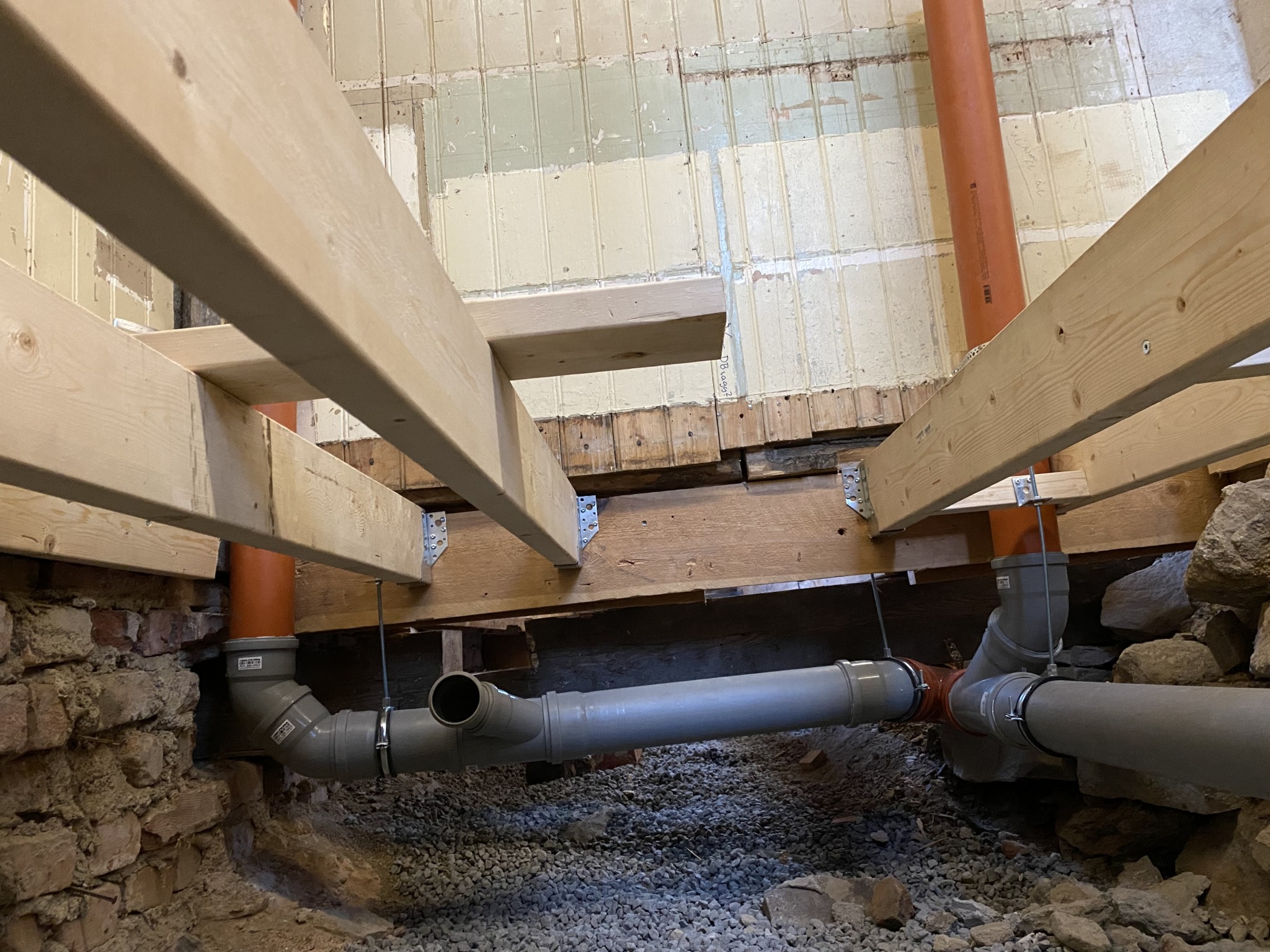
Hi, I just finished framing the floor joists in the bathroom. I have a 2.4m free span, so I checked what the Swedish wood dimensioning guide suggested for 300cc.
It landed on 45x145 C24 300cc with noggings at 600cc, staggered 300mm between the joist spaces.
Now I'm getting a sinking feeling that I might have used too small dimensions because when I read the "build safe bathrooms," BKR, and GVK, they don't mention any smaller dimensions than 45x190, although they specify a free span of 3.2m (C14).
Do I need to redo everything?
It landed on 45x145 C24 300cc with noggings at 600cc, staggered 300mm between the joist spaces.
Now I'm getting a sinking feeling that I might have used too small dimensions because when I read the "build safe bathrooms," BKR, and GVK, they don't mention any smaller dimensions than 45x190, although they specify a free span of 3.2m (C14).
Do I need to redo everything?
Do you have the possibility to switch to 45x195 in height?U Utsliten och utdömd said:Hello, I've just put up the joists in the bathroom. I have a 2.4m span, so I checked what the Swedish wood dimensioning guide recommended for 300cc. It landed on 45x145 C24 300cc with noggins at 600cc, staggered 300mm between the joist bays.
Now I have a knot in my stomach thinking I might have chosen too weak a dimension since when I read building safe bathrooms, bkr and gvk, they don't mention anything smaller than 45x190, although they specify the span as 3.2m (c14).
Do I need to redo everything?
I'm thinking if there's a possibility to glue and screw a 45x45 on top of the existing frame.
U
Utsliten och utdömd
Building conservationist
· 2 829 posts
Utsliten och utdömd
Building conservationist
- 2,829 posts

Best answer

45x145 C 24 is fully sufficient in terms of deflection and load. 45x195 C 14 is only slightly better when it comes to load. I would keep the 145s and opt for a stiffer sheet material on top. For example, 21 mm floor plywood which you glue and screw. The final result will be significantly better than 45x195 C 14 + chipboard.

You can always glue-screw on 45x45 underneath if it feels better.
U
Utsliten och utdömd
Building conservationist
· 2 829 posts
Utsliten och utdömd
Building conservationist
- 2,829 posts
The idea is to use a 22mm chipboard with grooves for water-borne underfloor heating, screwed and glued. On top, 13mm glued floor gypsum, leveling (min 12mm + slope) with electric heating, then moisture barrier and tiles.
Last edited:
Are you going to have both waterborne underfloor heating and electric heating? Either one complicates the underfloor heating. One should be aware that it is not a particularly sustainable long-term solution. Tracked 22 mm chipboard doesn't add much rigidity, so it's essential that the floor underneath is stiff. However, the bonding between the different layers is good.
U
Utsliten och utdömd
Building conservationist
· 2 829 posts
Utsliten och utdömd
Building conservationist
- 2,829 posts
Yes, it's 10 sqm, so it's quite a large area in this old house to heat with electricity. Also, installing electric heating is mainly because there's not much cost difference to include it when you're already renovating, and in the autumn and spring, before the water-based system is up and running, to have a warm floor in the bathroom.J justusandersson said:Are you planning to have both water-based floor heating and electric heating? Either one affects the floor heating. One should be aware that it's not a particularly sustainable long-term solution. Grooved 22 mm chipboard doesn't add much rigidity, so it's important that the subfloor is rigid. However, the bonding between the different layers is good.
The alternative might be to replace the plasterboard with floor ply and change the order.
1. Joists
2. Floor ply
3. Grooved chipboard
4. Heating pipes +plate
5. Screed with floor heating and reinforcement (min 12mm + slope)
6. Waterproofing and tiles
The build height will be similar in the end. Or stick to my initial order and layers but glue-screw onto 45x45 under my 45x145 joists.
But there seem to be different directives on whether just screeding over the heating pipes is sufficient or if you need a "dead" board on top.
Last edited:
U
Utsliten och utdömd
Building conservationist
· 2 829 posts
Utsliten och utdömd
Building conservationist
- 2,829 posts
What exactly do you mean by floor heating not being a sustainable long-term solution?J justusandersson said:Are you planning to have both waterborne floor heating and electric heating? Either one complicates the floor heating. One should be aware that it is not a particularly sustainable long-term solution. Routed 22 mm particle board does not add much rigidity, so it's important that the floor underneath is rigid. However, the bonding between the different layers is good.
Today we don't have any heating system except a wood stove and some electric radiators.
I understand that the pipe has a certain lifespan, etc., but at the same time, neither the bathroom nor its waterproofing has an infinite lifespan.
I think that's a better order. The leveling compound makes the plasterboard unnecessary.U Utsliten och utdömd said:
The answer to that can become lengthy and philosophical. I think what you're considering could be a good solution in your case. If you've been in the construction industry as long as I have, you become a bit jaded. In principle, I believe that one shouldn't combine water-borne underfloor heating or tiles with a wooden joist structure. It won't last for 100 years... On the right substrate, tiles last for thousands of years.U Utsliten och utdömd said:
U
Utsliten och utdömd
Building conservationist
· 2 829 posts
Utsliten och utdömd
Building conservationist
- 2,829 posts
Thank you Justus
I felt bad when you didn't say we should have underfloor heating so thanks for clarifying that it works but that you might not think it's the best solution. When you read up on renovating old timber houses, like this one, underfloor heating combined with hasopor seems like the most common/trendy solution.
I'm quite handy but have terrible confidence, so as soon as I read that someone else has done it differently, my thoughts start to swirl and I get a big stone in my stomach. Like yesterday when I built the joist frame and then couldn't find 45x145 in any regulations or assumptions for bathrooms, so I didn't get many hours of sleep last night.
I understand, so putting down plywood first to get a proper joist structure and subfloor.J justusandersson said:I think that is a better order. The leveling compound makes the plasterboard unnecessary.
The answer to that can be long-winded and philosophical. I think that what you are considering can be a good solution in your case. Having been in the construction industry for as long as I have, you become a bit cynical. In principle, I think you shouldn't combine waterborne underfloor heating or tiles with wooden joists. It won't last for 100 years... On the right substrate, tiles last for thousands of years.
I felt bad when you didn't say we should have underfloor heating
so thanks for clarifying that it works but that you might not think it's the best solution. When you read up on renovating old timber houses, like this one, underfloor heating combined with hasopor seems like the most common/trendy solution.I'm quite handy but have terrible confidence, so as soon as I read that someone else has done it differently, my thoughts start to swirl and I get a big stone in my stomach. Like yesterday when I built the joist frame and then couldn't find 45x145 in any regulations or assumptions for bathrooms, so I didn't get many hours of sleep last night.
Self-confidence ideally comes from knowledge. I believe Hasopor and underfloor heating are great in old log houses, but water-based underfloor heating should preferably be combined with a concrete slab to be really durable. The strength class of the timber is very important. C 14 only has about 60% of the stiffness that C 24 has. The geometry of the beam also plays a role. The most important parameter is the so-called moment of inertia. You can easily calculate it yourself with the formula: bxh^3/12. For 45x195 it is 2781 cm4, for 45x145 it is 1143 cm4. I dislike BKR's industry regulations because they contain a number of unexplained assumptions. They also pose as building standards, which they are not. I think the websites of Svenskt Trä are correct and exemplary.
The picture from your construction looks really good!
The picture from your construction looks really good!
It is the deflection in the bathroom floor joists that stresses the floor/sealing layer rather than the load-bearing capacity.
The load-bearing in walls and floors must be minimized with regard to deflection.
How strong it is doesn't really matter much.
It's important that the walls are well anchored to the floor so that the joint/sealing layer between floor/wall does not move.
The load-bearing in walls and floors must be minimized with regard to deflection.
How strong it is doesn't really matter much.
It's important that the walls are well anchored to the floor so that the joint/sealing layer between floor/wall does not move.