
2,444 views ·
21 replies
2k views
21 replies
Attach lightweight concrete to existing plaster?
Hello.
We suffered water damage in our turn-of-the-century brick house. It had previously been insulated internally with a stud framework, 90mm insulation, vapor barrier, and drywall. No sill paper = mold in the sill🙄 External additional insulation on the gables, with foam plastic and plaster. Ventilated construction.
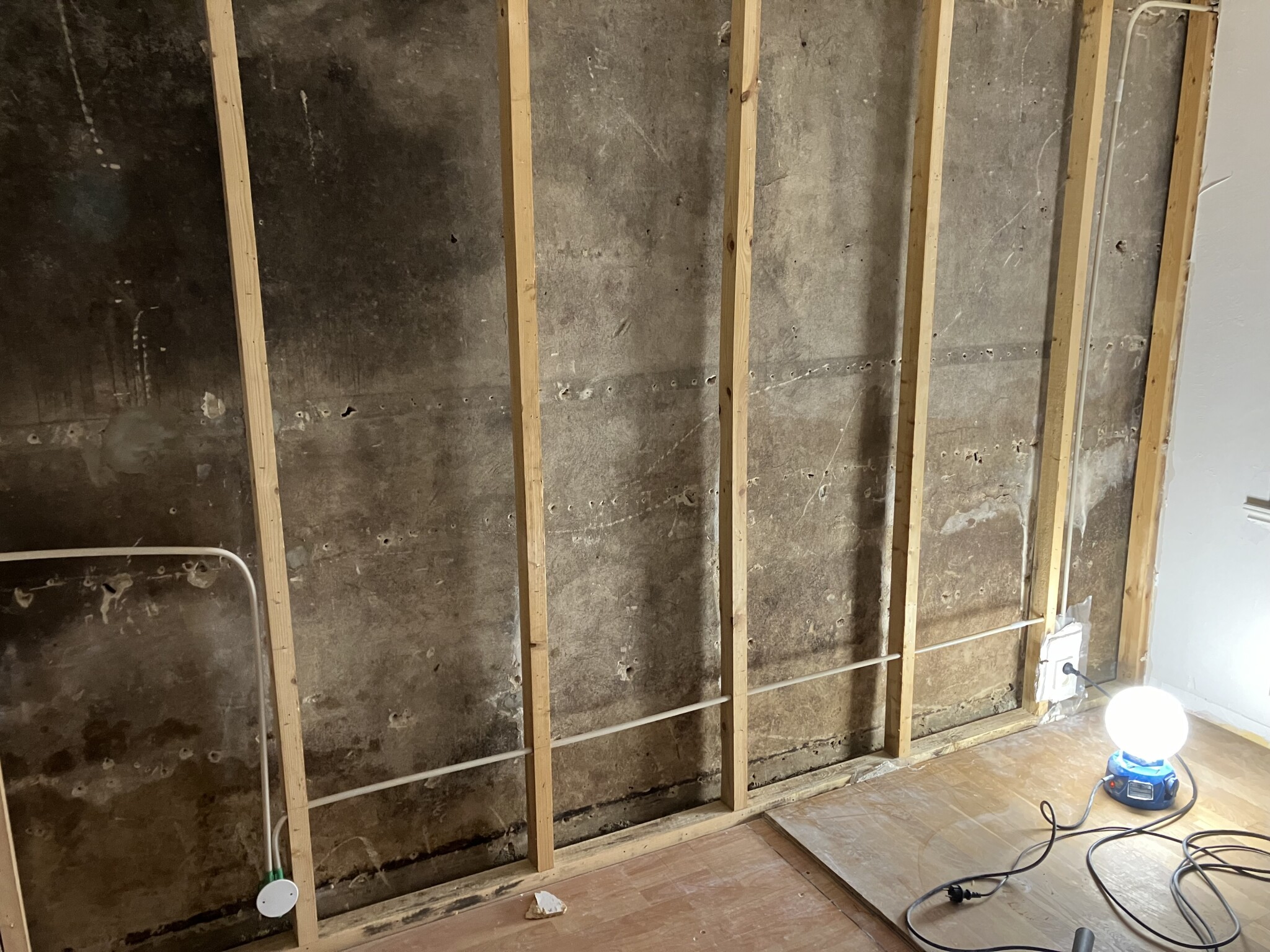
Now I have torn down the interior walls and exposed the plastered brick. Instead of a new stud wall, I was thinking of insulating internally with lightweight concrete blocks, to keep the wall "open" and avoid organic material. Then spackle and paint with open paint. What do you think about that?
When I put up the lightweight concrete, can I do it against the old plaster, or does the plaster need to be chipped off so that the lightweight concrete adheres to the brick?
Note! The dark areas on the plaster I don't think are mold. The plaster is sticking fairly well.
Best regards,
/Helge
We suffered water damage in our turn-of-the-century brick house. It had previously been insulated internally with a stud framework, 90mm insulation, vapor barrier, and drywall. No sill paper = mold in the sill🙄 External additional insulation on the gables, with foam plastic and plaster. Ventilated construction.
Now I have torn down the interior walls and exposed the plastered brick. Instead of a new stud wall, I was thinking of insulating internally with lightweight concrete blocks, to keep the wall "open" and avoid organic material. Then spackle and paint with open paint. What do you think about that?
When I put up the lightweight concrete, can I do it against the old plaster, or does the plaster need to be chipped off so that the lightweight concrete adheres to the brick?
Note! The dark areas on the plaster I don't think are mold. The plaster is sticking fairly well.
Best regards,
/Helge
Does anyone have an opinion on whether lightweight concrete blocks adhere well to plaster?H Händige_Helge said:Hello.
We suffered moisture damage in our turn-of-the-century brick house. It had previously been insulated internally with a stud frame, 90mm insulation, vapor barrier, and drywall. No sill paper = mold in the sill🙄 External additional insulation on the gables, with foam plastic and plaster. Ventilated construction.
Now I have torn down the interior walls and exposed the plastered brick. Instead of a new stud wall, I plan to insulate internally with lightweight concrete blocks to keep the wall "open" and avoid organic material. Then fill and paint with a breathable paint. What do you think about that?
When I put up the lightweight concrete, can I do it against the old plaster, or does all the plaster need to be knocked down so that the lightweight concrete adheres to the brick?
Note! The dark on the plaster I don't think is mold. The plaster adheres fairly well.
Best regards,
/Helge
Ok, I wouldn't rely solely on gluing these, but you can build them up with thin-set mortar from the floor upwards and then attach wall ties approximately 4 per m2 or even better with a wall anchor..H Händige_Helge said:
You drill a plug into the existing wall and then attach a wall tie or screw in the wall anchor that I attached..
In this way, the entire load isn't on the adhesion of the mortar, but the blocks are held in place by both parts..
You can keep the plaster on the wall..
https://www.k-rauta.se/produkt/murkamspik-essve-40x125mm-rostfri-a4-100-pack/7317761041528
https://joma.se/Lemoon/MasterPages/<%= Content.Url() %>
https://www.bauhaus.se/tunnfogsbruk-m10-20kg
Thank you very much! Is it a reasonable solution to replace the previous wooden construction with aerated concrete? I have worked a lot with wood, but never with aerated concrete🤔
The goal is good insulation with a diffusion-open construction.
The goal is good insulation with a diffusion-open construction.

If you're after good insulation, you might want it a bit thicker than 75 mm.H Händige_Helge said:
I would have placed a tongued and grooved 50mm XPS insulation in between if you want better insulation..H Händige_Helge said:
Can't find anything on that..H Händige_Helge said:
But comparing EPS insulation with concrete should come to diffusivity..
So I don't think you need to worry about that..
https://www.sundolitt.com/globalassets/inriver/resources/sundolitt-produktguide-sept-2019.pdf
Thanks! But if you then build up a wall of lättbetong inside the brick wall, how do you finish when you reach the ceiling? Should the wall go all the way up and finish with something like a sill strip against the wooden ceiling, or how do you finish it?Rejäl said:
Yes, some form of barrier doesn't hurt..H Händige_Helge said: