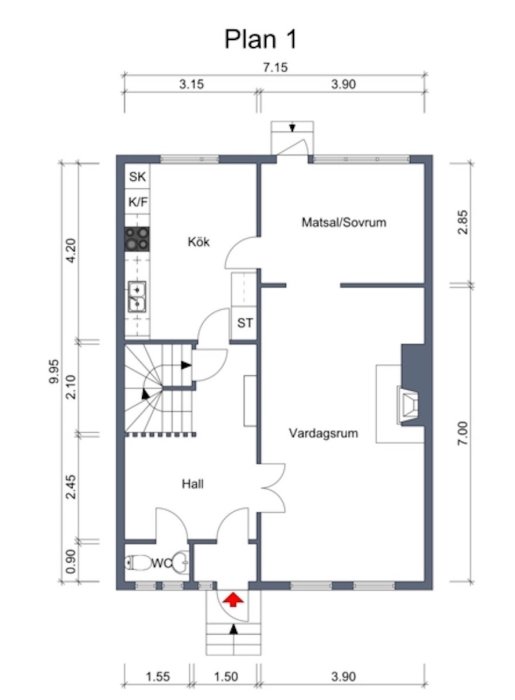
I live in a townhouse with two floors plus a basement. By comparing the construction of the interior walls with the technical description of the house, I have determined that the interior wall dividing the house lengthwise is load-bearing, as well as the wall between the kitchen and the hall and the wall between the dining room and living room.
I want to tear down the wall between the kitchen and dining room, and since it is load-bearing, it needs to be reinforced.
However, I have become a bit unsure if that wall is really load-bearing. I have looked at the roof boards and determined that the direction varies in different parts of the house. In the kitchen and dining room, they run in one direction, and in the living room and hall, another. Presumably, the beams in the floor structure are perpendicular to the roof boards. If so, I conclude that the beams run roughly like this:
Is it reasonable that this is the case? Outside the kitchen and dining room, there is a balcony on the upper floor, and its beams align with this. What does that mean for the wall between the dining room and kitchen? Is it not load-bearing, despite its sturdy construction?
As mentioned, it is "natural" for the floor to run across the building. However, it might very well be as you say since the balcony cantilevers out. If you don't have drawings, it might be a good idea to open up and take a look to ensure how it appears. If you have drawings of the foundation, you can also get some help on how the joists look.
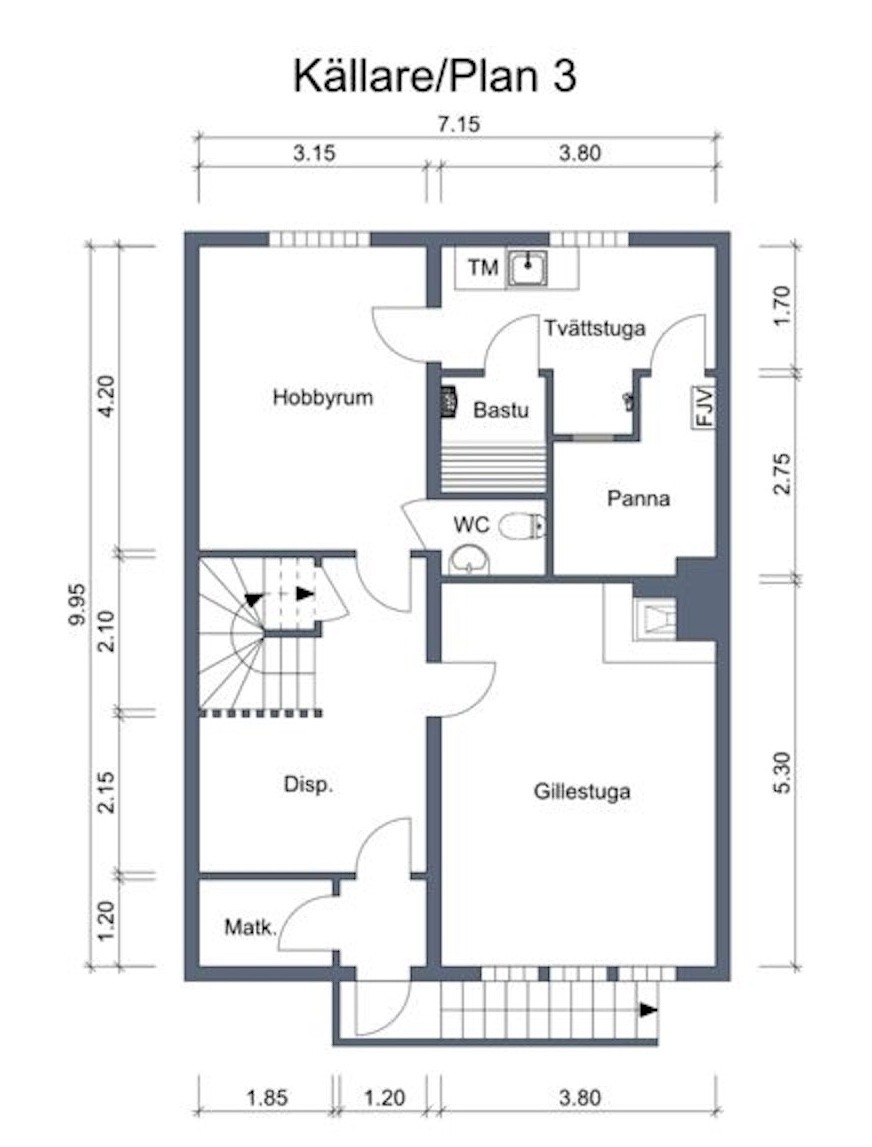
Below the ground floor is a basement level. The floor structure between the basement and the ground floor consists of 15 cm reinforced concrete. In the basement, there is a load-bearing interior wall that runs along the length of the house (vertically in the image below).
I have now used a stud finder on the kitchen ceiling, and it shows that the studs run according to my sketch above. Unfortunately, I cannot measure in any other ceiling because only the kitchen has ceiling cladding (masonite) that lies flush against the sheathing.
This suggests that the wall may not be load-bearing. I will open up the wall-ceiling angle this weekend to hopefully see how it is constructed.
Opened up the surfaces in the kitchen to see how it looks. The beams in the kitchen run as shown in my sketch. However, one of them runs parallel to and directly above the wall I want to demolish. It is also completely straight, unlike the ones in the middle of the room that have a slight bend (sagging in the middle). The wall should therefore be considered somewhat load-bearing, so I will install a beam. However, the load should be significantly lower than in the case with perpendicular beams, which is what I had calculated. Or am I thinking wrong?
You need to perform a structural calculation of how strong a beam you need in any case, and apply for planning permission. Don't you have any proper drawings? The sectional drawing shows what is load-bearing, even if it's reasonably the main wall that's load-bearing all the way, despite the joists being in the "wrong" direction in that part.
Missing construction drawings and the sectional drawing is not clear regarding this. However, the dimension of the wall suggests that it is load-bearing. Building permit is not required but a building notification is.
Have you checked how they are situated in the materials as well?
If it's just a beam lying over the wall, it's not load-bearing, so you actually don't need a beam based on the information in the thread. However, it may feel a bit different when you walk on the upper floor since a "support" for the flooring has disappeared.
I haven't opened it up to see in detail, but it seems there's a beam above the wall. I don't want it to start sagging when the wall disappears, even if it's harmless, so I want to support it with a glulam beam.
The question is whether the wall is classified as load-bearing (requiring a building notification for changes) or not. I would prefer to avoid the bureaucracy and cost if the building notification is unnecessary, but I don't intend to cut corners.
Vi vill skicka notiser för ämnen du bevakar och händelser som berör dig.