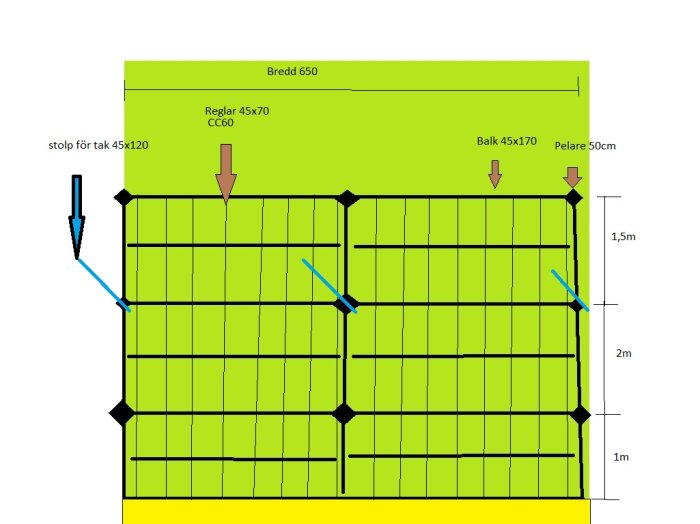
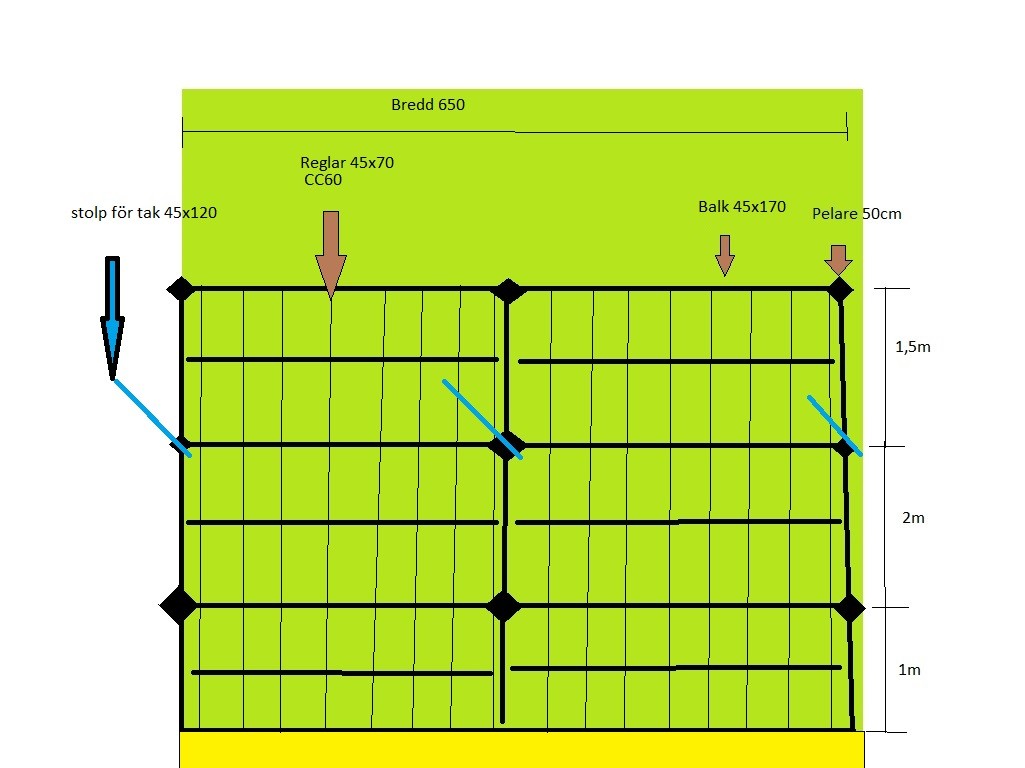
We are in the process of building a terrace with a roof. I have started digging and will dig down to begin the groundwork. Initially, I planned to use nine pillars 50 deep, and then lay 45x195 as a beam and 45x170 as joists, but it feels very over-dimensioned. Or maybe it's because I have to dig up the lawn 50cm and then another 50 for the pillars.
I have made a drawing for how I am thinking now...
Do you think this will work? With these measurements, I need to dig a depth of 35-40cm instead.
I am also wondering how to handle where the roof meets the façade, which is a wooden façade. The roof has to come against the bottom batten; can one make a 45-degree cut and then press in a flashing, or do I need to remove 10-20cm of the façade?
If I understand you correctly, you want to keep the height of the deck construction down. One way to achieve this is to first create frames from, for example, 45x195 timber that rest on posts and then recess secondary beams of, for example, 45x170 into these using joist hangers. The exact dimensions of the timber can be determined after you know the actual spans. You should use the same c/c distance between the joists across the entire deck. You also need to decide the direction you want the decking boards to run. If you use slightly thicker decking, for example, 34x145, you will get a stiffer floor and can still increase the c/c distance between the joists to 700 mm.
45x120 is certainly too weak a dimension for the posts. For free-standing posts, one should always choose timber with a square cross-section. 95x95 is a suitable dimension in this case, even if you can only get quality class C14.
The design of the seal between the roof and wall depends a bit on what roof material you will use. In any case, you must saw away a section of the clapboard/clapboards so that you can insert sheet or metal next to the baseboards of the facade.
If I understand you correctly, you want to keep the height of the deck construction down. One way to achieve this is to first create frames of, for example, 45x195 timber resting on footings, and then recess secondary beams of, for example, 45x170 into these using joist hangers. The exact dimensions of the timber can be determined once you know the actual spans. You should use the same c/c spacing between the joists across the entire deck. You must also decide in which direction you want the decking boards. If you use slightly thicker decking, for example, 34x145, you will have a stiffer floor and can still increase the c/c spacing between the joists to 700 mm.
45x120 is certainly too small a dimension for the posts. For free-standing posts, you should always choose timber with a square cross-section. 95x95 is a suitable dimension in this case even if you only get hold of quality class C14.
The design of the sealing of the transition between roof and wall depends a bit on what roofing material you will use. In any case, you must cut away a section of the facing boards/lap siding so that you can insert felt or metal against the bottom planks of the facade.
Okay, it's smart to recess them, yes. Another idea was to lay 45x195 and then recess them with joist hangers with cc80 and then lay 45x70 on top and then use 9 posts in the ground and add another 9 screw piles to support where the window and door will be as well as on the open areas to make the floor more rigid.
The reason I want to dig as little as possible is because I've now hit concrete "lumps" of 50x50 that are buried in the ground, I've dug halfway now with a depth of 35.
Okay, then I'll go with 95x95 for the posts.
I forgot to add that in the future it should also be glazed, so that adds some weight.
Kane said:
Do you have no side view of the drawing? I don't understand your reasoning about 50 plus 50 in digging.....
Deck joists 45x70 feel a little flimsy.
When I said 50 plus 50, I mean I will dig to a depth of 50cm where the decking will be, and then dig another 50 for each post. I'm incredibly bad at explaining
but do you think 45x70 is too flimsy if I add another 45x195 recessed with joist hangers with cc80?
I can recommend the app "lathunden" from Svenskt Trä for sizing, where you can calculate suitable dimensions of timber for a certain span. Usually, you build with a layer of supporting beams with support at certain intervals (e.g., plinths) and on top of that (or alternatively, embedded in the support beam to save height) a layer of joists with, for example, cc 60 (depending on deck dimension). The decking comes on top of that. Your construction is a little different as far as I can see, with support beams in two directions and rather slender joists with a short span instead. Have I understood correctly? I'm sure that works too, but maybe a bit more challenging if you want to calculate suitable dimensions.
Can recommend the app "lathunden" from Svenskt Trä for dimensioning, where you can calculate suitable dimensions of timber for a specific span. Usually, one builds with a layer of support beam with support at certain distances (e.g., plinths) and on top of that (or recessed into the support beam to save height), a layer of joists with, for example, cc 60 (depending on decking dimension). On top of that comes the decking. Your construction appears a bit different as I can see, with support beams in two directions and rather slender joists with a short span instead. Have I got it right? Surely that can work as well, but maybe a bit harder if you want to calculate suitable dimensions.
this is how we did it if it might be of some help:
[link]
Downloaded the app, realized it will be very slender, especially if I want glass later on. Have to go with posts and maybe use glulam as a support beam.
maah said:
Screw-glueing is easy. It is exactly what it sounds like, you distribute wood glue generously on one of the beams and then screw them together.
camaro1969 said:
It's better to screw-glue 2 of 2"x4", they don't warp as easily.
but posts should work
Okay, then it's probably just as well to do that. Can you do this even with pressure-treated wood?
yes, it is possible with treated wood. I will do it soon... but I'll let the wood dry a bit first... then two sides will be planed to remove the V-joint between the planks.
I haven't seen laminated wood as treated. It should be solvable with regular construction lumber.
There is, for those who are interested, a printed laminated timber post 90x90 at at least one building supply store, Google is your friend.
Just saw that there are. But they weren't free
How do you do with the patio roof against the wooden facade? Do I need to cut and take down the facade? Or is it possible to make a groove and insert something like a flashing?
8 concrete bases in 2 rows of 4. Place these rows 2.2 m and 4.4 m from the house. Use 45x195 as support beams and 45x120 as floor joists with c/c 60 and then at least 28 mm thickness for the decking.
Glued laminated timber should probably not be needed in the support beam. Just make sure you have support all the way down under the load-bearing parts of the frame to the roof/conservatory and it should be fine.
Last edited:
Vi vill skicka notiser för ämnen du bevakar och händelser som berör dig.