
2,910 views ·
14 replies
3k views
14 replies
Door openings in load-bearing wall

We are sketching a renovation of the basement in our 1930s house (basement + 1 floor), and one of the ideas involves creating two openings in the load-bearing wall for doors as shown in the picture below.
I'm not looking for super concrete answers, but more interested in whether the idea is even feasible, and if so, we will contact a contractor for detailed calculations.
What I'm thinking is that it shouldn't be a problem to reinforce the openings with some form of beam, but since I'm far from an expert in the area, maybe there are things that complicate the whole thing?
I'm not looking for super concrete answers, but more interested in whether the idea is even feasible, and if so, we will contact a contractor for detailed calculations.
What I'm thinking is that it shouldn't be a problem to reinforce the openings with some form of beam, but since I'm far from an expert in the area, maybe there are things that complicate the whole thing?
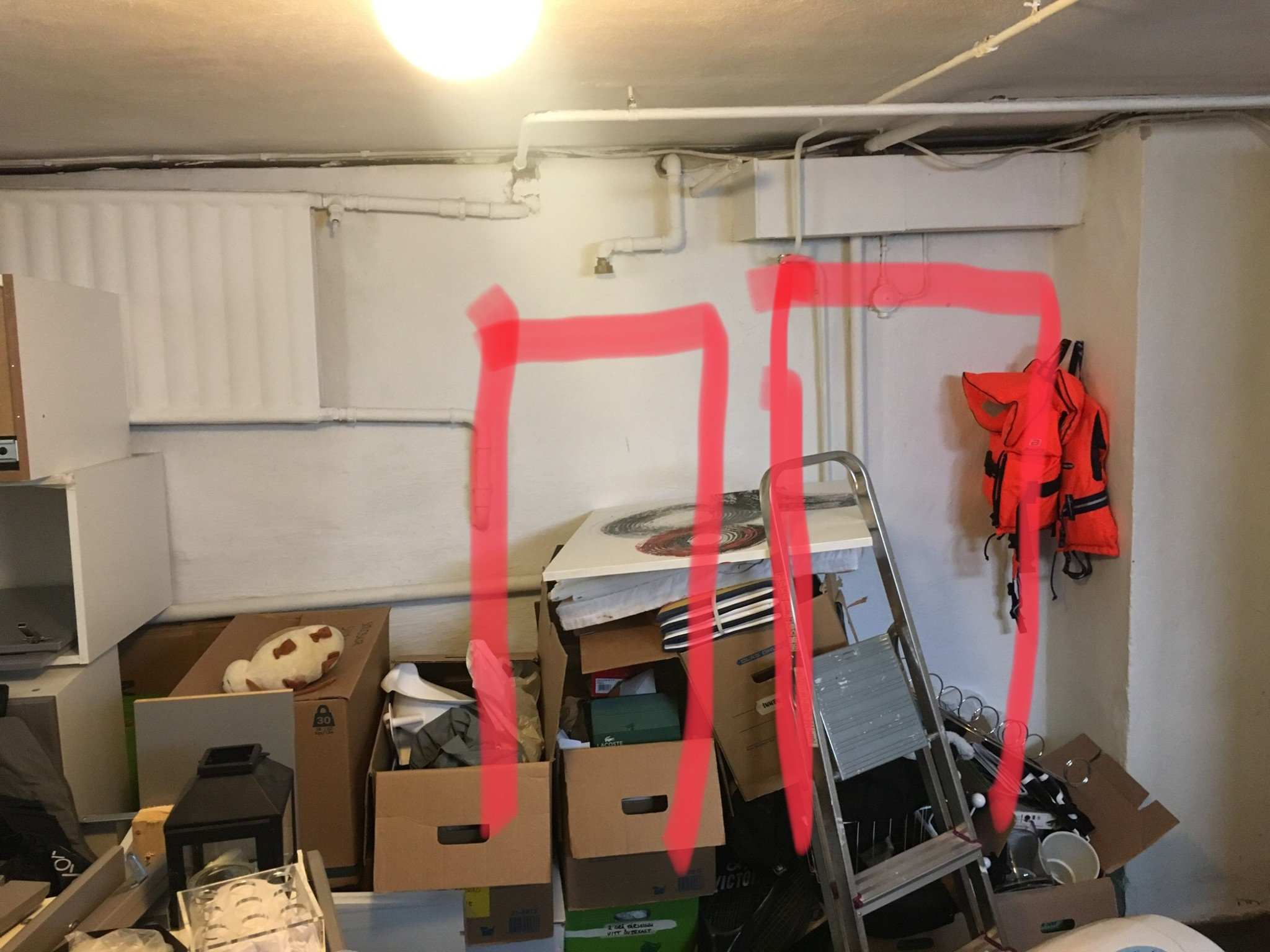

It is certainly doable. But if nothing else, it's complicated by all the pipes that are there.
Yes, the pipes need to go. I'm planning to dig out the basement at the same time and lay as much of the existing plumbing as possible in the floor. It has been built and rebuilt many times since the 1930s and many of the pipes are capped off spurs that are no longer used, but no one bothered to clean this up in the storage for obvious reasons.H hempularen said:
If it is a 1930s house, I think there is a high risk that the core wall consists of in-situ reinforced concrete. In that case, it's not enough to support with a steel beam; the new wall edges should also be reinforced. You need to enlist the help of a competent structural engineer. Letting a concrete cutter make the openings (it's best to make just one large hole) is the easiest part.
If you are going to break up the floors in the basement, you must not excavate deeper than the bottom edge of the footings that the outer walls and core wall rest on. Here too, it's good to have some competent advisor.
If you are going to break up the floors in the basement, you must not excavate deeper than the bottom edge of the footings that the outer walls and core wall rest on. Here too, it's good to have some competent advisor.
Thanks for the input! Yes, the plan is to outsource the entire job to a company since we ourselves don't have the time and expertise required for such major interventions as we are planning. We live in an "own home area" with many similar houses, so there are a number of companies that have previously done similar work for others in the area that we intend to use.J justusandersson said:If it's a 1930s house, I believe there is a high risk that the core wall consists of cast-in-place reinforced concrete. In that case, using a steel beam won't suffice, and the new wall edges should also be reinforced. You must seek the help of a competent structural engineer. Hiring a concrete cutter to make the openings (it's best to just make one large hole) is the simplest part.
If you're going to dig up the floors in the basement, you must not excavate deeper than the bottom edge of the foundations that the outer walls and core wall stand on. Again, it's good to have some competent advisor here.
I actually have something as unusual as some pictures of when the houses were being built https://stockholmskallan.stockholm.se/skblobs/2e/2e7273a7-2b51-4974-800b-db1ee2d41db1.jpg and I think I see some brickwork, but as I said, I'm far from an expert on this. However, the core wall is not visible in the picture.J justusandersson said:If it's a 1930s house, I believe there's a high risk that the core wall is made of cast-in-place reinforced concrete. In that case, it's not enough to use a steel beam for support; the new wall edges should also be reinforced. You need to consult a competent structural engineer. Hiring a concrete cutter to create the openings (it's best to make just one large opening) is the easiest part.
If you plan to break up the basement floors, you should not dig deeper than the underside of the footings on which the outer and core walls stand. Here, too, it's advisable to have some competent guidance.
The basement walls are built with concrete block and probably the inner wall too. That makes it much easier. What I said about the floor still applies.
That's right, we live in Norra Ängby. Well, that's great, then you really know what you're talking aboutMazen said:

The floor, yes, it was a thin slab of concrete, max 30 mm, while the actual ledge that the wall stands on was substantial. It extended about 100-150 mm and was nearly 300 mm high if I remember correctly. (The floor was broken up when I replaced the sewer pipes in the bathroom and also when a new riser was made for the kitchen). Underneath, it was mostly pure sand.
I have made an opening in the retaining wall in my basement. I had someone calculate it, of course. Installed a steel beam, and I also used expanding mortar to press the beam up against the ceiling. Concrete block in all the walls. Good luck!

Click here to reply
Similar threads
-
Undersized floor structure or load-bearing wall?
Building Materials and Construction Technology -
Are these "heart walls" load-bearing
Building Materials and Construction Technology -
Replace sill on supporting wall in basement
Building Materials and Construction Technology -
Bearing partition wall or?
Building Materials and Construction Technology -
Raise door opening in load-bearing wall
Building Materials and Construction Technology