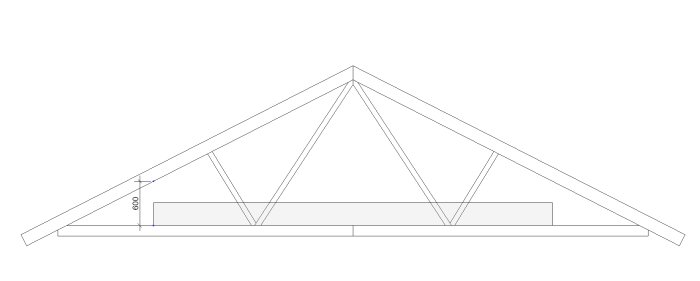
Can someone help me explain how a truss is constructed?
I am building a garage and am wondering if and how much a potential loft could support in weight. To me, it looks like the weak part of the construction is the joints at 6, 7, and 8 in the drawing below. If the truss can withstand 30kg/m2, is this with or without the weight of the roof?
Can/Should one reinforce with a glulam beam and then posts if you would like to use the space for storage?
Generally speaking, a roof truss like that is calculated to bear the weight of the roof and possibly some skis and such if one makes a "floor." One shouldn't count on more storage. If more is desired, it would require a typical intermediate floor dimensioned for the intended load and then a roof truss on top of that. Or calculate everything together. But without support in the middle, it would likely require quite substantial dimensions regardless.
Generally, such a truss is designed to carry the weight of the roof and possibly some skis and such if you make some sort of "floor." You shouldn't expect to store much more than that. If you want more, it would be like a regular intermediate floor designed for the intended load, and then a truss on that. Or calculate everything together. But without support in the middle, it will probably require quite substantial dimensions regardless.
Thanks, the idea is to store scaffolding there when it's not in use. So maybe 400kg. Could it work if I spread and distribute it along the outer edges? The garage is 7.2x12m.
Sounds like a lot... In which part of the country is it? The same truss for everyone or is there some lightweight variant for southern latitudes? In any case, it probably won't collapse, but with the right conditions, it could go wrong.
You could also look at it the other way, maybe there's a simpler way than hoisting 400 kg of scaffolding into an attic? Spreading it out just makes it even more complicated...
On the other hand, you don't have to lend it to any Tom, Dick, and Harry, when it has to be dragged down from the attic to be borrowed...
Skåne, don't think it's any special variant though, just their standard. Unfortunately, it's something I probably should have looked into better earlier... Hmm, you may be right that it might not be entirely optimal to store there. Will have to reconsider. Thanks for your opinions!
Skåne, don't think it's any special variant though, just their standard. Unfortunately, it's something I probably should have looked into better earlier...
Hmm, you might be right that it might not be completely optimal to store there. I'll have to think it over again. Thanks for your opinions!
I would probably place it on a pallet in the garage, (maybe build one of those in steel like the "real scaffold builders" usually use), and spend the money you save on both reinforcing the roof trusses and visits to the physiotherapist on a pallet jack to move them around when they're in the way ...
I know this is an old case, but I thought I’d explain a little about how common gable roof trusses are "normally" calculated regarding wind load.
It is usually calculated with a "useful load" of about 50 kg/m2. This is calculated from an internal minimum height of 600mm. As the example in the image below shows:
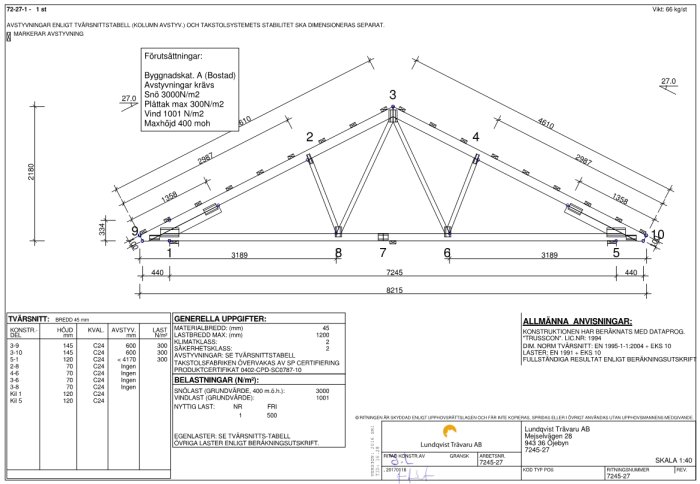
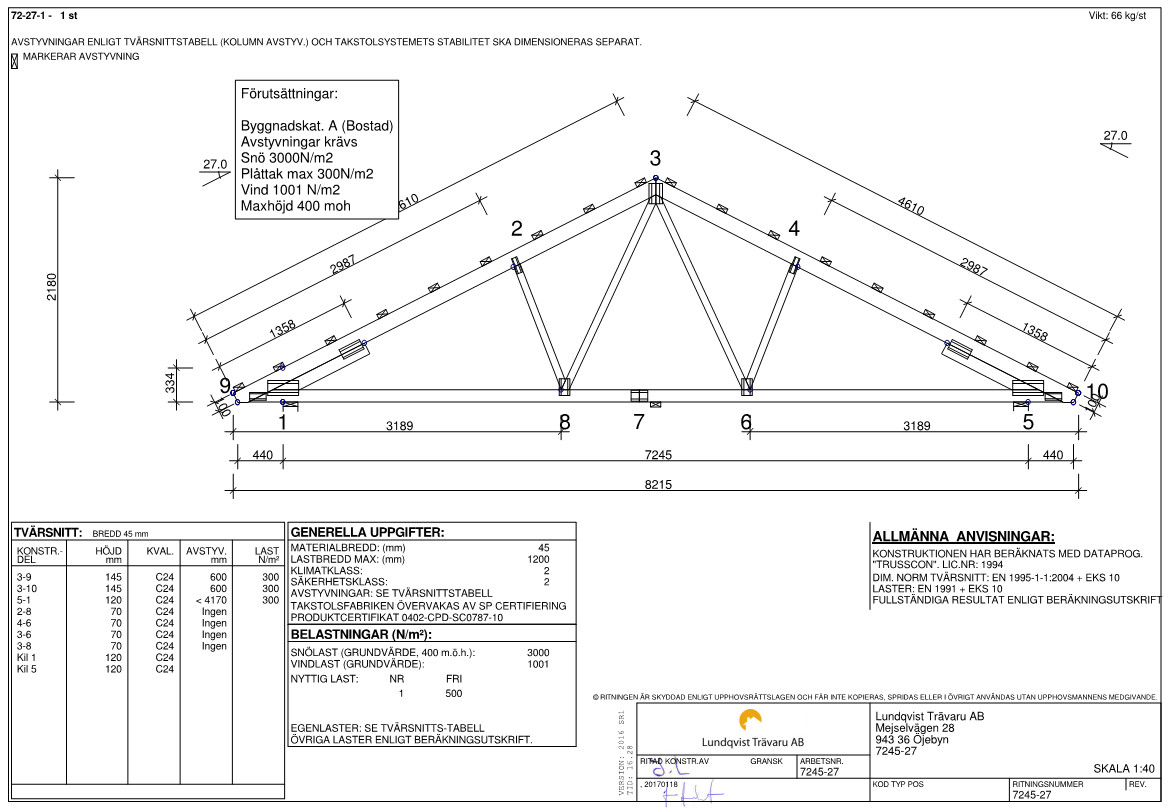
You can also see that it is described in the drawing as USEFUL LOAD FREE 500 (kN/m2).
So, if you are planning to load a lot or heavy things, you need to ensure it is evenly distributed among the trusses so that it doesn’t result in a concentrated load on one spot.
I know this is an old case, but I thought I'd explain a bit about how common truss roofs are "normally" calculated regarding wind load.
One usually calculates a "useful load" of about 50 kg/m2. This is calculated from an internal minimum height of 600mm. As the example image below shows:
[image]
This is also illustrated in the drawing where it's described as USEFUL LOAD FREE 500 (kN/m2).
Meaning, if one plans to place a lot or heavy things, it's important to ensure it's evenly distributed between the trusses, so the load isn't too concentrated at one point.
Thanks for the explanation! I can inform you that the attic is still basically empty, only a sled and a bike are there for now. The scaffolding wasn't purchased either, so that storage solution was resolved too...
Click here to reply
Vi vill skicka notiser för ämnen du bevakar och händelser som berör dig.



Shakula said: