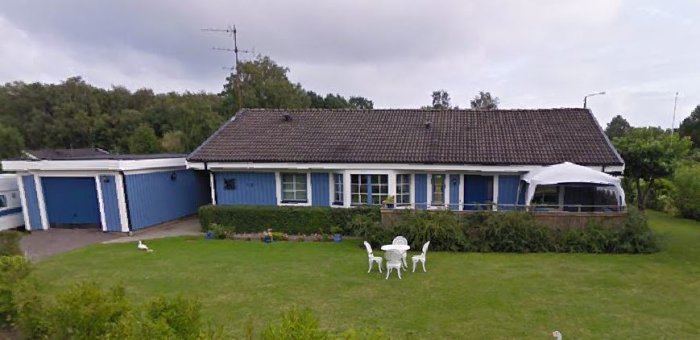
This summer, we plan to replace the roof on the house we just bought. It's concrete tiles from 1982 with substantial moss piles, but so far no leaks as far as we can see. The new roof will be a significantly lighter metal roof, and in connection with the change, we also want to shorten the roof overhang. I'm well aware of the purpose of a large roof overhang, but since my partner is an architect and the house also looks "pressed down" to me, I have to concede. The problem with shortening the roof overhang is that the rafters' top chords rest on the bottom chord in the actual overhang, so it’s not just a matter of cutting it off without adapting new supports between the top and bottom chords.
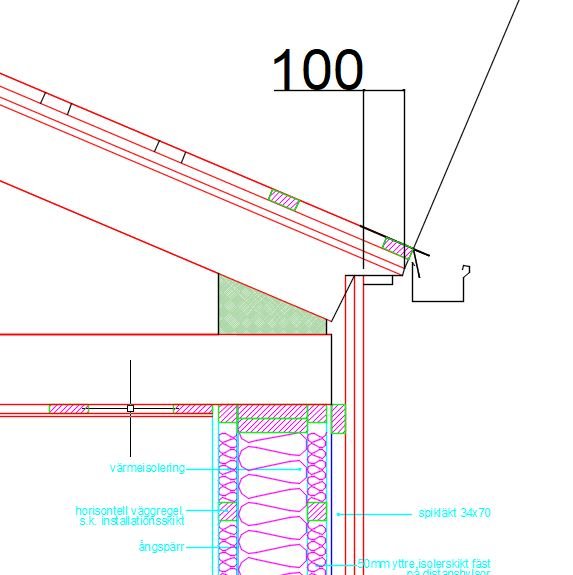
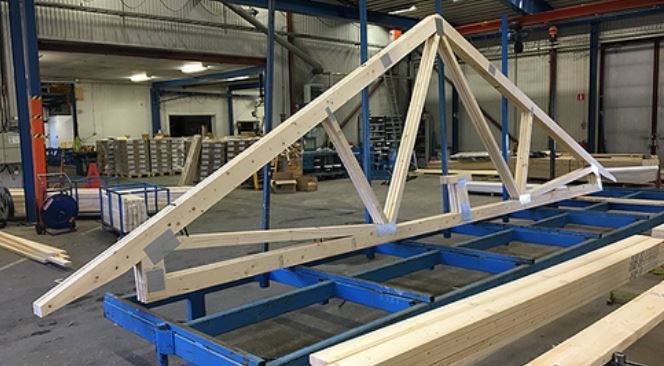
Below you can see how the truss looks today:
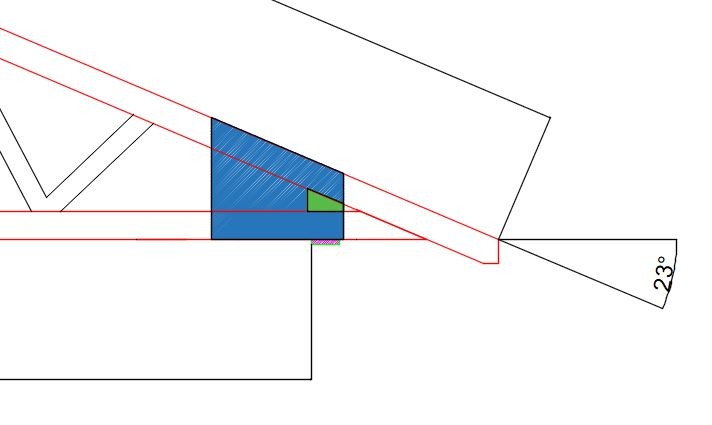
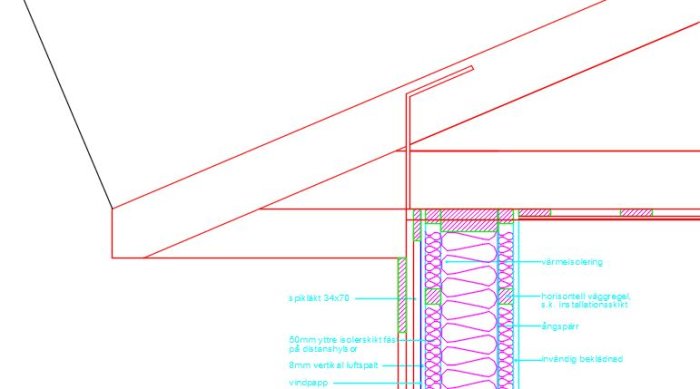
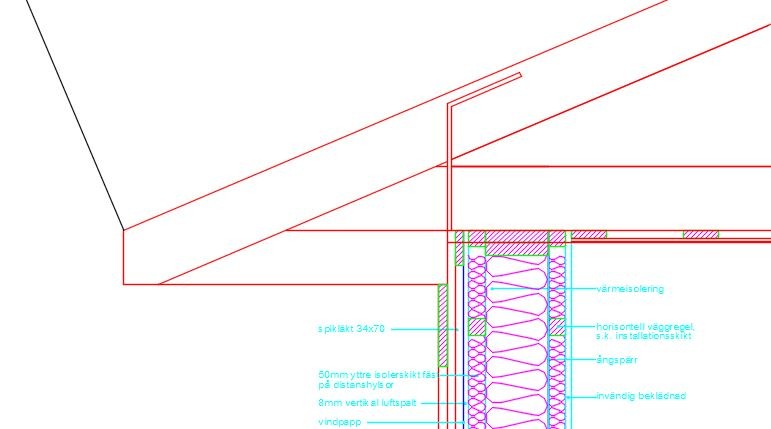
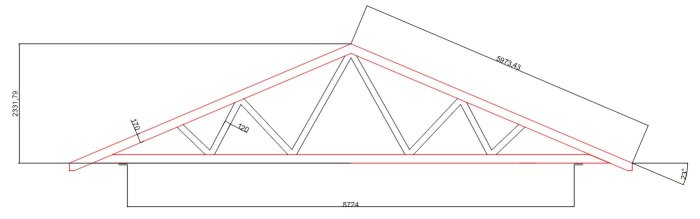
And in principle how I imagine the new support should be (in green).
Logically, the load on the truss will want to press the support inwards, so I also plan to attach a "locking batten" on the inside, connecting all the trusses, for a little extra security. I thought of making the support from composite battens so that the width becomes slightly wider than the bearing under the truss using nail plates. Nail plates will then connect the support with the top and bottom chords.
Do you think this solution should suffice, or should other measures be taken?
I will need to make the alteration on 8 out of 14 trusses, and the rest will be replaced with scissors trusses that are already adapted. I should mention that I spoke with a friend who is a structural engineer, and he (without calculating it) thought it should be sufficient. The house is in Kungsbacka with snow zone 1.5.
Maybe you can ask your friend to really calculate it?
There is missing information regarding span, cc measurements, load on the subframe, the original appearance of the truss, etc.
There's still some time before this becomes relevant, and I obviously want to be sure it's sound, so my question was along the lines of "does my concept hold" before I take it further. This example looks quite similar to what we want to achieve:
Here, the beam does not rest directly on the lower beam but is connected with a vertical support. However, they do have an extra brace...
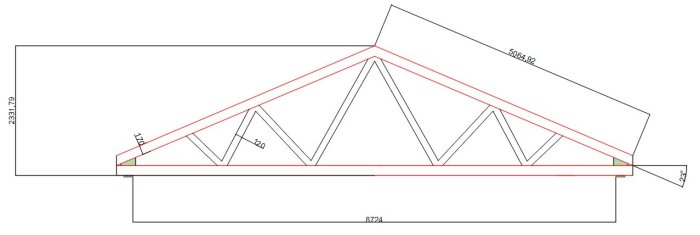
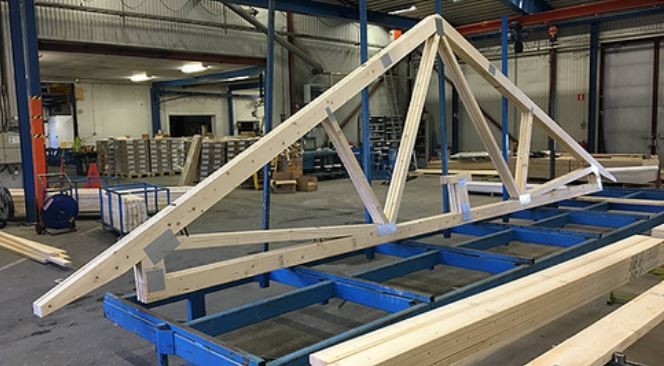
The trusses currently look like this:
The framework will remain unchanged; only the support at the ends differs.
Apart from that, I don't know how the loads are distributed, but the trusses are self-supporting and are installed with cc 1200mm on a single-story house with a span of about 8700mm. Concrete tiles -> Metal roof.
Should I consider adding more braces, and if so, where? The framework will remain intact.
Adding a brace like in your attached image makes it look more accurate; you can understand and see the force distribution. Your solution probably works well too, but let your friend calculate it if so. Unfortunately, the truss will not be intact when you cut a "node," and this alters the original design's force distribution.
I have difficulty understanding why one would make such a complicated change to an existing, functioning house.
For appearance's sake? You don't see it yourselves, only the neighbors.
You may not be aware that nowadays the lifespan of a concrete roof can be greatly extended by washing and perhaps also repainting?
I understand your point of view and I agree with you to some extent, but as I mentioned, an architect (my partner) doesn't see the matter through the same eyes, and that needs to be understood as well. We have been searching for a plot for a long time to build a house that we designed, but unfortunately, we've not been able to find something suitable. Instead, we found a house located where we wanted, and which we felt we could "refine" towards the direction we wanted with the house we designed.
According to the inspection report and conversation with the inspector, it became apparent that the roof will probably/should need replacement within a couple of years. Even now, for instance, the fascia boards and edge plates need replacing, which, of course, is a minor cost relative to an entirely new roof. But the combination of the security in knowing the roof is replaced and that it also gives the house the expression we want makes me also think it is a good option.
A wooden façade requires at least 30 cm, preferably 40 cm of overhang plus the gutter. At home, we had significantly shorter overhangs on the gables, but when we re-clad the house, we extended the overhangs to about 35 cm so the new boards would last somewhat. I know they don't cover things like that in architecture school, so I excuse your partner's lack of knowledge.
Whether the overhang is 10 or 40 cm is not the question here. There is also no "requirement" for a projection, but I am well aware of the purpose and that it can extend the lifespan of the panel, etc.
However, I think it's good that architects and other creative professionals work to do things differently, but you may not be one of them, but that's your choice.
The solution you've outlined will hold. There are probably no doubts there.
However, I would advise you not to shorten the overhangs as much as you have drawn; it doesn't look good in my opinion. You might be going for some kind of functionalist look, but I don't think it will work on your house. Rather choose the overhangs somewhere in between because I agree with the architect that it looks a bit odd as it is today.
It is clear that it is part of architectural education to understand the importance of roof overhangs, especially on the west coast. As I've been following this thread for a few days, I've been contemplating whether there are any alternative courses of action. Several of the house's appearance issues are not solely related to the roof overhangs. The hedge in front that effectively conceals the height of the facade, as well as the color scheme and roofing material, are some obvious examples. The white fascia boards and window frames truly emphasize the protruding position of the roof. The bright blue and the white are certainly not beautiful, either together or individually. The vertical facade paneling's relatively coarse texture sends the wrong signal about the scale of the house.
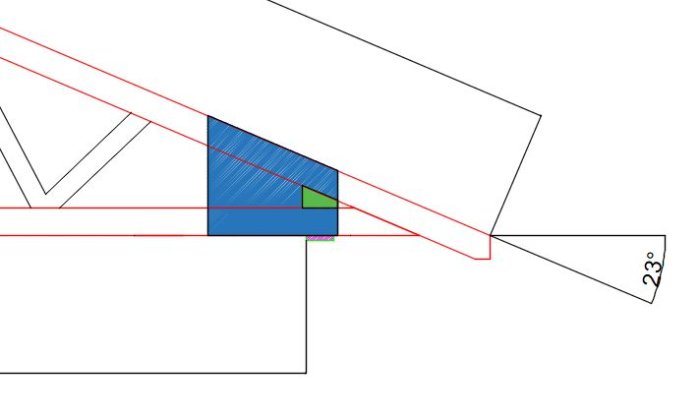
Regarding the truss issue, I think the Prototype had a sensible idea that we will take advantage of. On each side of the truss, 18mm construction plywood is screwed and glued. Such a joint should be able to handle the loads and a bit more, especially considering the lighter roof that will be installed. Perhaps a strong bolt and washers in each corner of it. Another round with the designer with that thought!
Green: Wedge of 220x45 stud
Blue: 18mm construction plywood on each side of the truss
More ideas in this area are gratefully received!
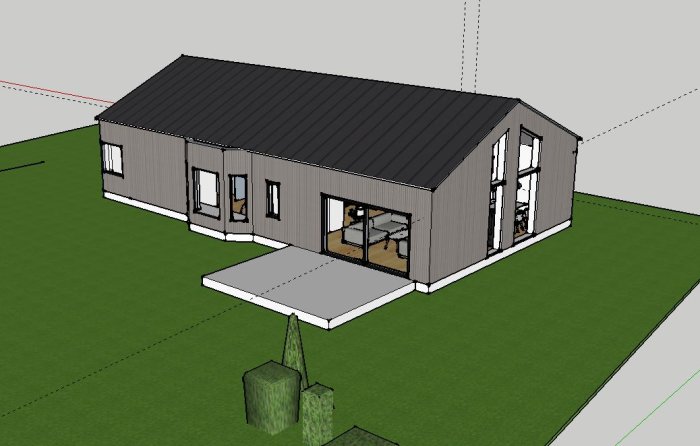
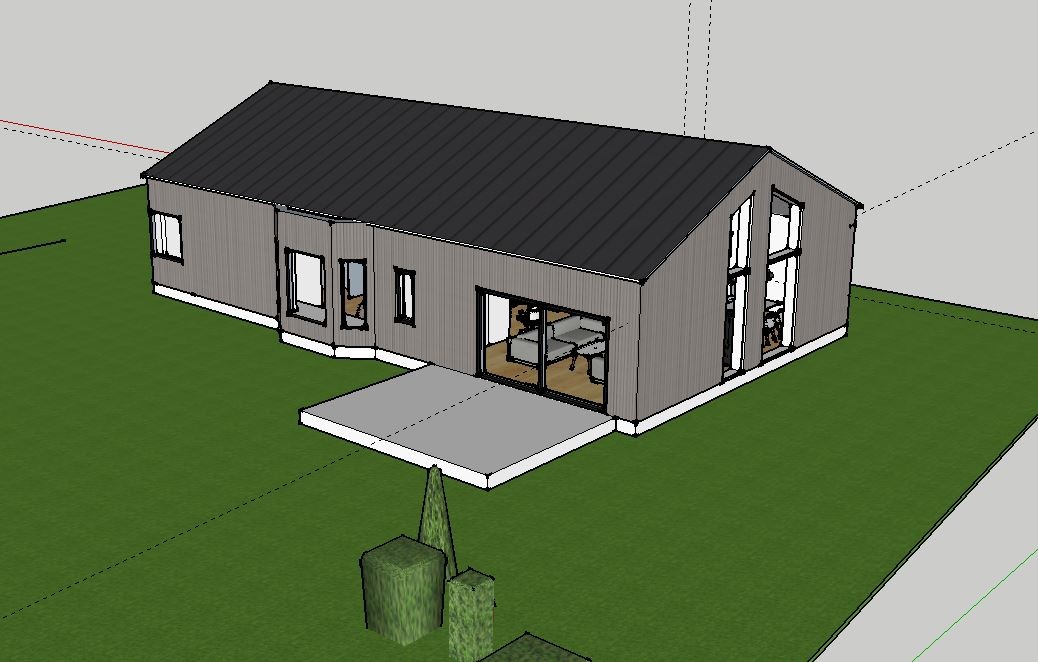
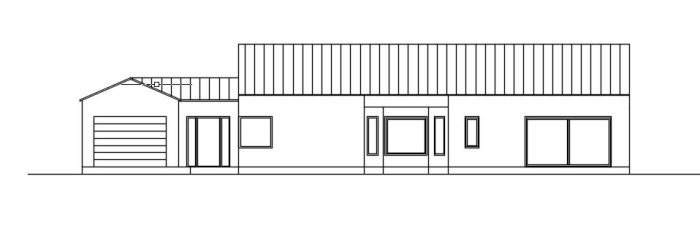
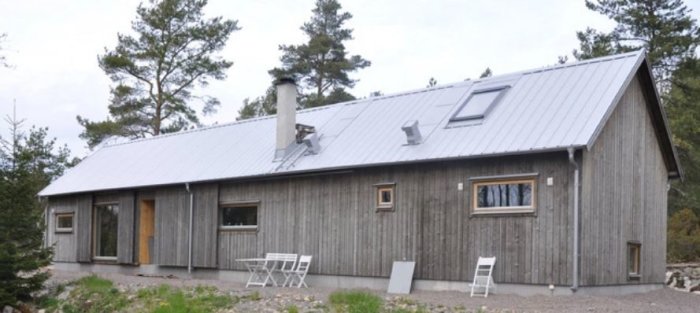
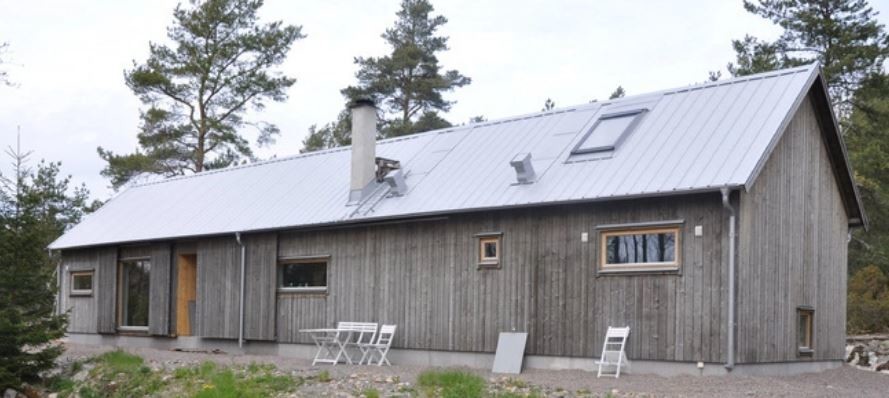
Note that I used the original truss in the image above because one of my sketches attracted so much attention. The eaves will be shortened, that much is clear, otherwise, I wouldn't have created this thread. To clarify even more, here is a picture (not my picture) of how much roof overhang and style we envision; it is not necessarily a modernist house with all that implies. We haven't decided yet, but shorter than it is currently will be, and no heavy built-in eaves.
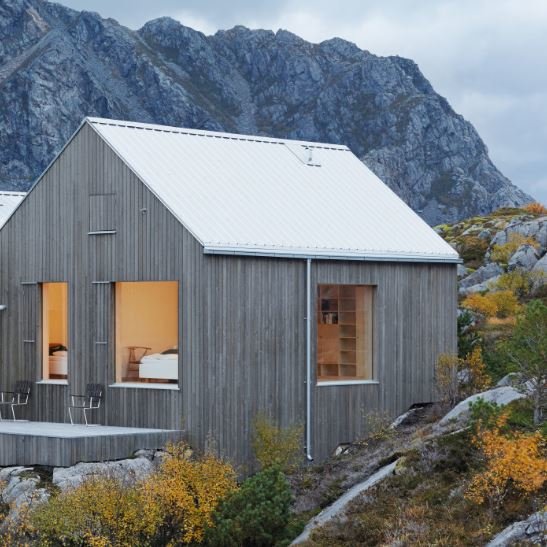
But just to tease all the modernist haters and eaves police (with a wink), here's something for you to comment on =) (not my picture).
Vi vill skicka notiser för ämnen du bevakar och händelser som berör dig.





KnockOnWood said:
I have difficulty understanding why one would make such a complicated change to an existing, functioning house.