
1,219 views ·
4 replies
1k views
4 replies
Which walls/ceiling for closet "background"?
Uncertain if this is the right thread but taking a chance. We have just torn out our closet section in our house from '67, they were more or less built-in so it was a bit tough to remove them.
Attached is a picture of how it looks now and I'm wondering what materials to use for the ceiling and walls? (please link) I assume it's easy to just install whatever needs to be there, we were thinking of trying to do it ourselves.
The pipes running there I assume are for the kitchen, and when we plan to replace that in the future, they should be accessible from the other side (as the closets were built, you would never have been able to access them from the closet side, so to speak).
Then there's the floor as well, do we need to put some sort of chipboard or similar there to cover the holes?
The old ones were just sitting directly on a frame of joists, we've removed that since our closets are a few centimeters higher than the original ones.
We have bought Pax closets with sliding doors from IKEA.
Attached is a picture of how it looks now and I'm wondering what materials to use for the ceiling and walls? (please link) I assume it's easy to just install whatever needs to be there, we were thinking of trying to do it ourselves.
The pipes running there I assume are for the kitchen, and when we plan to replace that in the future, they should be accessible from the other side (as the closets were built, you would never have been able to access them from the closet side, so to speak).
Then there's the floor as well, do we need to put some sort of chipboard or similar there to cover the holes?
The old ones were just sitting directly on a frame of joists, we've removed that since our closets are a few centimeters higher than the original ones.
We have bought Pax closets with sliding doors from IKEA.
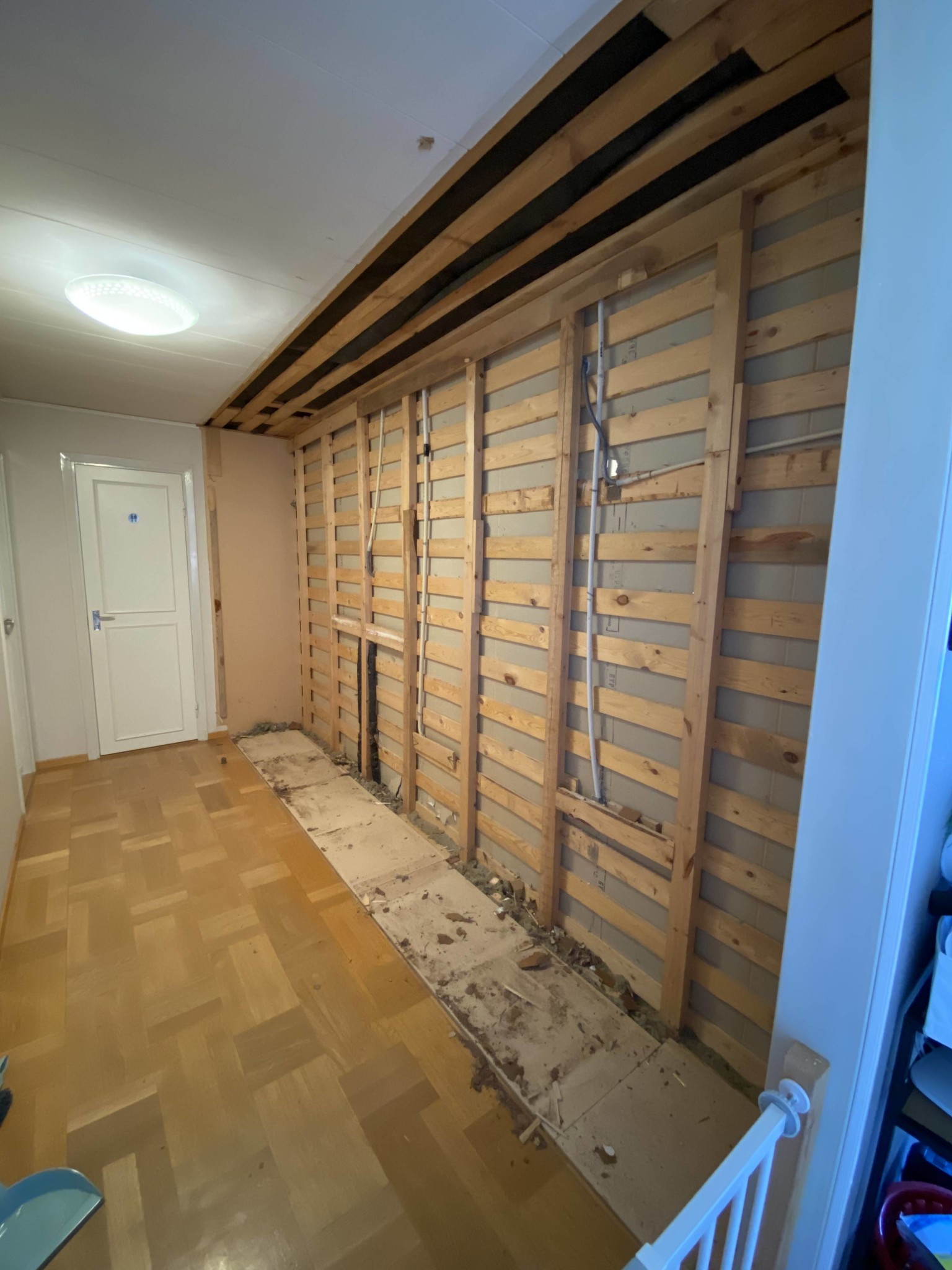
Is there no flooring material at all where the closets stood? It's a bit hard to see in the picture. If there's no floorboards or any other panel there, it would probably be easiest to lay down chipboard, available at the nearest hardware store.
For the ceiling, it's easiest to install drywall, which comes in various sizes and edges at the hardware store. If the new closets will cover everything, I would use standard 90x240 drywall panels and screw them up. However, they are quite heavy, so it helps to have 2-3 people assisting.
On the far wall, it looks like there are already drywall panels, so you don't need to worry about that unless you want to paint it.
Are you just placing the new closets there, or are you going to build them in somehow?
For the ceiling, it's easiest to install drywall, which comes in various sizes and edges at the hardware store. If the new closets will cover everything, I would use standard 90x240 drywall panels and screw them up. However, they are quite heavy, so it helps to have 2-3 people assisting.
On the far wall, it looks like there are already drywall panels, so you don't need to worry about that unless you want to paint it.
Are you just placing the new closets there, or are you going to build them in somehow?
There are likely those chipboard panels, see picture. Then it should be okay to just place the wardrobes on that?zarkov said:
Is there no flooring material at all where the wardrobes stood? It's a bit hard to see in the picture. If there's no subfloor or any other board there, it's probably easiest to lay chipboard there, available at the nearest hardware store.
For the ceiling, it's easiest to put up drywall, which comes in various sizes and edges at the hardware store. If the new wardrobes are going to cover everything, I would choose regular drywall, 90x240, and screw it in place. However, they are quite heavy, so it helps to have 2-3 people to assist.
On the distant wall, it seems there are already drywall boards, so you don't need to worry about that unless you want to paint it.
Are you just going to place the new wardrobes there, or are you going to build them in somehow?
There's some sort of ceiling panel installed, but I think it doesn't matter much what goes up there since we're planning to renovate the hallway in the future and the wardrobes will likely extend a bit as well. We will install some sort of molding/edge on the sides and at the ceiling to cover seams/wallpaper edges, etc. Should we still use drywall, or is something else sufficient? I noticed drywall isn't expensive regardless, though perhaps more cumbersome to work with. Drywall might also be beneficial for insulation reasons?
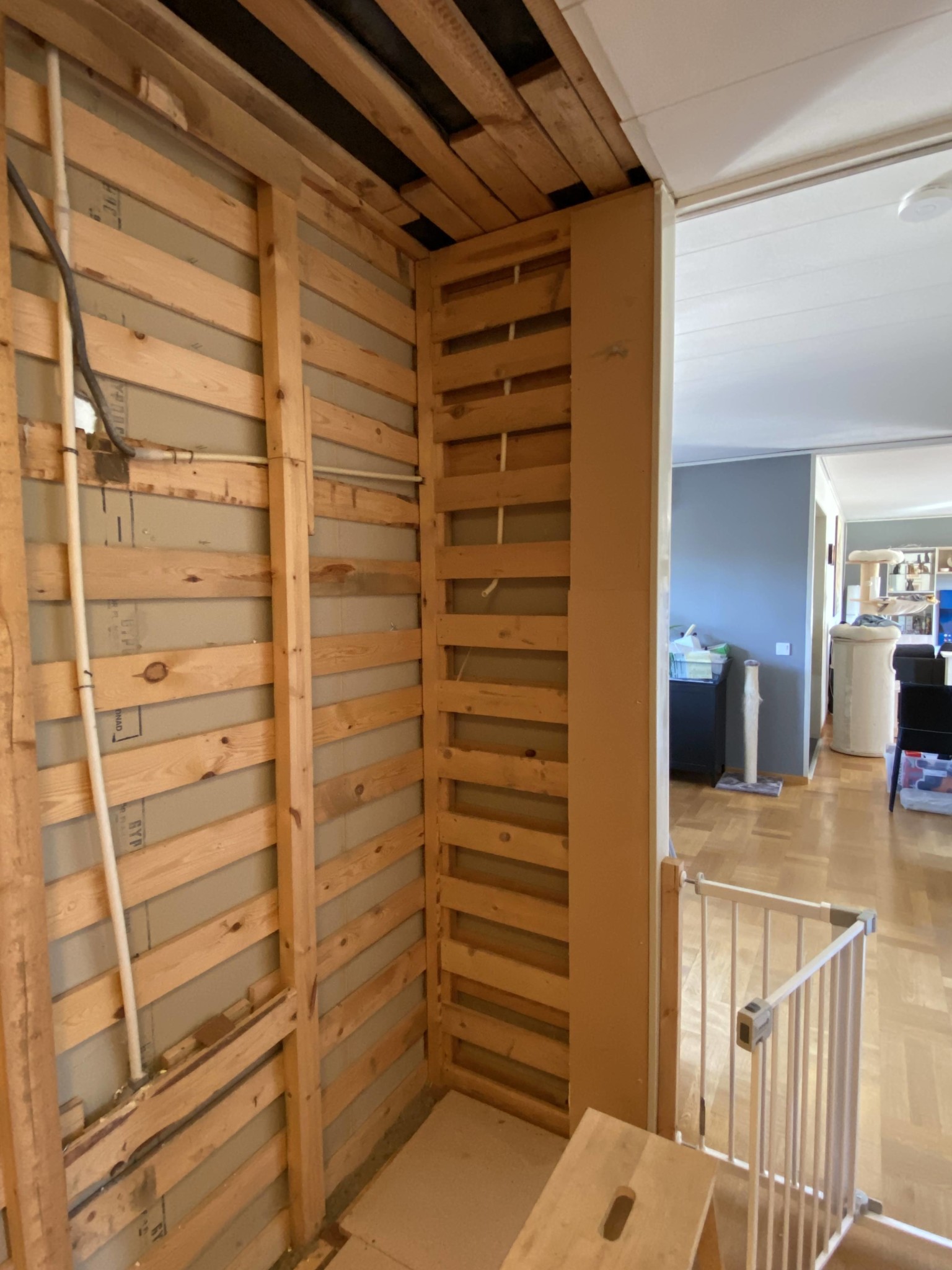
You're right about the distant wall; it's drywall and won't be touched since it won't be visible anyway. However, we have a corresponding side where a bit of drywall is missing; should we fill that in?
The idea is for the wardrobes to be built-in. They're 4m, and the length between the walls is about 5-8 cm longer on both sides, so we thought about installing some wooden molding/piece there. Similarly, there'll be a bit of gap at the ceiling, and we'll see how we can solve it since the sliding doors need 5 cm of space to hang. Then, we'll see how we can make it look nice


Click here to reply
Similar threads
-
Vilka takpannor ska man välja?
Tak & Vind -
Hitta gamla elledning i väggar o tak
El -
Bärande väggar? Längsgående takbjälkar
Fritidshus -
What dimensions envelope roofs
Building Materials and Construction Technology -
Framing interior walls before drywalling the ceiling?
Building Materials and Construction Technology