
530 views ·
3 replies
530 views
3 replies
Which mortar for plastering and for embedding a smoke pipe
Hi!
I'm going to install a new fireplace in an existing chimney flue (but with a new hole) in the chimney breast and I'm wondering which mortar to use for setting the pipe collar and for repairing the plaster.
The chimney breast is probably plastered with lime mortar and I'm thinking of continuing with that. Does Lime Mortar D work well? e.g. https://www.bauhaus.se/kalkbruk-grov-cs-i-20kg
The plaster that's missing needs about 10-15 mm to come up to the same level as the old plaster.
Or should I go for something harder with a mix of lime and cement? (e.g. https://www.bauhaus.se/puts-murbruk-c-20kg-combimix)
Then the pipe collar needs to be set. What should be used there? (The old one seems to have been set with some kind of cement. (see picture). Is heat-resistant mortar needed? Or what do you recommend?
I'm going to install a new fireplace in an existing chimney flue (but with a new hole) in the chimney breast and I'm wondering which mortar to use for setting the pipe collar and for repairing the plaster.
The chimney breast is probably plastered with lime mortar and I'm thinking of continuing with that. Does Lime Mortar D work well? e.g. https://www.bauhaus.se/kalkbruk-grov-cs-i-20kg
The plaster that's missing needs about 10-15 mm to come up to the same level as the old plaster.
Or should I go for something harder with a mix of lime and cement? (e.g. https://www.bauhaus.se/puts-murbruk-c-20kg-combimix)
Then the pipe collar needs to be set. What should be used there? (The old one seems to have been set with some kind of cement. (see picture). Is heat-resistant mortar needed? Or what do you recommend?
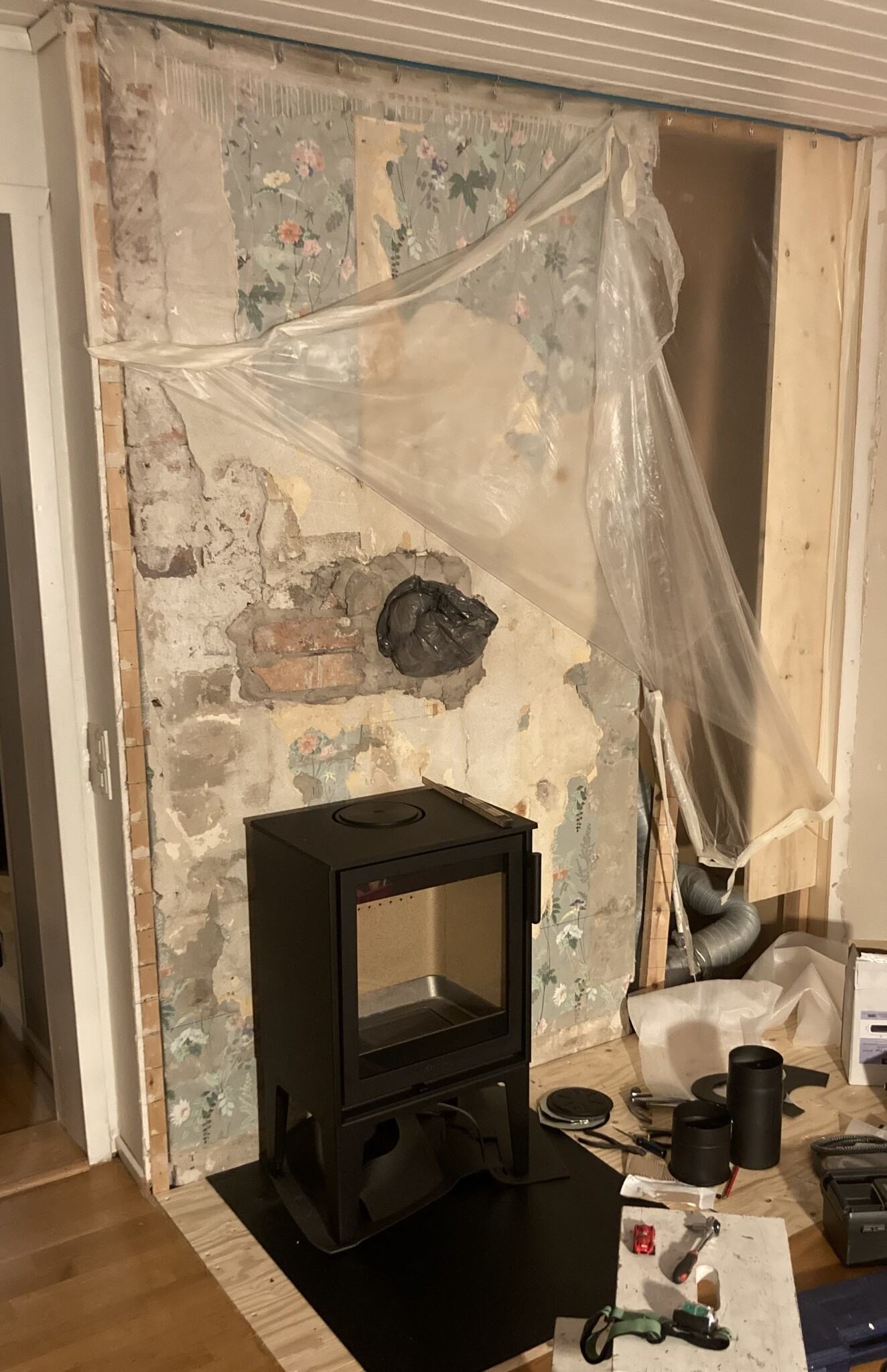


The classic choice is lime mortar if everything is built and plastered with it.
But many have probably used KC-bruk C and it has worked well over the years. In theory, cement doesn't like heat as lime does. But I wonder if it makes a difference in practice for a chimney on a small house.
EDIT: Had to google a YouTube video about how concrete is lost to heat:
Seems it starts to micro crack at 300 degrees C. Lower than I thought.
But many have probably used KC-bruk C and it has worked well over the years. In theory, cement doesn't like heat as lime does. But I wonder if it makes a difference in practice for a chimney on a small house.
EDIT: Had to google a YouTube video about how concrete is lost to heat:
Seems it starts to micro crack at 300 degrees C. Lower than I thought.
Last edited:

Agree with the above. There is no reason to use a harder mortar than lime mortar, either around the flue pipe or as plaster on the fireplace. Refractory mortar is only needed if there is going to be a fire directly on the mortar, like inside an open fireplace.
Click here to reply
Similar threads
-
Hjälp, vilket bruk till denna mur?
Grund & Markarbeten -
Vilket putsbruk till sockel
Fasad -
Vilket bruk till baljan, menar grunden? Kalksten, hus från 1912.
Byggnadsvård -
Which mortar for repairing plastered interior walls (rendering)?
Building Materials and Construction Technology -
Vilket bruk till badrumsvägg/förberedelser innan tätskikt
Badrum