Hello!
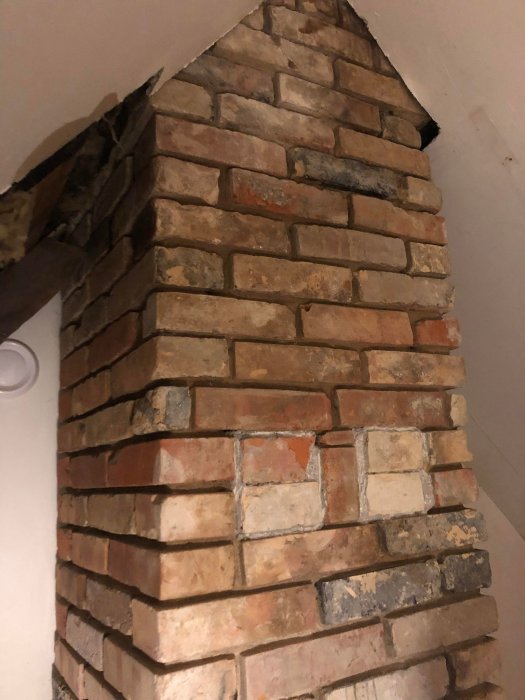
Since January, we have been living in an older house, a Skånelänga from 1865. In the middle of the main building, we have a chimney (not in use) which is currently plastered and painted. Now the plaster has started to peel on the visible part of the chimney (up in a loft). The rest of the chimney is built-in behind drywall, making it inaccessible for inspection. We have potential plans to chip off all the plaster on the visible part and let the brick show.
Now to the problem:
The joints between the bricks fall apart just by looking at them, so they need to be fixed somehow. The question is, what were they mortared with before and what type of mortar do you think would be suitable to use again? It almost looks like dried clay/sand when you look closely at it.
You should use lime mortar. Hydraulic is usually what is available from dealers and it works well. Lime mortar, unlike cement, never becomes rock hard. You can shape, smooth, and brush with a wire brush even when it is dry, and old mortar, as mentioned, crumbles very easily. Perfect mortar if you are inexperienced because it can always be corrected and worked on afterwards.
How much of the old joints do you think needs to be removed and will the lime mortar adhere to the old crumbly mortar?
I've never worked with lime mortar before, so it feels promising that it is "forgiving" and easy to correct afterwards. You mention that it's easy to brush with a steel brush, does the lime mortar dust when it's cured? Is it possible to use some form of dust binder to treat the brick surface later? I would prefer it not to dust later on.
It's very easy to scrape out, so put out a few cm so it's not too thin. It sticks well enough if you vacuum and wet the stones a little where the mortar will go. Then it's just a matter of "slathering" on.........lime mortar is nice to work with and, as mentioned, can be adjusted afterwards as well. Hydraulic mortar becomes slightly harder than pure lime mortar, so it won't dust or cause issues once it's dry. Bauhaus usually has Hydraulic from Combimix.
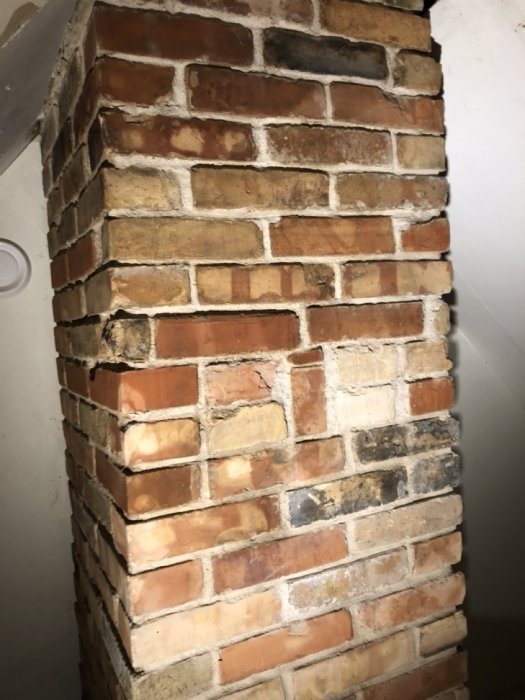
Tomorrow it's time to grout! (things take a bit of time when you have small children) After much effort, we have managed to remove all the plaster and scraped out the joints. It was quite a mixture of different mortars and it was incredibly dusty, but now it's gone. It's clear that it's been patched up in rounds over the years and some parts of the log aren't particularly nice, but the hope is that new joints, a thorough wash, and surface treatment of the brick will work wonders for the end result.
Phew, we're not doing this again, but at least the joint is in place now! The angle between the sloped roof and the chimney made this part somewhat of a challenge, and we're not quite sure how the joints look up against the sloped roof since it was hard to see what the heck we were doing.
It took a bit more than 1 bag of Weber hydraulic lime mortar. Relatively easy to work with, and I have to agree that it was quite forgiving since we could press and shape the joints for quite some time after application (and even now after it has dried). We had to pre-water quite a bit since the chimney was really dry, which also made us extra careful to keep it moist afterward.
The bricks have also been cleaned multiple times with water, dish soap, and steel wool. Some still look a bit dull, and the idea is to try using descaling agent tomorrow. If that doesn’t work, the last resort would be to use hydrochloric acid, which we'd like to avoid given that it's indoors and we don't have the best ventilation options up in the loft.
The next step is to clean up all the dirt that's ended up on the floor and then oil it with concrete oil.
Click here to reply
Vi vill skicka notiser för ämnen du bevakar och händelser som berör dig.