Hello,

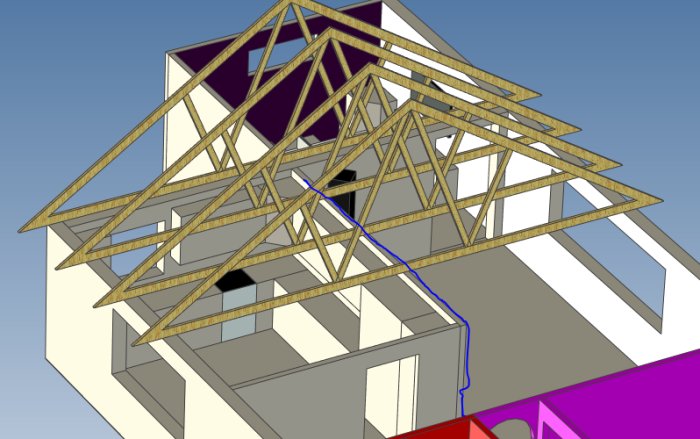
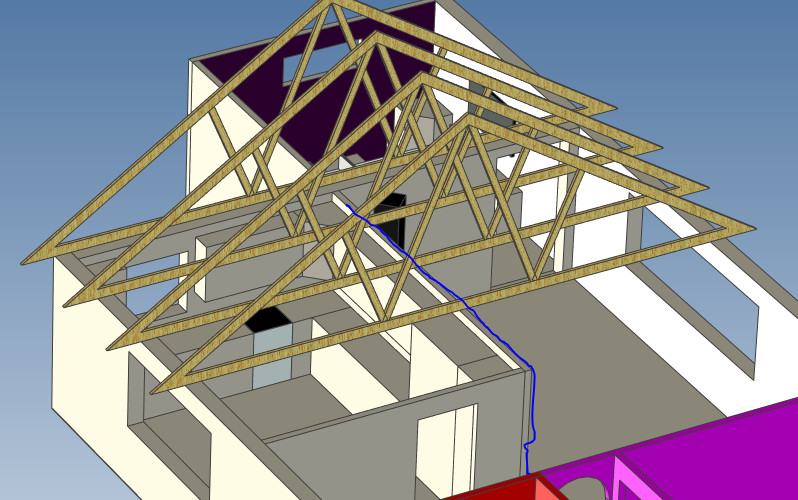
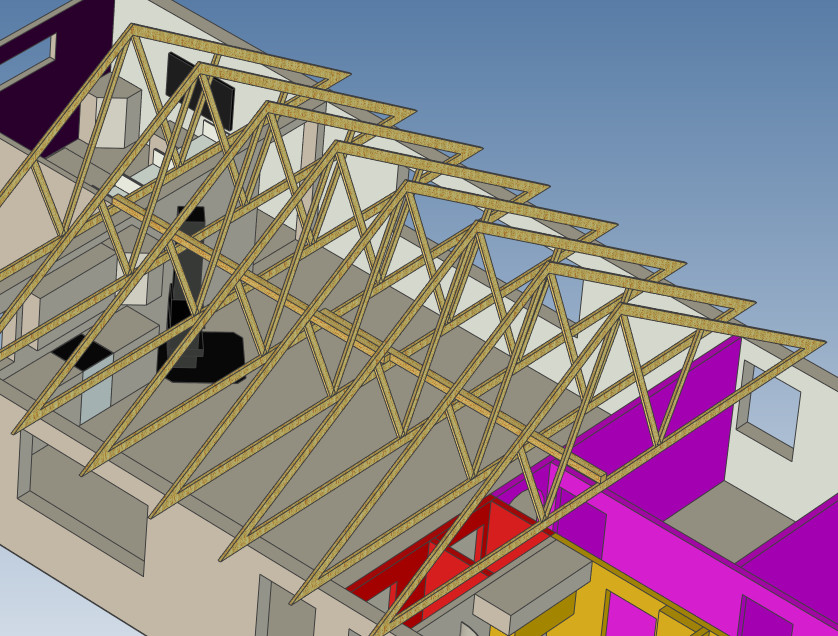
I would like to remove the wall between the living room and the kitchen. See the wall marked in blue below.
Drawing of a house interior showing roof trusses and interior walls, with highlighted section indicating a wall to be potentially removed.
My initial thought is yes, it's load-bearing, but looking at how the house is built, I'm uncertain.

It's clear that the house was built as an open shell since the panel ceiling was nailed before the interior walls were constructed.
This means that there was no support for the roof trusses (where the wall stands today) while the ceiling was being nailed.

Regardless, I feel uncertain and would like to ensure that the roof trusses are well-supported so that the house doesn't collapse in the middle. :)

Suppose I remove the wall, can a glulam beam be attached above the roof trusses to provide support?
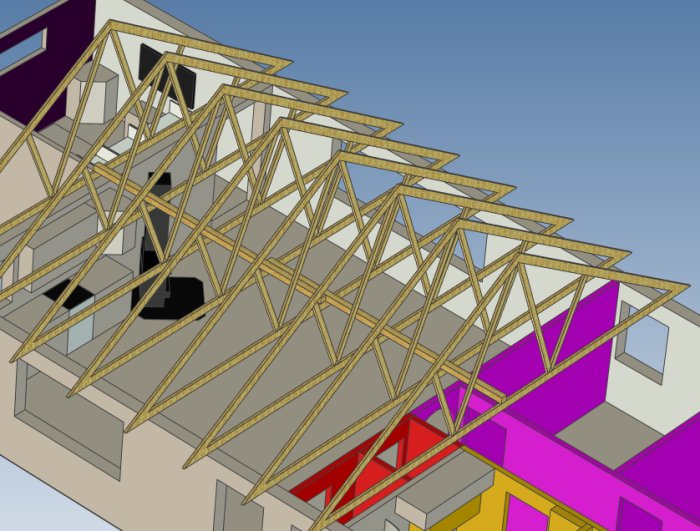
Wooden roof trusses diagram showing construction detail; part of a discussion on wall removal and structural support in home renovation project.

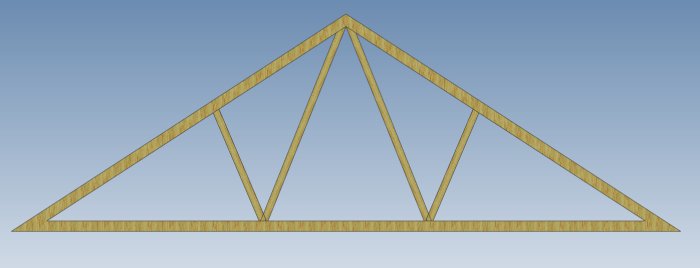
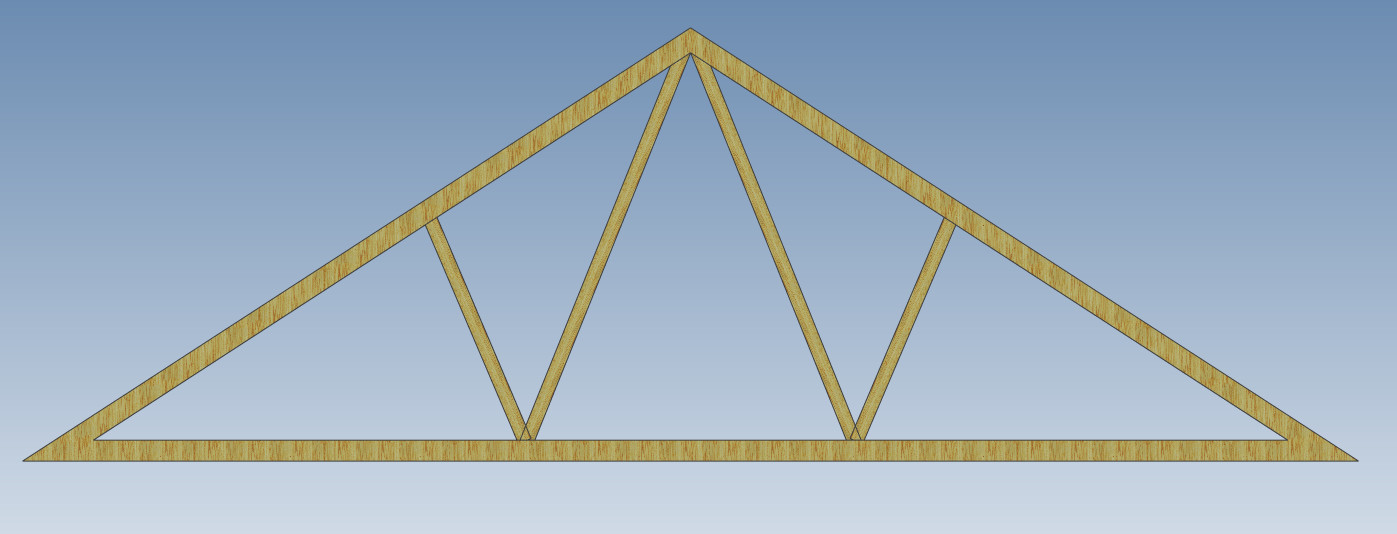
The roof trusses essentially look like the one below
Drawing of a wooden roof truss with a triangular shape, vertical and diagonal supports, set against a blue gradient background.
 
S
What kind of span is it? How would a glulam beam on top of the rafter provide support, you mean underneath as a carrying beam?
 
  • Like
Dusty_Roads
  • Laddar…
S scorp1on said:
What is the span? How would a laminated timber beam on top of the truss provide support, you mean underneath in the form of a transfer beam?
The house is about 7m wide.
Of course, I mean underneath, haha.
 
S
  • Like
Dusty_Roads
  • Laddar…
The depicted truss is generally self-supporting and correctly sized, no underlying walls are needed. This type is useful for spans up to about 12 m before the timber dimensions become too bulky, so 7 m is nothing special. My initial impression is that no interior walls are needed at all.
 
  • Like
Jonny Hylander and 3 others
  • Laddar…
S scorp1on said:
7 m is quite a long span, but it depends on the dimensions you have on the rafters. You have some guidance here:

[link]

Using a secondary beam depends on how the walls that the beam will rest on look, whether they are load-bearing or not.
The rafter on that page looks exactly like mine. Mine are in dimensions 45x95mm.
 
I had a similar situation. To avoid taking a chance or involving a contractor, I just built pillars at each end of the opening to transfer the load to the underlying heart wall in the basement and then placed a big glulam beam on top of the bottom chord of the trusses, which I then hung each truss from. The house has not toppled now 15 years later.
 
S
D Dusty_Roads said:
The truss on that side looks exactly like mine. Mine are in dimensions 45x95mm.
That's not much of a truss, in my opinion. What kind of roof do you have, what's the c/c on the trusses, and which snow zone?
 
Click here to reply
Vi vill skicka notiser för ämnen du bevakar och händelser som berör dig.