Now our construction has run into trouble, and I hope you can help me solve it. We are building a lightweight concrete house, a two-family house with a pitched roof on the second floor (parts of floor 2 will be rented out), and of course, we have a building permit for it (the construction drawings were produced by our house builder).
The house builder usually builds single-family houses/ordinary villas, and now the walls, roof, and the frame of the intermediate floor in wood are in place. The point is that the construction company will neither furnish the upper floor nor insulate the intermediate floor.
Now the site manager has pushed back and demands that the intermediate floor must have a type-approved construction that ensures the Swedish National Board of Housing, Building and Planning's acoustic requirements are met. (Meeting the fire requirements is not a problem). Alternatively, a building acoustics consultant can approve a design.
The construction company is washing their hands of it and does not want to be responsible for producing a functional design or hire a sound consultant. The company claims that it would be solved "from above," not from the lower floor which they would furnish.
The problem is that they have built/are building a house that has a traditional floor structure for a single-family house, even though they knew it would become a two-family house.
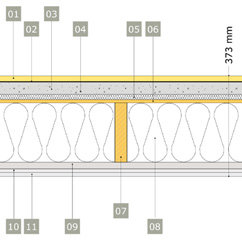
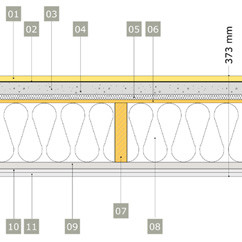
But now the floor is in place, and the question is which type-approved construction gives the most for the money, based on the possibilities available now. (45x220 mm wooden beams, one layer of gypsum on the ceiling mounted without so-called spring suspension. An additional layer will be installed there.)
We are thinking of insulating with Paroc eXtra stone wool between the beams.
But the question is which finished, type-approved construction we can use (by insulating upwards). On Träguiden there are two examples that might work (I guess these are considered type-approved), Casa Nova from Denmark (with 20 mm rigid mineral wool, and then 45 mm battens with sand/gravel between.
Another example on the same page is Vik from Finland http://www.traguiden.se/TGtemplates/PageTwoColumn.aspx?id=5408
According to a report from Chalmers, the method using sand in the joist that is used in Casa Nova may have problems. Sand tends to move toward the sides and compress in the middle (see page 11 and page 21). However, the problem can be solved if it is divided into cells and studs, as described on page 21 - but it is said to be an untested method.
Another alternative could be to pour cement on top of the wooden beams. But then, of course, someone has to calculate whether the joist can handle the weight. In the report (page 14) I mentioned, such a solution is presented. Such a floor increases the weight of the joist, which improves the good sound properties, and additionally, it is laid floating, easy to perform, and the materials are cheap. The beams in the example are sturdier than my 220x60. A benefit of pouring cement would be that I could then lay the underfloor heating pipes in it!
Click here to reply
Vi vill skicka notiser för ämnen du bevakar och händelser som berör dig.