Hello!
I'm not sure if this question is placed in the right section of the forum, but I'll try here.
I am a newly graduated construction engineer with very little practical experience. I have just bought a house with my partner and in a few months, we will start renovating.
One of the things we're going to do is tear down a load-bearing concrete wall to improve the layout and the feeling when you step into the home. I have looked around a lot on this forum and other sites on the internet, consulted my contacts in the construction industry but I still have questions and thoughts...
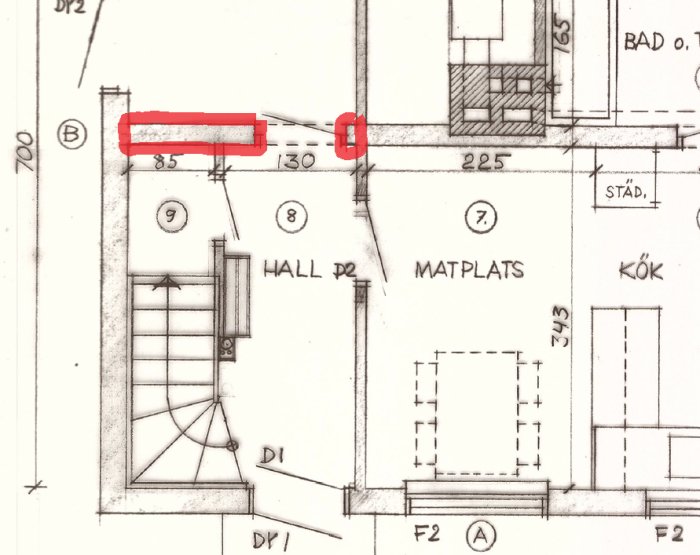
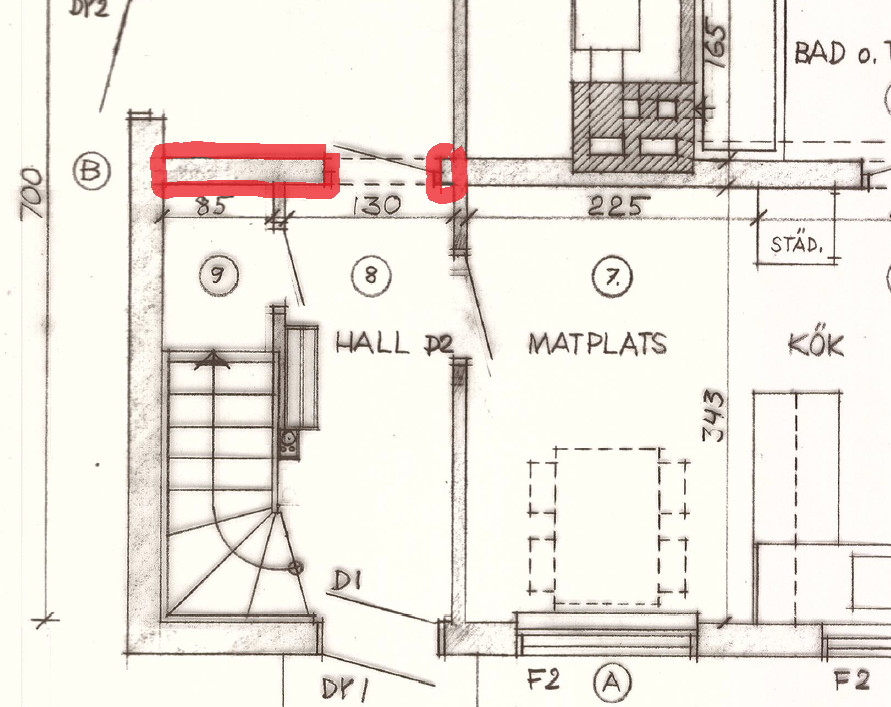
The wall to be demolished is the one marked in red on the picture.
I've talked to my municipality and a building permit is not needed but a building notification is required, and I'm not entirely sure but I assume some form of construction drawing with load-bearing calculations is needed? (Like frame-analysis.)
I could actually do this myself, but would you who have experience recommend using a more experienced designer or do you think the municipality would accept me as the KA myself?
Once the construction drawing is done, is this a task I can manage myself with the right tools? Or should a professional hole-drilling company be hired?
Are there cases when you don't need to brace?
If one is to brace and reinforce afterwards with a beam, can someone explain a bit more thoroughly how this is done? Right now, I'm not quite getting the picture...
If it were a wall with wooden studs, I would be more "in the game," but when it comes to concrete, I'm unsure of how it works at the different contact surfaces.
Apologies for a vague post with many questions, but I hope you understand what I'm after and can answer some of it at least
It feels a bit strange to have a concrete wall on the ground floor of a small house, which is also not particularly old. There must be some explanation for it. What does it look like on the next floor and how is the floor structure executed?
The house is from 1960. The wall feels rock-hard and unyielding when I knock on it. I actually don't know what the bjälklag is =0
I've been told that it's concrete, but I can go there and cut a bit to see what it actually is... Maybe I should have done that before writing the post ^^
Judging by the hatching on the drawing, it is not concrete. Rather, it’s aerated concrete or brick. Take the opportunity to check the floor above at the same time. It is important for choosing the appropriate measure.
Judging by the hatching on the drawing, it's definitely not concrete. More likely lightweight concrete or brick. Make sure to check the floor structure above at the same time. It is relevant for the choice of appropriate action.
Okay!
Thanks for the tip! I'm going there next week, so I'll take a look at it then and update!
Now I have checked, it's solid concrete in the wall and no electrical wiring in it either.
So, to the question again, how does one do this?
Remove the wall in the best way, and then you have 3 beams that you put up? 2 vertical and then one that lies on top of these 2 standing?
How would you do it?
Damn it, I forgot to check the beam structure like you asked me to when I was there.....
Above is a non-bearing wall anyway.
I've been searching around the internet a bit now trying to figure out how to find out how the beam structure is constructed, but haven't found anything good. How do you do it? Hole in the floor? (not an option) Remove a skirting board or floor piece?
Regards,
Sussens
I have spoken with an engineer, been there and checked under and in all the walls and joists.
I have done calculations on the load effects and reactions, spread over 1920 which the opening will be. HEA 160 can handle this with a good margin. I understand how I should do it but I'm wondering quickly really about how much concrete the beam needs to rest on at the ends?
I will cut out the opening in the concrete, then saw a small piece on top of the sides where I will then place the beam, but how much should I notch out? Is 160mm enough?
I can send pictures and drawings later, I'm in an awkward position right now but wanted to write and ask before I forget! hehe
Are you really sure that it is cast-in-place reinforced concrete in the walls? I find it very hard to believe. If so, it would be as cold as a grave in the rooms. Concrete hollow blocks sound more reasonable in that case.
No, you are absolutely right! It is masonry stone that then has "laid" concrete on it, or whatever you say. But it doesn't affect the load-bearing capacity or construction =)
It just makes it a bit easier to tear down
how much concrete is needed for the beam to rest on at the ends?
I will cut out the opening in the concrete, then saw out a small piece at the top on the sides where I will then place the beam, but how much should I notch out? Is 160mm enough?
Take down the entire wall and place the beam on something like VKR 100.
It will be cheaper than the notching and requires less space.
If the wall had been concrete, then 160 support would be enough.
With hollow bricks, I wouldn't dare to guess.
Take down the whole wall and place the beam on, for example, VKR 100.
It will be cheaper than the notching and requires less space.
If the wall had been concrete, a 160 support would have been enough.
With hollow blocks, I wouldn't dare to guess.
That's what I was thinking of doing first, but I don't quite understand how to "connect" the beams to each other and the stabilization down and into the wall. Should the beams be welded together?
I understand that it takes up less space, but why does it become cheaper? =0 Then I have to buy more steel.
No, you are absolutely right! It's built stone that has then been "covered" with concrete, or whatever you might say. But it doesn't matter for the load-bearing capacity or the construction =) Just makes it a bit easier to demolish
Probably plastered then?
Have you started to think about how you will go about demolishing it?
Vi vill skicka notiser för ämnen du bevakar och händelser som berör dig.



Jarlingar said: