
2,246 views ·
8 replies
2k views
8 replies
Switch load-bearing wall for opening
Hello, we are in the process of opening up a load-bearing wall to a width of 120 cm. I spoke with a structural engineer who came home and checked it out, and he said that opening up such a small amount wouldn't be a problem as long as a slightly larger beam, like 45x145, is used. Now, the carpenter here wants to place 4 horizontal 45x70 beams resting on top of the old studs. He says it will hold without a problem and that you avoid having to notch 45mm at the top of the studs to fit the 45x145 beam. I'm asking here because, in my limited knowledge, you should always choose to mount them vertically? Since they're much sturdier that way but I would like this confirmed elsewhere before I discuss it with the carpenter. I have uploaded two pictures that explain a bit more about the different methods I'm talking about.
Best regards,
Jesper Karlsson
EDIT: I noticed the pictures turned out tiny, but they might still work.
Best regards,
Jesper Karlsson
EDIT: I noticed the pictures turned out tiny, but they might still work.

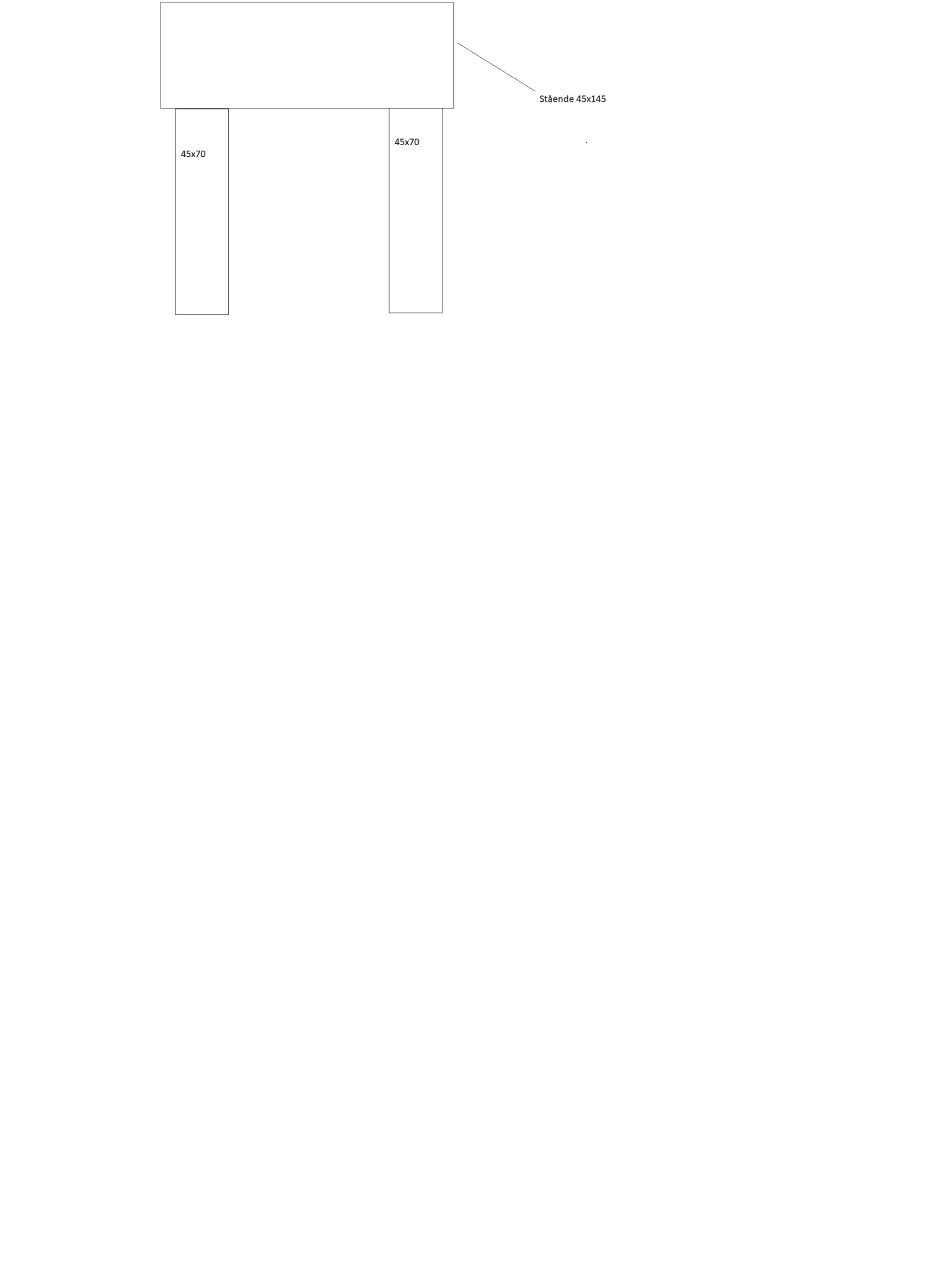

Four 45x70 on top of each other are worse than one 45x145 in load-bearing capacity if not glued together.
It's a bit frustrating when carpenters play at being designers "just because it doesn't fit." If they want to make a change against what a designer has specified on a drawing or verbally, they ought to consult the designer - they can't just place it on the customer who lacks the knowledge! Sigh!
Good that you're asking, very sensible!
Good that you're asking, very sensible!
Hello and thank you for your answers!
A little clarification to my question that I thought of after Justus's post. The carpenter intended to screw-glue the horizontal timbers.
But if I turn the question around, can 4 screw-glued 45x70 on top of each other be better than a standing 45x145 in any way? He mentioned that then he wouldn't have to notch out 45mm from each timber and could place them on top of the beams and just cut them shorter.
This is a carpenter with long experience, so I want to believe that he knows what he's doing.
Best regards,
Jeppe
A little clarification to my question that I thought of after Justus's post. The carpenter intended to screw-glue the horizontal timbers.
But if I turn the question around, can 4 screw-glued 45x70 on top of each other be better than a standing 45x145 in any way? He mentioned that then he wouldn't have to notch out 45mm from each timber and could place them on top of the beams and just cut them shorter.
This is a carpenter with long experience, so I want to believe that he knows what he's doing.
Best regards,
Jeppe
It's nice to hear that he seems to know what he's talking about, even though the decision shouldn't end up on your desk, unless it's to take it further to your constructor, that is.
As a constructor, you want to know what is actually being built since you have a responsibility to ensure things hold up - so you can sleep well without worrying that something might collapse because someone thought it would be better with a different solution without perhaps seeing the big picture. It probably isn't the case in your situation, which is comforting
If they are screw-glued, I would feel at ease, then you get 70x180 instead of 45x145. It doesn't become exactly like a solid beam, of course, but you do get good synergy between the joists, at least. Justus might know what screw-glued is usually equivalent to?
As a constructor, you want to know what is actually being built since you have a responsibility to ensure things hold up - so you can sleep well without worrying that something might collapse because someone thought it would be better with a different solution without perhaps seeing the big picture. It probably isn't the case in your situation, which is comforting
If they are screw-glued, I would feel at ease, then you get 70x180 instead of 45x145. It doesn't become exactly like a solid beam, of course, but you do get good synergy between the joists, at least. Justus might know what screw-glued is usually equivalent to?
Thank you for all the answers; now I have a bit more knowledge when I talk to the carpenter on Friday.
It would be fun to see how he manufactures these "balkar"; it surely requires a substantial screw to reach 180 mm thickness.
Best regards,
Jeppe
It would be fun to see how he manufactures these "balkar"; it surely requires a substantial screw to reach 180 mm thickness.
Best regards,
Jeppe
If you split a log into four parts and screw-glue them together, the result becomes stiffer than the original log. You can get an idea of the improvement by looking at laminated wood. The composite beam has a significantly higher modulus of elasticity than the individual parts.
Thanks for the information!J justusandersson said:
Can this be credited even if it's not done in a controlled environment, like in the production of glulam?
Yes, I think so, to a reasonable extent. The screws replace clamps and they have their limitations.
Click here to reply
Similar threads
-
Shifting a load-bearing wall
Building Physics -
Switch load-bearing wall with 95mm studs.
Building Materials and Construction Technology -
Shift load-bearing wall between kitchen and hall
Building Materials and Construction Technology -
Växla av en bärande pelare/vägg
Lösvirke & Timmerhus -
Calculation shifting of load-bearing wall
Building Physics