Was supposed to hang a heavy mirror on the wall in the hallway today. The mirror should be attached at both the bottom and the top.
After marking the holes at the bottom, I drill the first hole to insert a plug which goes well. Then with the second hole, it stops after 15 mm. Shining a flashlight reveals metal inside. Tried moving the hole up, down, left, and right. Everywhere I encounter the same metal obstacle.
So now I have about 10 holes in the wall, so the mirror just has to go up to cover the terrible wall.
What do you think I've encountered?? The wall is in the hallway and is an exterior wall. Can I just use a metal drill and drill through the metal or could I damage something essential?? Could it be electricity, water or something similar??
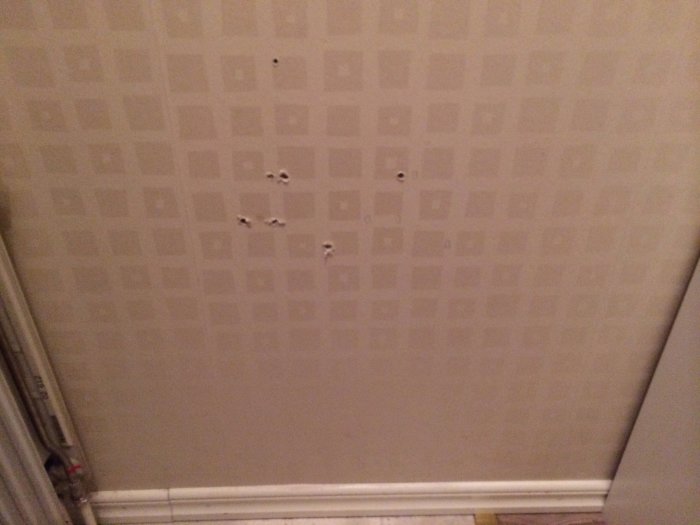
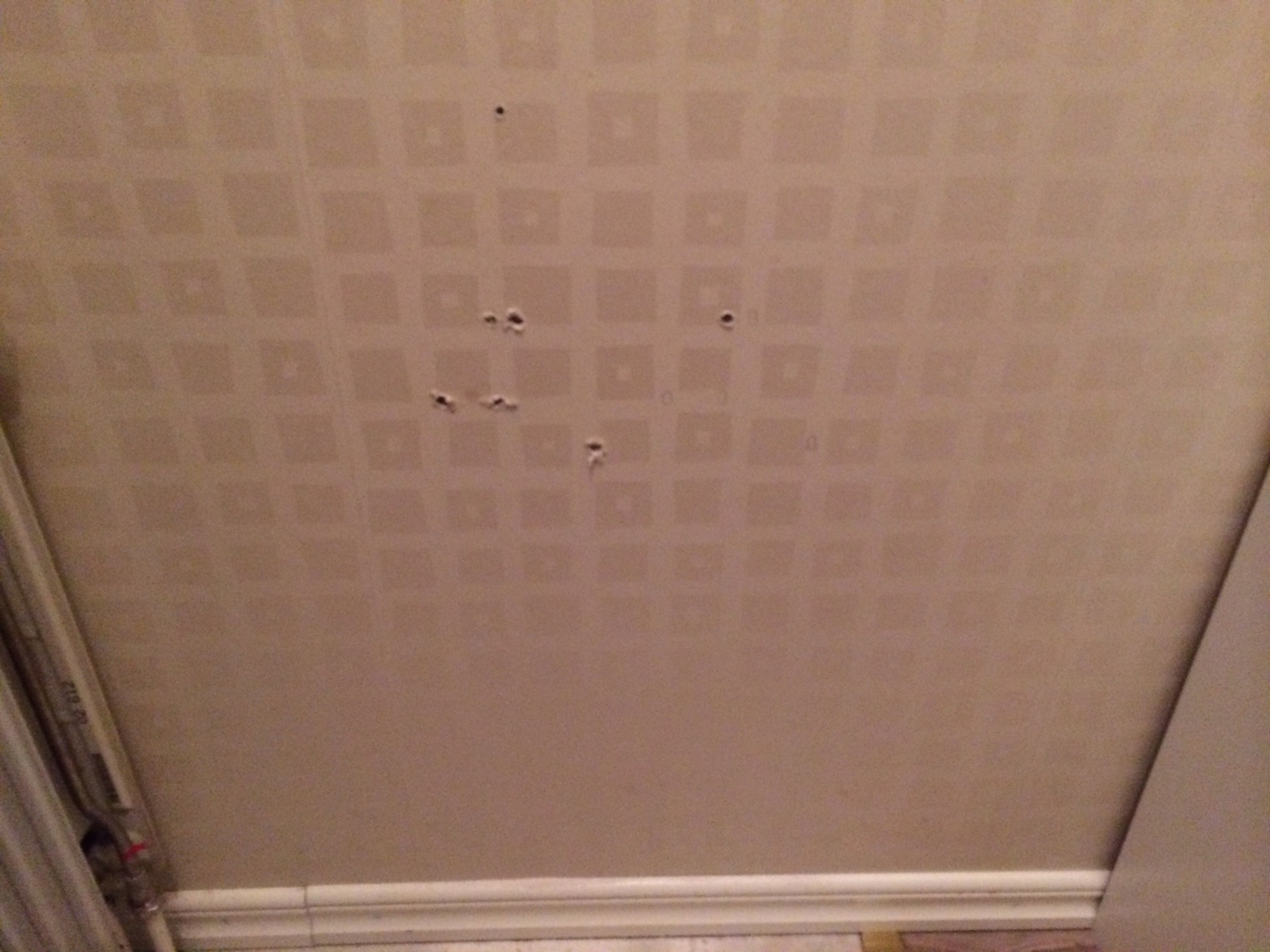
This is how the wall looks now
All holes except the one furthest to the right get stopped. (Yes, I was born with two left feet and am doing my best)
I don't know how wide it is. But at least 10 cm
I assume based on the fact that it's so far between the holes farthest from each other and it still hits the metal.
If there is metal behind all those holes, it might be that you have a sheet metal which is a burglar protection in the wall. The sheet metal is in that case approximately 1mm thick and can be used to attach the mirror with sheet metal screws.
If there is metal behind all those holes, then you might have a metal sheet that is a burglary protection in the wall. The sheet is then about 1mm thick and is for attaching the mirror with sheet metal screws.
Aha: Do people install that against, for example, stairwells etc. today?
If it's against the stairwell, a metal sheet is reasonable. Congratulations in that case, because with assembly screws for metal, you'll get incredibly good anchorage.
It is NOT likely to have such sheet metal in a typical house. Find out what kind of metal it is before you continue drilling.
Actually, it is common against, for example, stairwells and other tenants in multi-family buildings and premises with drywall against these spaces. A 0.8 mm sheet metal mounted innermost against the apartment (should always be innermost) usually provides protection class 1 and is sometimes required by insurance companies against these spaces. So you might find it here and there actually.
Exactly. I live in a townhouse, and we have the house on the very edge, and the wall is against that outer wall. In other words, on the other side of the wall is our lawn.
But it IS not a stairwell and not an apartment, read what TS writes!
Touchy?
This is what TS writes:
"The wall is in the hallway and is an exterior wall."
"We live in a house"
Most people live in a house whether it's a rental building, condominium, villa, farm, castle so some form of house and I don't know which but obviously you do
Not touchy, but a little irritated by people who can't understand written text. A wall against an outer wall in a hallway is NOT a wall in an apartment against a stairwell, then it’s not an outer wall.
And if to the statement "such are in stairwells in apartment buildings" someone replies "we live in a house" it means in plain Swedish "No, we don't live in an apartment."
Above all, I'm irritated that you're teasing the OP when you insist on harping about apartments. In my opinion, it’s very unpleasant to point out to the OP that you believe they’re unclear by deliberately choosing to misinterpret what they write as "it COULD be an apartment she's referring to if you really stretch what’s written.”
Stop fooling around.
Assume it's a water pipe, but you continue to harp on about your burglary protection and how it will adhere extra well, then you’ll be responsible for the water damage that occurs if they choose to drill through the metal. You realize that, right?
So no, I'm not touchy, but I don't want the OP to embarrass themselves, as it’s actually more likely to be electricity, water, or sewage and NOT burglary protection. Could it be the back of the electric cabinet?
It could be that the installation layer has been built with metal studs instead of wooden studs in your case. Such a metal stud is usually as wide as a wooden stud, i.e., 45 mm. Sometimes, two may have been placed next to each other for some reason, which could explain the 10 cm wide metal sheet for you.
It's hard for me to think of anything that would be damaged by drilling through. If you want to be completely sure, you could cut a large hole to see better (large hole = e.g., a junction box for electrical fittings = 70 mm round hole). Considering you want to hang a mirror there anyway, I mean...
Vi vill skicka notiser för ämnen du bevakar och händelser som berör dig.