
1,652 views ·
3 replies
2k views
3 replies
Soundproof Wall - What Can I Tear Down?
Inspired by post #11 in this thread, I want to soundproof the wall between the kitchen and the bathroom. My plan was to replace the chipboard on the kitchen side with double gypsum mounted on its own 45x45 studs, shifted a few millimeters from the bathroom board. Making the wall thicker is unfortunately not an option on the table, as we need the kitchen space (aware of the compromise with the final result).
When I tore down the kitchen side, I found a bunch of "kortlingar" with dimensions of 45x145, which complicate matters for me. Ideally, I want to remove or notch them to more easily be able to frame the kitchen wall, but I'm uncertain about what purpose they really serve. Will I destroy any desired property of the wall if the kortlingar are removed or notched?
/Patrik
When I tore down the kitchen side, I found a bunch of "kortlingar" with dimensions of 45x145, which complicate matters for me. Ideally, I want to remove or notch them to more easily be able to frame the kitchen wall, but I'm uncertain about what purpose they really serve. Will I destroy any desired property of the wall if the kortlingar are removed or notched?
/Patrik
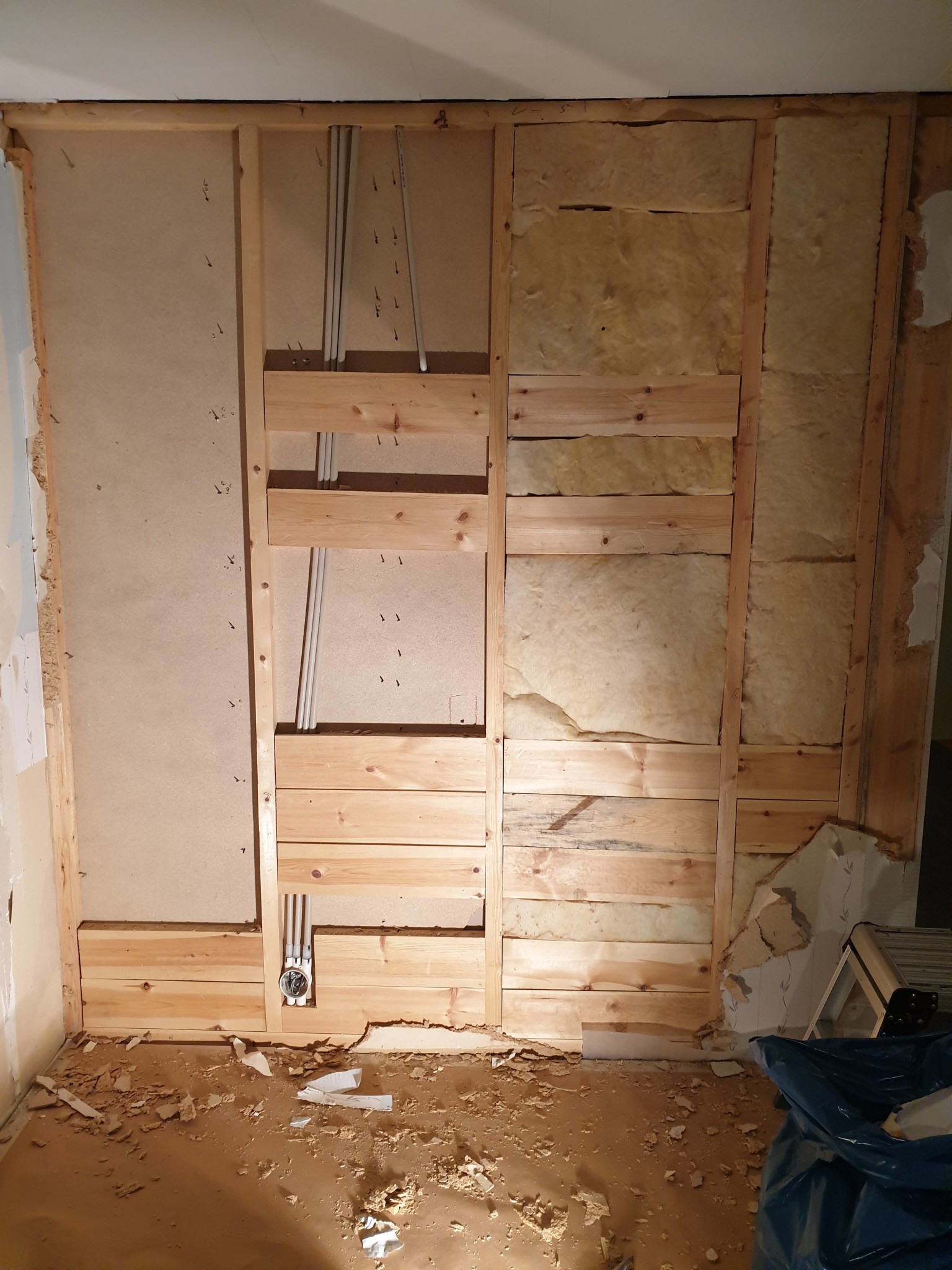

Constructing double frameworks that are independent of each other is an established method for soundproofing. Normally, it is better to use insulation with greater volume weight than fiberglass. I guess the noggings are there to allow kitchen cabinets to be hung at different heights. It's not a completely modern house, is it?
Exactly, the house was built in 1980. It's a reasonable hypothesis, I assumed that the kortlingar were intended as fasteners.
Regarding the insulation: the wall is quite thin (45-reglar). Is it really worth choosing a "heavier" insulation? Will the difference beyond double gypsum, separate studs, and airtightness still be noticeable?
Regarding the insulation: the wall is quite thin (45-reglar). Is it really worth choosing a "heavier" insulation? Will the difference beyond double gypsum, separate studs, and airtightness still be noticeable?
When you have to fill the space between the studs (as with 45 mm), I believe it is better to use insulation with a greater volumetric weight than glass wool. Keep in mind that different types of measures are required for the sound insulation to be effective across the entire frequency range.
Click here to reply
Similar threads
-
Ny fasadbelysning, problem med kablar/mellanrum lampa-vägg.
Belysning -
Align outer wall with blocks - how?
Building Materials and Construction Technology -
Oisolerade innerväggar - ljudisolera?
Isolering -
Soundproof wall 70s house
Building Materials and Construction Technology -
Ljudisolera väggar -08
Isolering