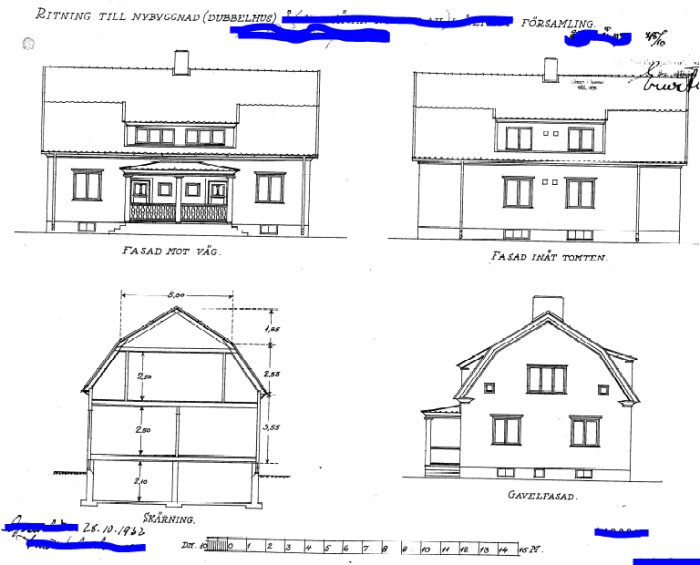
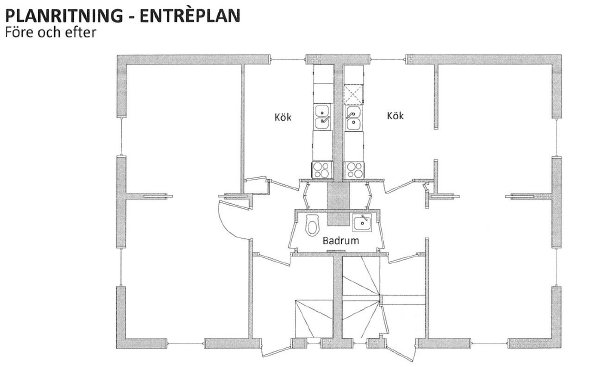
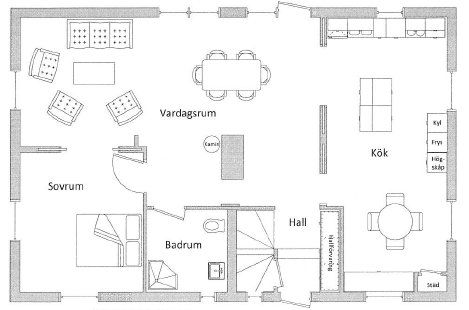
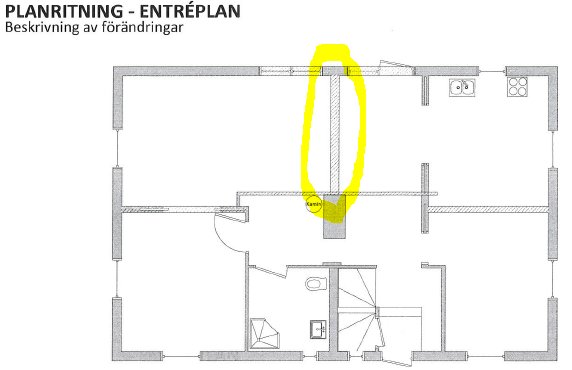
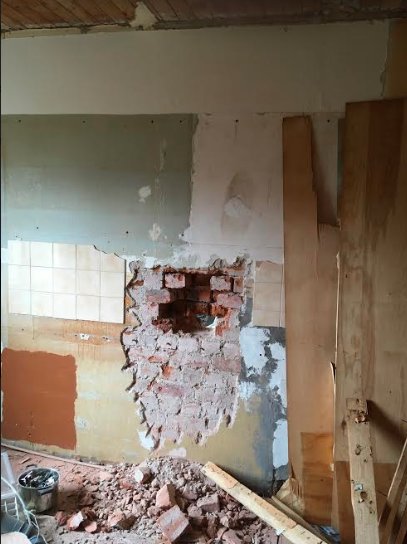
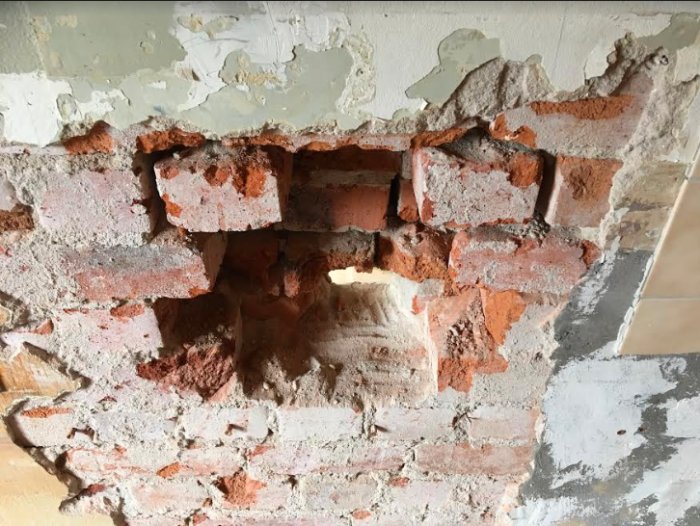
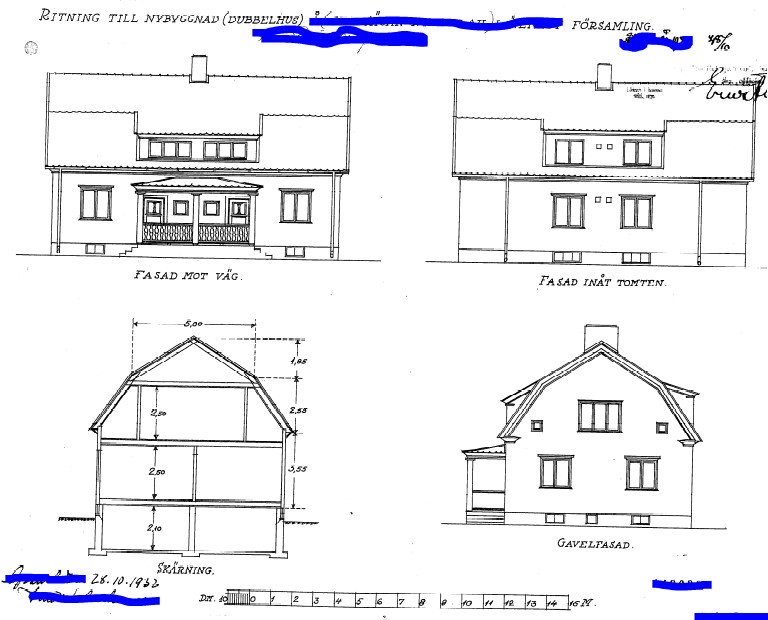
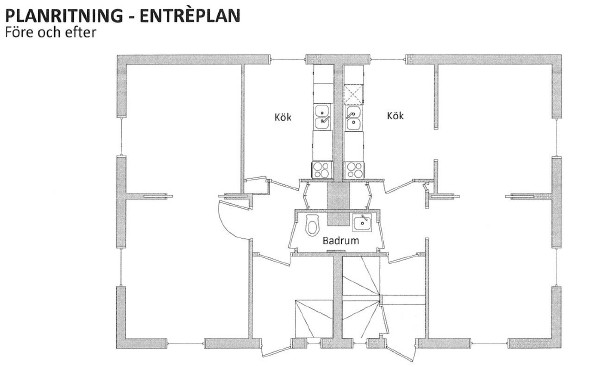
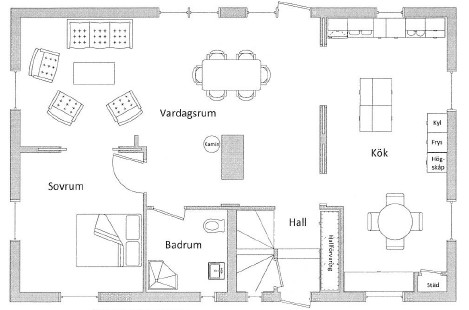
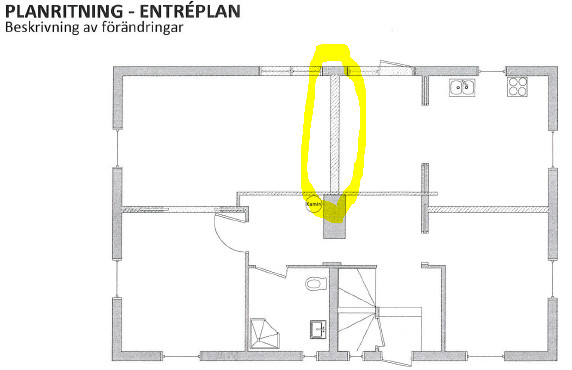
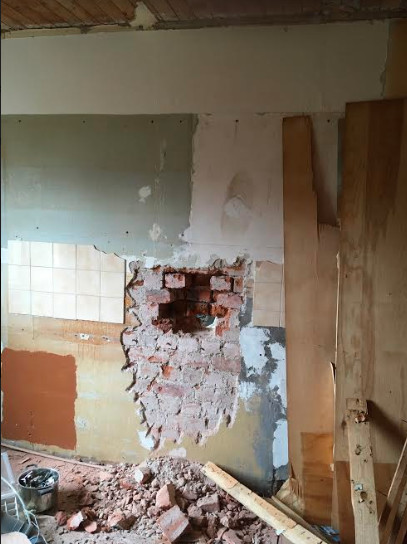
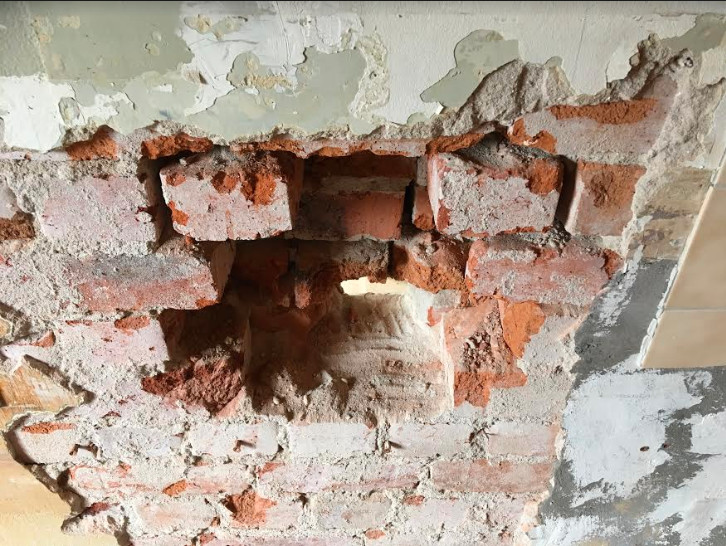
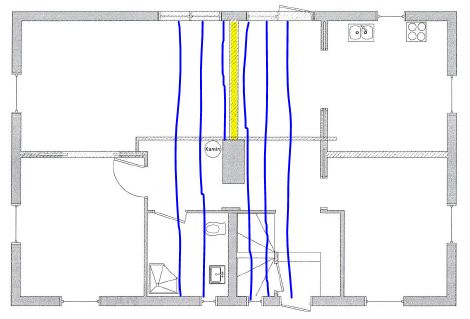
I am wondering how to practically go about removing a brick firewall between two rooms. The firewall divides the entire house and extends all the way up to the roof ridge. The floor structure between the entrance floor and the upper floor runs along the firewall and is attached to it. The wall naturally weighs quite a bit. According to the pictures, we are in the process of changing the layout of the entrance floor in our two-story house with a basement. According to the approved building permit, a steel beam will be placed there.
The opening should be as large as possible (the entire wall between the rooms should be removed). Leaning towards getting help with the support but would like to do much of the demolition on my own before, if possible. However, I don't want to hinder those who will carry out the support. I don't know if they want the wall to remain and install the beam before the wall is demolished? I haven't contacted any company yet. Is it a regular construction company that's needed? Can "everyone" handle that? Tips on how I can proceed? How much brick is safe to remove now? Grateful for any thoughts!
You don't want anything to collapse or settle. Buy props and sturdy beams. Remove the ceiling where you place these. It should be very tight. Depending on how the floor structure looks, you may need to set them on both sides if it's joined on the wall. Make sure there is space to work between the props. You save many nice thousands by tearing it down yourself. I did something similar a while ago. But I let a firm put in the beam to be sure of getting insurance money if something goes wrong.
Hi!
The crux of the matter here is that the beams run along the wall that needs to be removed, so it's not quite like a traditional load-bearing wall. The masonry wall that needs to be removed is load-bearing in the sense that it is a framework in the middle of the house. This wall runs continuously from the basement floor to the outer roof. I understand what you write about support against beams that are nailed into the fire wall, but how do I ensure that the masonry wall doesn't collapse when I chip away the brick...?
Not entirely sure I understand what you're trying to achieve. Weren't you supposed to remove the wall? A simpler drawing might help?
However, it's important that the bracing is tight. Tight at the top and tight at the bottom. There could be a lot of load coming down. I don't know what it looks like at your place, but it's a bit unfortunate if floors start tilting slightly on upper floors. You also seem to have some beam structures above there. If you also have a masonry/plastered facade, I would be meticulous about keeping it tight. Preferably not even a mm!
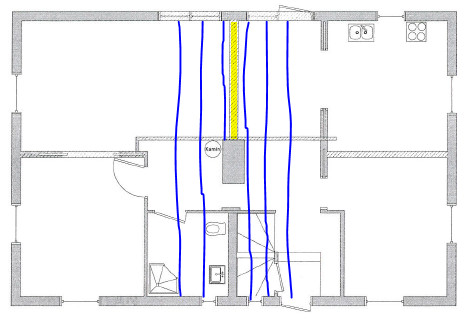
Sure, the wall on the entrance floor is going to be removed, and it's the part of the wall above that I'm worried about. A beam needs to be installed so the wall doesn't settle/collapse "from the upper floor." As mentioned, it runs as ONE from the basement all the way to the roof. Firewall. The house used to have four apartments. Usually, the joists above run perpendicular to the supporting wall that is to be removed. In this case, they run parallel. You could say it's the wall's own weight that's the problem. How do I practically get a beam in place? Supplementary sketch:
The blue is the joists. The yellow brick wall is to be removed.
Practically speaking. Two vertical beams, either steel or glulam. One closest to the wall and one where I believe is the chimney stack? The load-bearing beam will rest on these. There are no specified measurements, but if you want as "slim" a solution as possible, you need to use steel. Otherwise, glulam works, but it will, of course, be significantly wider. It depends a bit on how far it is. But you have quite a lot of weight coming down there from what it looks like!
It's possible to use the existing outer wall. However, it is fully occupied handling the load from the roof. And I'd probably avoid the chimney stack.
You place the struts on both sides of the wall. Use "large size strength" timber across the blue on both sides of the wall. So you need four props on each side. I would take six. The load from all the floors above will mostly go down in the blue beams closest to the wall. So, it is critical that it doesn't move. The question is whether you can support just the studs closest to the wall. But, I don't know if you'll have room to work with the new structure then. Maybe it gets tricky and tight? But it would really ease things if it worked.
If you're the least bit unsure, get help. You don't want anything on your head. Just saying. Now, I don't think it will collapse, but it's sensible to be a bit cautious when it's heavy.
Hmm, what you mean is perhaps that the brick wall looks the same on the upper floor? You simply remove the lower part of a huge brick wall that starts on the first floor and continues on the second floor? In that case, I have missed this.
If you're the least bit unsure, get help. You don't want anything falling on your head. Just saying. Now, I don't think it will collapse, but it's wise to be a little cautious when it's heavy.
SSideshowBobBuilder said:
If you're the least bit unsure, get help. You don't want anything falling on your head. Just saying. Now, I don't think it will collapse, but it's wise to be a little cautious when it's heavy.
Thanks!
I have a pretty good idea about supporting the (blue) wooden floor, but I think before installing the sturdy steel beam in the ceiling under the brick wall, I need to ensure the bricks don't collapse? I can’t demolish the whole wall without securing/supporting the brick wall itself?
Hmm, what you mean is maybe that the brick wall looks the same on the upper floor? You're simply removing the bottom part of a huge brick wall that starts on the first floor and continues to the second floor? If that's the case, I missed this.
Exactly what I mean! Great, now you're with me.
It goes from the cellar floor and doesn't stop until the sheathing under the battens So what I'm wondering is how I can secure the wall without it collapsing while I'm removing the bricks, so to speak...
Yes, the whole wall must be extremely heavy. Had I used your words "remove the bottom part of a brick wall," it might have been more obvious what I meant.
Wouldn't it be better to tear down the entire wall, from the raw plank down, so you avoid the beam and can do everything yourself.
FFixar_Krille said:
Wouldn't it be better to tear down the entire wall, from the raw plank down, so you avoid the beam and can do everything yourself.
Oh, well, that's not really something to consider. It might have been an option 10 years ago, but I partly think it serves a function in supporting the house with the chimney, etc., and furthermore, the upstairs is completely renovated.
Fiddly project. I don't know how you will completely avoid settling.
Make holes as close to the ceiling as possible "straight through the wall."
Insert steel studs (will become part of the construction when everything is done) that lie flush against the wall.
Support as before (across the blue) with the difference that you do it straight through the wall now. So a support on each side takes up the load for each steel beam. (It doesn't need to be particularly long, I suspect!)
Do the above in several places along the wall.
Tear down the wall and hope it holds.
Place vertical steel posts on the sides.
Lay a steel beam to replace the wall. This will lie on the vertical but under the steel cross braces you use for the supporting.
Cut away excess steel from the cross braces.
Not something you typically do yourself, I suspect. But there is a bit of "hope it holds" there in one spot once the wall is gone. You don't really know how the loads are carried down in the wall.
So you get a wall resting on steel. You probably need to do something more to secure the wall laterally.
Another thing. When you are tearing down walls made of wood that you're unsure of, you can insert a handsaw vertically and saw a little. If there's a significant load there, it will become very tricky to saw after a while. Then you know you've got something to deal with right there. But, I don't know how to handle a masonry wall.
I don't know how to usually resolve this kind of support.
You have an engineer who has calculated this, I assume? He should reasonably have an idea of how this should be executed?
One thought I have is to mill out the brick from both sides (but leave enough material in the middle for the wall to remain standing) and insert 2 L-profiles (one from each side) of steel. Then bolt them together. This way, the wall can be demolished when the reinforcement is complete.
Vi vill skicka notiser för ämnen du bevakar och händelser som berör dig.