
9,641 views ·
29 replies
10k views
29 replies
Rundown Skåne Longhouse, worth spending some time and money on?


Hello!
I'm not quite sure if this is the right forum section, but if I'm in the wrong place... please move the thread to the correct spot
I wonder if there is anyone who is knowledgeable about Skånegårdar/länga (the technique they were built with) and renovating them..?
I have been looking at a property that is quite run-down, but it's hard to know how run-down it actually is since some things are easier to fix than others (for example, if the paneling is ugly, the house can look awful, but it's relatively easy to replace the paneling..). Now it's more than panel replacement that is needed (they are mainly selling the plot for possible new construction..)
But I'm curious about the possibility of renovating what's there.. (if there is any)
I haven't been inside the main house yet but have checked the area around and a bit in the outbuildings. The house has been uninhabited for a very long time (and I don't know when it was built).. it's a so-called U-shaped Skånelänga.. with a barn and stable.. (around 380 square meters building area I think)... and I think the plot is nicely situated
I have some pictures, but I'm not quite sure how much I want to show here (it's not my house after all!).. I can upload them somewhere else if I find someone who is interested/knowledgeable about renovating Skånelänga and wants to help me with some knowledge
Personally, I think one of the wings should be completely demolished.. (half of the roof has already collapsed).. but the other two might have a chance... as I said, hard to know!
Well.. ANYONE who feels inclined to take a look at the pictures? Give their thoughts, tips, opinions? If it's worth "wasting" time and money on or if it's easier to tear everything down and build new..
Have a nice day,
Best regards, Sandra
I'm not quite sure if this is the right forum section, but if I'm in the wrong place... please move the thread to the correct spot
I wonder if there is anyone who is knowledgeable about Skånegårdar/länga (the technique they were built with) and renovating them..?
I have been looking at a property that is quite run-down, but it's hard to know how run-down it actually is since some things are easier to fix than others (for example, if the paneling is ugly, the house can look awful, but it's relatively easy to replace the paneling..). Now it's more than panel replacement that is needed (they are mainly selling the plot for possible new construction..)
But I'm curious about the possibility of renovating what's there.. (if there is any)
I haven't been inside the main house yet but have checked the area around and a bit in the outbuildings. The house has been uninhabited for a very long time (and I don't know when it was built).. it's a so-called U-shaped Skånelänga.. with a barn and stable.. (around 380 square meters building area I think)... and I think the plot is nicely situated
I have some pictures, but I'm not quite sure how much I want to show here (it's not my house after all!).. I can upload them somewhere else if I find someone who is interested/knowledgeable about renovating Skånelänga and wants to help me with some knowledge
Personally, I think one of the wings should be completely demolished.. (half of the roof has already collapsed).. but the other two might have a chance... as I said, hard to know!
Well.. ANYONE who feels inclined to take a look at the pictures? Give their thoughts, tips, opinions? If it's worth "wasting" time and money on or if it's easier to tear everything down and build new..
Have a nice day,
Best regards, Sandra
Don't know much about "skånelängor," but my dad completely renovated one (as much as it's possible) and it was a lot of work. The climate down there is quite humid, so he at least had to tear out all the floorboards because they were completely rotten and pour a concrete floor.
So make sure to carefully check for any moisture damage.
So make sure to carefully check for any moisture damage.
noone70:
As I said, I haven't gone in and looked, mostly just checked the outside of all the buildings. What I saw of the inside looked like wooden floors and some kind of plastic mat in parts. But you have to go in and look to see more thoroughly than that.. however, I expect moisture somewhere! At least!
As I mentioned before, it's probably mainly sold as a plot for a new building.. but I'm a bit curious if that really means you have to tear everything down (it might be the case, but you can check a bit..). Half of the roof on one building has already collapsed.. so the ventilation is good
However, despite having read a bit, I'm not really knowledgeable about how they've built everything up.. how you can expect the foundation to be laid.. the things you don't see for example.. What they've mixed in the walls (something like kalk, I think, because it was white and lumpy).. and what is used today to renovate such things?.. Many such small questions about different parts of the construction..
Thanks for the input!
Best regards, Sandra
As I said, I haven't gone in and looked, mostly just checked the outside of all the buildings. What I saw of the inside looked like wooden floors and some kind of plastic mat in parts. But you have to go in and look to see more thoroughly than that.. however, I expect moisture somewhere! At least!
As I mentioned before, it's probably mainly sold as a plot for a new building.. but I'm a bit curious if that really means you have to tear everything down (it might be the case, but you can check a bit..). Half of the roof on one building has already collapsed.. so the ventilation is good
However, despite having read a bit, I'm not really knowledgeable about how they've built everything up.. how you can expect the foundation to be laid.. the things you don't see for example.. What they've mixed in the walls (something like kalk, I think, because it was white and lumpy).. and what is used today to renovate such things?.. Many such small questions about different parts of the construction..
Thanks for the input!
Best regards, Sandra
noone70:
Probably, the important thing about such floors is that they can breathe out the moisture from underneath.. so the flooring material must not be completely sealed.
What did it look like underneath then? What kind of material did they have? sand? stone? beams? compacted earth? *curious*
Best regards, Sandra
Probably, the important thing about such floors is that they can breathe out the moisture from underneath.. so the flooring material must not be completely sealed.
What did it look like underneath then? What kind of material did they have? sand? stone? beams? compacted earth? *curious*
Best regards, Sandra
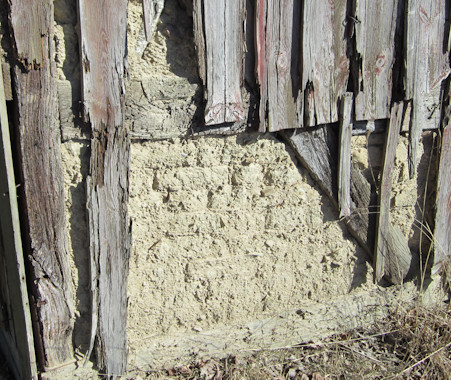
It looks like clay stone, i.e., air-dried clay. Often used to fill the gaps in Skåne half-timbered houses. It washes away quite quickly if it gets wet...Snigla said:
arkTecko:
Well, you can see that it seems to have run quite a bit... and it's not surprising considering it's not protected at all! All the planks are gone right there...
It looks like there are bricks in there and such "paste" around it (you can clearly see brick shapes...)
How is such a thing done today? because I assume there must be better ways to do it... but which materials, I wonder? (you can also see that the wood around the clay stone - or rather in it? - also seems to have had its day...). How do you renovate something similar..?
Thanks for the answer
Best regards, Sandra
Well, you can see that it seems to have run quite a bit... and it's not surprising considering it's not protected at all! All the planks are gone right there...
It looks like there are bricks in there and such "paste" around it (you can clearly see brick shapes...)
How is such a thing done today? because I assume there must be better ways to do it... but which materials, I wonder? (you can also see that the wood around the clay stone - or rather in it? - also seems to have had its day...). How do you renovate something similar..?
Thanks for the answer
Best regards, Sandra
Clay bricks are often in brick molds; I have them in some interior walls myself. At the time, they were cheaper than bricks since they could be made on the farm from local clay. As long as they don't get wet, they have fairly good properties, including an incredible ability to buffer moisture and keep indoor humidity even. There is some reading material about them, see here, for example (pdf).
But it's not impossible that it's bricks either, perhaps laid with clay mortar in that case, I suppose? You can notice it quickly if you scratch the stone a little or poke it a bit.
In the construction above, the timber frame is load-bearing. The clay brick is infill, and the panel protects the two from rain and weather.
I don't know what the best strategies are for renovating it, but I wouldn't rule out keeping the clay brick. I might refer to this thesis from LTH: A 200-year-old Skåne cottagemeets the energy requirements of the 21st century. It is mainly wet rooms that can become/be tricky, especially against exterior walls.
Make sure to get someone who knows old Skåne cottages to inspect it if you plan to buy. I might be able to help with a contact from when we inspected our house if it becomes relevant, let me know in that case.
But it's not impossible that it's bricks either, perhaps laid with clay mortar in that case, I suppose? You can notice it quickly if you scratch the stone a little or poke it a bit.
In the construction above, the timber frame is load-bearing. The clay brick is infill, and the panel protects the two from rain and weather.
I don't know what the best strategies are for renovating it, but I wouldn't rule out keeping the clay brick. I might refer to this thesis from LTH: A 200-year-old Skåne cottagemeets the energy requirements of the 21st century. It is mainly wet rooms that can become/be tricky, especially against exterior walls.
Make sure to get someone who knows old Skåne cottages to inspect it if you plan to buy. I might be able to help with a contact from when we inspected our house if it becomes relevant, let me know in that case.
I think you should check out the building preservation forum here. There are probably some people who have knowledge about old half-timbered houses. Especially if you're interested in getting advice on how to take care of the existing buildings. Many otherwise have the attitude "tear it down and build new." This applies to builders, real estate agents, forum users, and acquaintances alike.
Everything can basically be fixed. It's just a matter of interest, time, and resources. I think it's great that you're considering whether the buildings can be saved. Keep in mind that there are plenty of new standard houses but fewer and fewer old houses that haven't been badly renovated. A catalog house might be practical but can never tell a story like an old house. But you must be clear that it's a big project to take care of an old house in need of maintenance. It's probably a matter of many years of work, but it can also give a lot back, both during the process and when things are finished.
Everything can basically be fixed. It's just a matter of interest, time, and resources. I think it's great that you're considering whether the buildings can be saved. Keep in mind that there are plenty of new standard houses but fewer and fewer old houses that haven't been badly renovated. A catalog house might be practical but can never tell a story like an old house. But you must be clear that it's a big project to take care of an old house in need of maintenance. It's probably a matter of many years of work, but it can also give a lot back, both during the process and when things are finished.
Last edited: