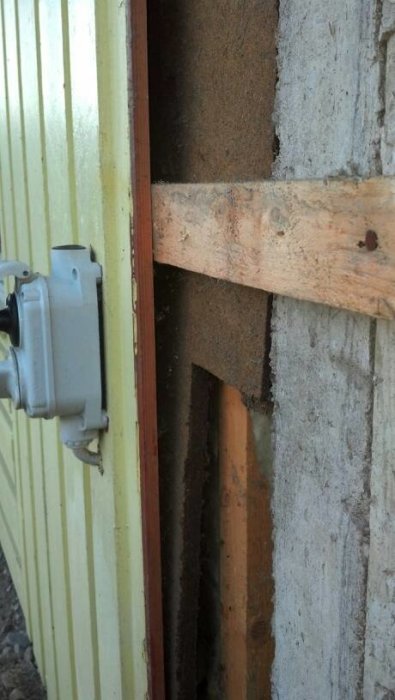
The panel needs to be fixed. We are going to replace everything, because currently, much of it is in poor condition and we don't know what kind of paint is in the different layers (some of which are peeling, presumably because different types of paint have been used...). Scraping everything to bare wood and then still needing to replace 40-60% isn't worth the effort. The house is from '73, split-level. Today I removed a few boards to see how it was built and this is the result: It's in the corner on the downside, hence the concrete. The construction seems to be (from outside to inside): Panel-some kind of horizontal battens-fiberboard-insulation-plastic-drywall. Is the fiberboard what's called tretex? So, there is no vertical air gap. Neither is there any paper, fabric, or anything else to seal against the wind. Is it the fiberboard's task? When I now replace the panel, should we change the construction to introduce a vertical air gap and should we install paper, membrane, or whatever is used these days? It wouldn't hurt to have better energy efficiency than in 1973, when electricity for the direct-acting elements was almost free. We are likely going to switch to an oil glaze instead of regular paint, if that matters.
The black board is probably asfabord. In a way, you have an air gap, there is likely a gap of about a centimeter between the planks in the inner layer, the damage is that there is air between the planks and the asfabord.
If you're going to take down the entire facade, it might be worth also removing the asphaltboard, nailing horizontal 45x45, insulating between the studs, adding a new wind barrier (like a west coast board), and then battens/cladding on top of that.
But maybe it's an unnecessary cost that doesn't yield enough return? How does asfa/asphaltboard really hold up when it's 30-40 years old, no issues if everything is intact or should it be addressed if you already have the facade open?
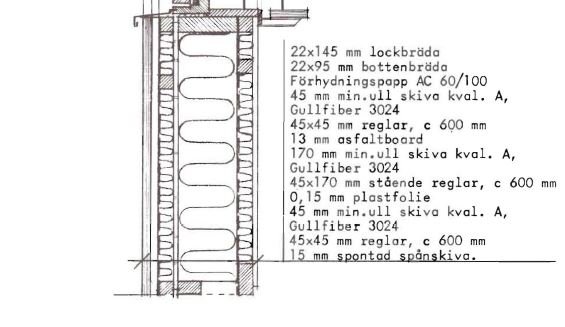
I myself have a split-level house from the 70s, although 6 years younger than yours but seems to differ a bit in the construction of the exterior walls, see the cross-section in the image below:
The black board is probably asfabord. In a way, you have an air gap, there's likely a gap of about a cm between the boards in the inner layer, the damage is that there's air between the boards and the asfabord.
Unfortunately, it's not two layers. It's what I believe is called stenvallspanel, so there is no direct gap.
If you're taking down the entire facade anyway, maybe it's worth also removing the asphalt board at the same time, nailing horizontal 45x45, insulating between the studs, adding a new wind board (like a west coast board), and then batten/panel on this?
But maybe that's an unnecessary cost that doesn't yield enough return? How does asfa/asphalt board really hold up after 30-40 years, is it okay if everything is intact or should it be addressed if the facade is open anyway?
I have a split-level house from the 70s, though 6 years younger than yours, but it seems there's a slight difference in the construction of the exterior walls, see section view in the image below:
[image]
Flat roof ==> no roof overhang, so additional insulation is excluded.
Your house was built after the energy crisis, which means you have oceans of insulation compared to me. I don't have a figure yet, but I'd be surprised if it's more than 90 mm in my walls.
Bump! Is it stupid to change the construction? To remove the board and install windproof fabric/paper or whatever is done in modern times, and create an air gap. Can it cause problems?
All panels allow a little air through the gaps. If the asfaboard and nail battens are okay, it has worked on your house as well.
Then I believe that most panels today are grooved on the back, which provides extra ventilation.
If everything except the bottom part of the panel is in good condition, I would not do anything other than replace the panel.
If it ain't broke, then don't try to fix it!
You have a point there. Maybe it's better to let the kåken continue being leaky so new moisture problems aren't created. It does feel cheaper and easier too.
Thanks for the input, good people!
Click here to reply
Vi vill skicka notiser för ämnen du bevakar och händelser som berör dig.