
6,952 views ·
8 replies
7k views
8 replies
Planning to lay floorboards, question about noggings against exterior walls
Hello!
We are currently renovating one of our rooms in the house and have torn everything down to the joists and shoveled out old slag stone and sawdust from the joists, replacing it with rock wool. Now, chipboard will be laid on the joists, and as I have read in several places, noggins should be placed along the outer corners to support the chipboard.
My question now is whether it's okay to attach the noggins to the wall (we have solid tongue-and-groove plank as walls) as I have done according to the picture, or if it’s better to attach them to the studs? Does it really matter?
The only thing I can think of is that there might be creaking if you walk on a stud where the noggin doesn’t move but the stud does and vice versa. You can easily counteract this by shortening the noggins slightly so they never touch the studs.
(The floor joists are crisscrossed and partly attached to the studs further into the room as well as in the middle of the room, in case anyone wonders, but the above is solely about whether the noggins are placed with the outer wall to support the chipboard.)
We are currently renovating one of our rooms in the house and have torn everything down to the joists and shoveled out old slag stone and sawdust from the joists, replacing it with rock wool. Now, chipboard will be laid on the joists, and as I have read in several places, noggins should be placed along the outer corners to support the chipboard.
My question now is whether it's okay to attach the noggins to the wall (we have solid tongue-and-groove plank as walls) as I have done according to the picture, or if it’s better to attach them to the studs? Does it really matter?
The only thing I can think of is that there might be creaking if you walk on a stud where the noggin doesn’t move but the stud does and vice versa. You can easily counteract this by shortening the noggins slightly so they never touch the studs.
(The floor joists are crisscrossed and partly attached to the studs further into the room as well as in the middle of the room, in case anyone wonders, but the above is solely about whether the noggins are placed with the outer wall to support the chipboard.)
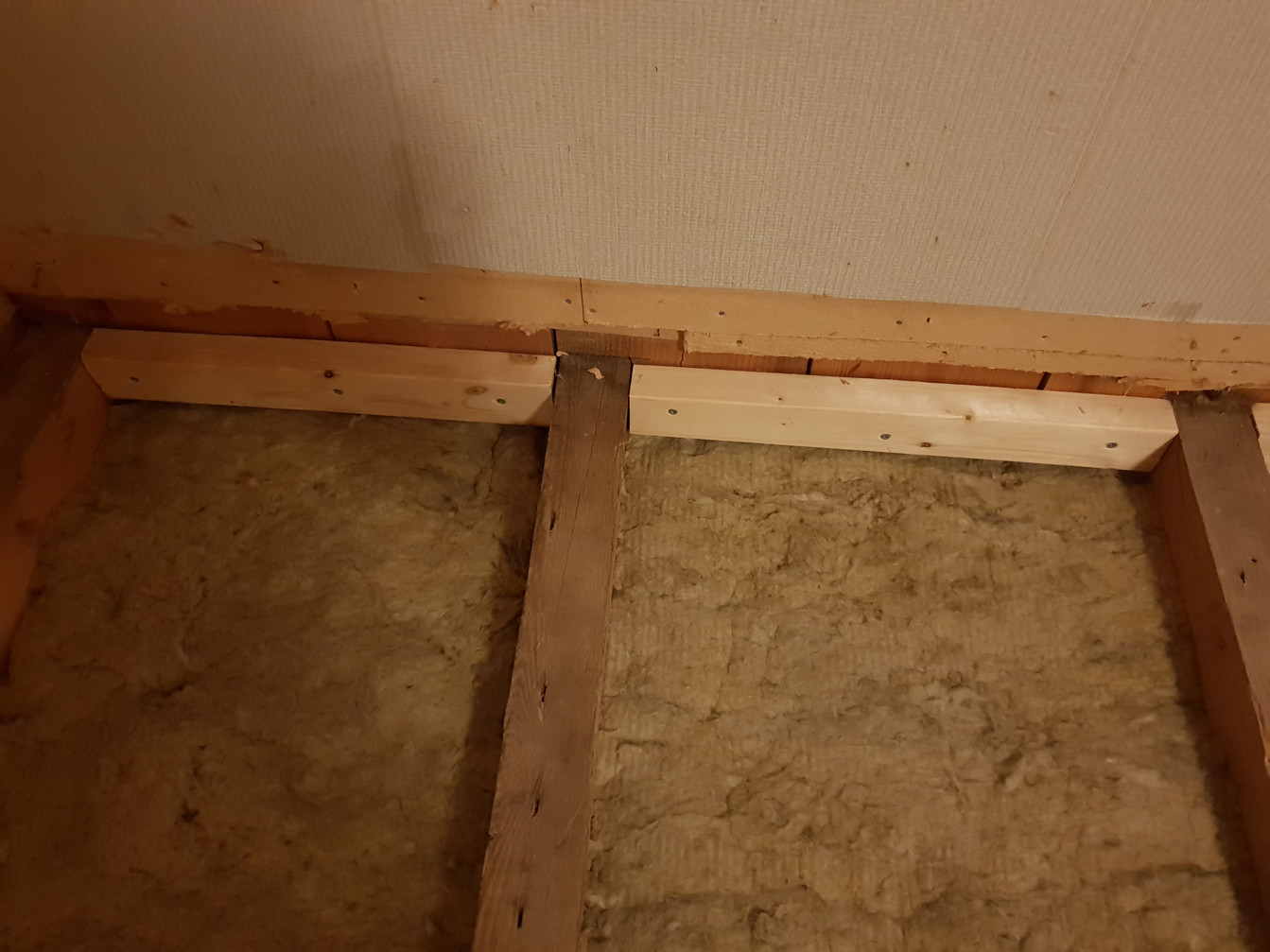
Would have done just like you have done, looks great.
One more question. How should I brace here? Zig-zag brace and screw through the studs? There are double studs, so I would need really long screws in that case. Or can I use angle brackets to attach the bracing to the studs? I took the opportunity to reinforce some offsets with sturdy angle brackets in places around the room, offsets which some studs are attached to solely with nails. Albeit sturdy ones, but they've been there since the 40s, so I thought it might be good to add some angle brackets and a bunch of anchor screws. Hope I'm thinking correctly? The wood is hard as hell, if you drive the screws too fast or far, they break easily.Bernieberg said:
(Not insulated here yet as seen in the picture. I'll put down some flex conduit for future needs under the floor before the insulation goes in.)
Edit: To the right is the chimney, so I can't access the other side of the stud to screw, so either angle the screw in or use angle brackets are the options.
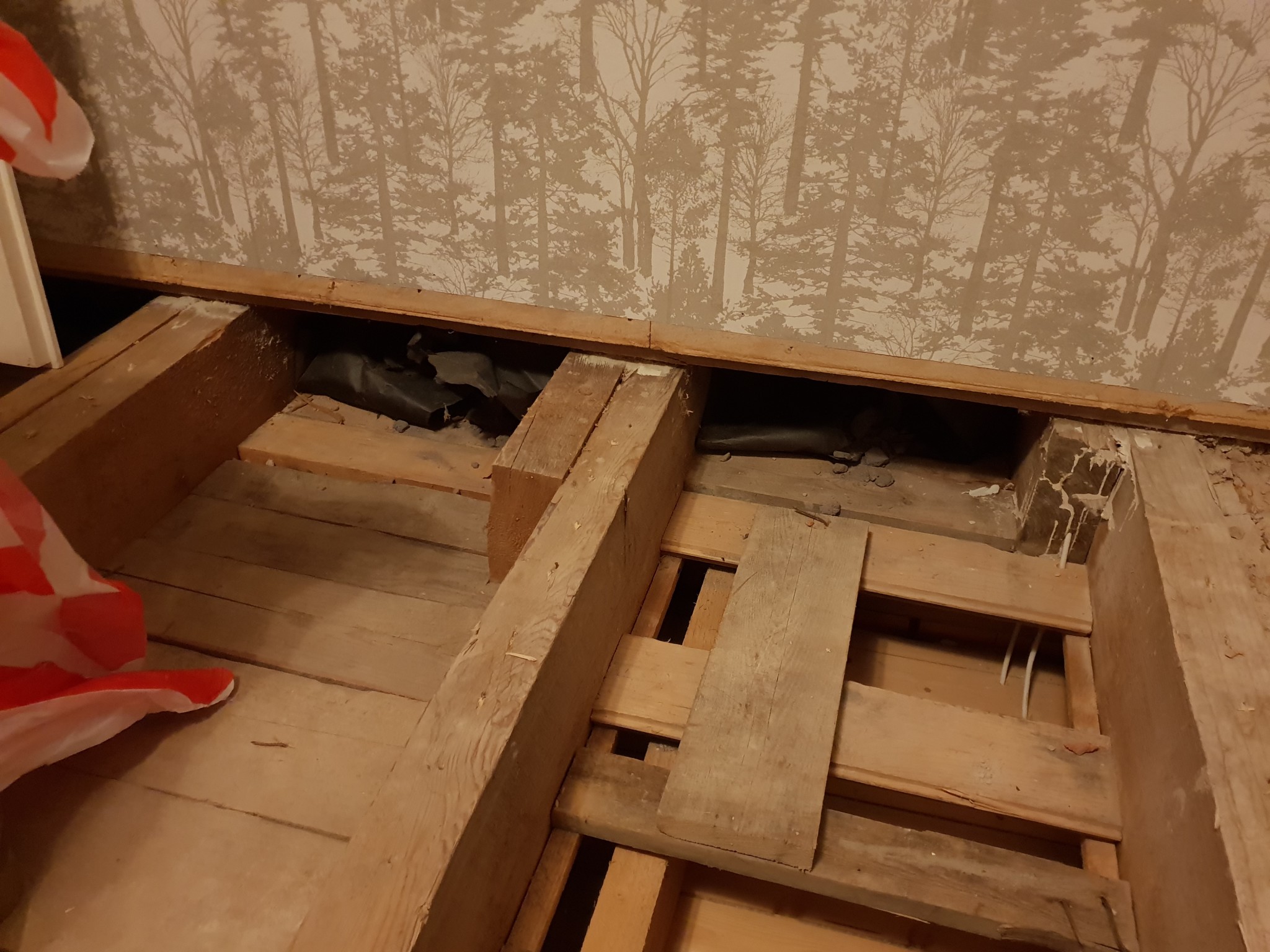
Yes, those are thick beams and it's a hassle to screw through them. I would angle screw the cross members, preferably with a construction screw like Essve ETT, but a regular wood screw will also work. That way, you can place them in line exactly where you want them next to the wall.
Your reinforcements with angle brackets are hardly bad but it's hard to say if they add anything. But it's always nice to try to improve everything you can when the floor structure is open.
Your reinforcements with angle brackets are hardly bad but it's hard to say if they add anything. But it's always nice to try to improve everything you can when the floor structure is open.
Thanks for the quick answers in the middle of the nightYes, they are thick beams and difficult to screw through these. I would have used pocket screws for the blocking pieces, preferably with a construction screw like Essve ETT, but a regular wood screw would work too. Then you can place them in line exactly where you want them next to the wall.
Your reinforcements with angle brackets are hardly bad but hard to say if they add anything. But always nice to try to improve everything you can when the floor structure is open.
 I angled wood screws where I put in new blocking pieces in the middle of the floor structure, so I'll do something similar here as well.
 Yes, there are solid beams in my 1940s house... 75(or 70)x230 and 100x230 beams. And all walls contain tongue-and-groove planks, exterior walls as well as interior walls. Solid constructions in the past
The picture above shows the middle of the house, with a load-bearing wall underneath that the beams rest on. One set of beams extends into the room we are renovating and the other into an adjacent room, hence the double beams.
Regarding the angle brackets, I thought they hopefully won't do any harm, but they might provide some sort of benefit for a bit of stabilization, but you might be right. They might not add anything significant.

Diversearbetare
· Göteborg
· 10 704 posts
It is also important that you both screw and glue the floor particle board to the rules and in the tongues between the boards, otherwise you will inevitably get creaking in the floor. It takes a lot of glue.
Yep, that's the plan. I actually dislike the idea of gluing the subfloor to the joists, as it will be difficult to ever remove it again, but it seems that's the way to do it. By the way, what quality wood glue should one use?
Diversearbetare
· Göteborg
· 10 704 posts
Use the wood glue called "vinterlim" that is significantly sturdier when it has dried. I believe that 1 liter is enough for 5m², but I'll leave that unsaid. Anyway, you should "overuse" when gluing. It should swell up a little in the joints. However, you don't need to worry that it can't be broken apart. Ask me how I know.
Click here to reply