
17,576 views ·
34 replies
18k views
34 replies
Panel instead of OSB + drywall?

Construction rookie
· Stockholm
· 311 posts
Originally, we had planned to use only plasterboard on the inside of the studs when we extend the summer house, but the builder recommends using OSB + plasterboard so that you can "hang anything anywhere."
Now we've received several tips to use paneling instead of plasterboard. We like that idea. Some questions:
Now we've received several tips to use paneling instead of plasterboard. We like that idea. Some questions:
- What type of paneling is suitable for interior walls?
- Does it work everywhere (e.g. wall where the kitchen will be installed)?
- Are there any disadvantages compared to plasterboard?
- Can you skip OSB if you use paneling?

Construction rookie
· Stockholm
· 311 posts
You can also use x2 layers of drywall + customized screws for drywall mounting, if you want some hanging capacity but don't want OSB+drywall. Now, I don't know which panel you're considering, but it should still be cheaper with x2 layers of drywall, and it can handle x amount of kilos in that respect.
I personally think that just the panel is a bit semi-weak, so I have plywood behind the panel where I have made such walls.
I personally think that just the panel is a bit semi-weak, so I have plywood behind the panel where I have made such walls.

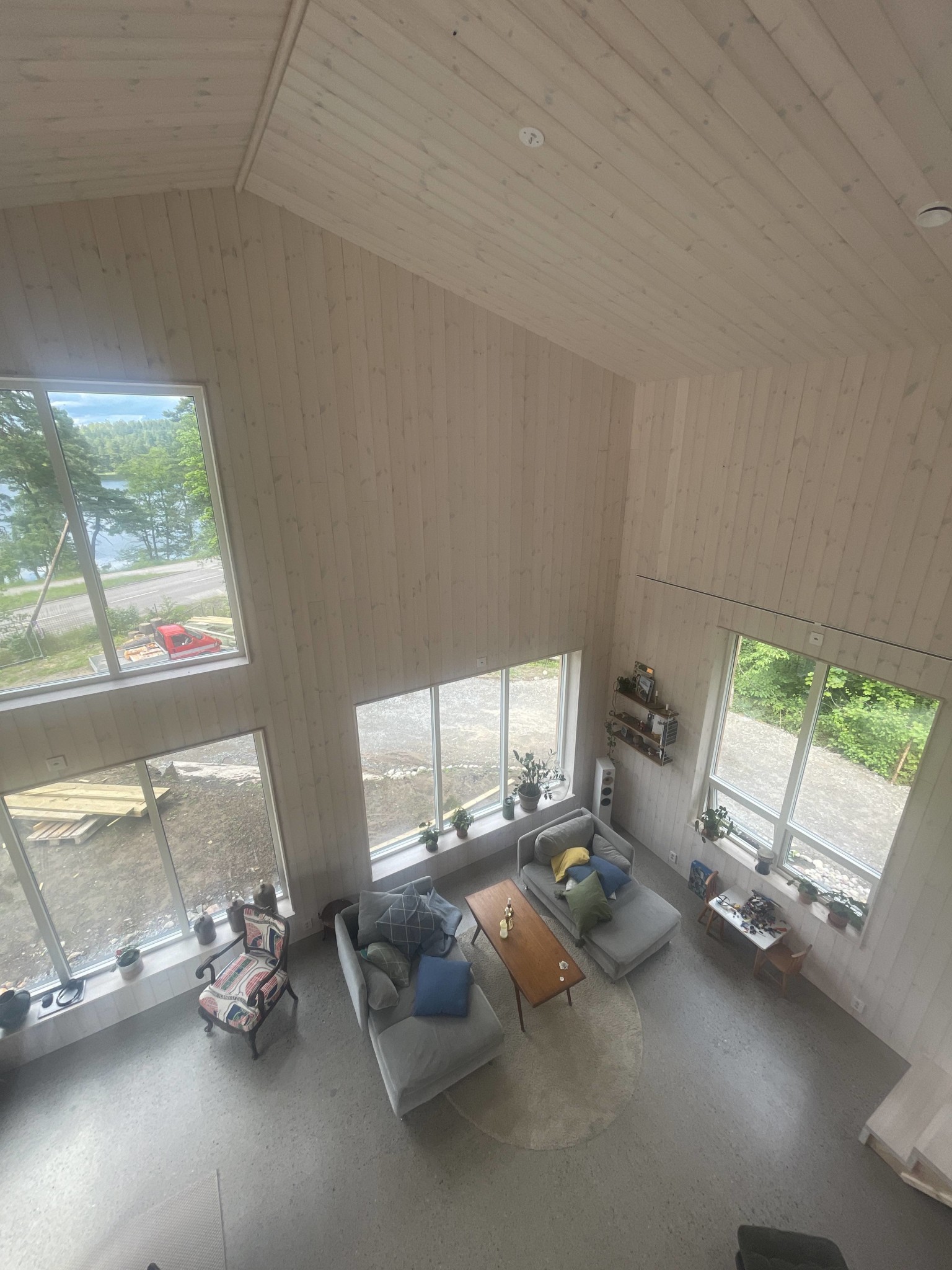
Inner paneling is nice and you avoid having to plaster, sand, plaster, sand, and paint a lot! We installed inner paneling about 12 mm thick and stained it with one layer, looks great. However, OSB behind for stability and easier to nail the paneling. Otherwise, just inner paneling is probably sufficient as well.
If one is to completely ignore fire safety, then sure, although I don't know how insurance companies feel about that particular solution in vacation homes.
Worth checking, I think.
Worth checking, I think.

For single-family homes, the entire house is its own fire compartment, so it doesn't matter what you have on the walls. We have installed panels from Norrlandsträ on both the ceiling and walls! Behind the walls, we have OSB or chipboard. In the ceiling, it's just battens. I think it looks great and also extremely nice to avoid the endless plastering/sanding/painting nightmare!Sleepymike™ said:
Do you know what you're talking about or are you just guessing now? Bring forth a source that says you can't build with wood paneling inside or that the insurance company won't compensate in the event of a fire if so.
I am sharing my thoughts as a professional construction worker, however, it should be noted that my experience with fire protection is almost exclusively related to new construction, NOT the renovation of holiday homes.Jonatan79 said:
Yes, it's usually double gypsum or a 13mm and a 15mm also called "Protect", 1 layer of gypsum can withstand 15 minutes, 2 layers 30 minutes, and so on...
But as mentioned, there is a difference between new and old.
A tip is to check Boverkets byggregler chapter 5, I believe it's about fire.
But as mentioned, there is a difference between new and old.
A tip is to check Boverkets byggregler chapter 5, I believe it's about fire.
To meet the fire protection class for new single-family homes, at least 13mm gypsum is required.
What applies to the renovation of older summer houses is a good question...
But gypsum is very cheap, especially today when OSB has increased significantly in price.
https://www.boverket.se/sv/PBL-kuns...gregler/brandskydd/brandklasserd-for-ytskikt/
I personally applied beadboard directly onto gypsum with installation adhesive.
It holds very well and feels "solid."
Gypsum on walls and ceilings can be the decisive difference between a completely damaged room and a burnt-down house.
Gaining time before the fire brigade arrives.

No, a fire rating is required, which is often ei30 but can certainly be higher sometimes, but how to achieve it is up to each individual, though plasterboard is the "simple" solution.Huddingebo said:
As an addition, I can say that it was only a few weeks ago that I was at a new build completely without boards in the outer wall. It was a 45mm horizontal installation layer and 22mm pine panel, I recall, sparse in the ceiling.
Last edited:

Råspont is what's needed if you skip OSB or plywood. Available in 17 / 20 mm thicknesses. It involves a lot of hammering/cutting with råspont. Prices for different materials, råspont 152:-/sqm (20 mm) 135:-/sqm (17 mm) Plywood 126:-/sqm (12 mm) OSB 10 mm 104 :-/sqm Prices from Byggmax (it took a while to check this).
That's exactly what I meant.Rickard. said:
No, a fire rating is required, which is often ei30 but can certainly be higher sometimes, but how you achieve it is up to each individual, but gypsum is the "simple" solution.
As an addition, I can say that it wasn't many weeks ago that I was on a new build completely without boards in the outer wall. It was 45mm lying installation layer and 22mm pine panel I seem to recall, sparse in the ceiling.
With at least 13 mm gypsum, you generally achieve the minimum requirement.
But you can solve the fire rating however you like, with whatever materials you want.
But with wood paneling directly on wood boards, you're not even close to meeting even the old requirements.
There is always an opportunity to cheat. No one opens up walls and checks during the "final inspection".