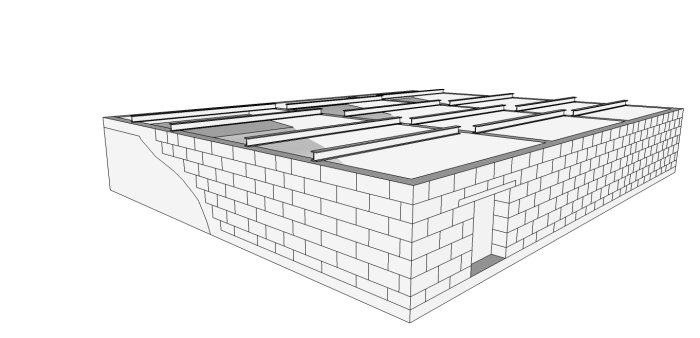
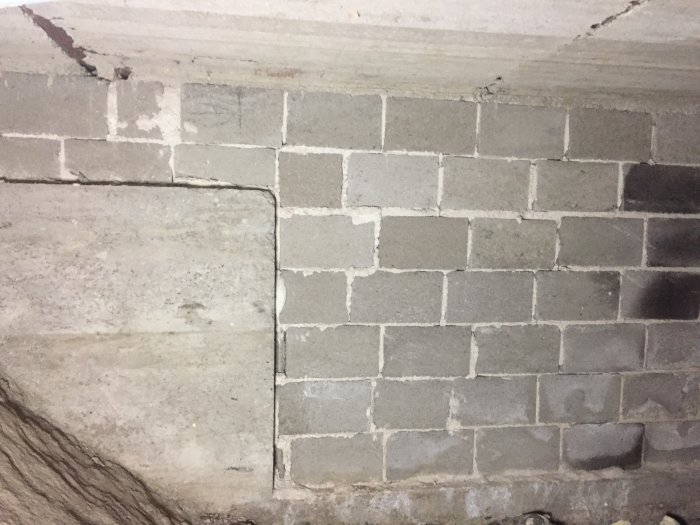
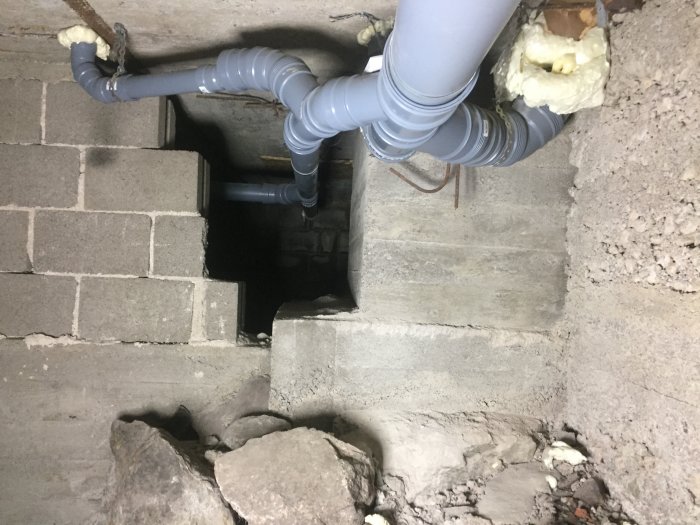
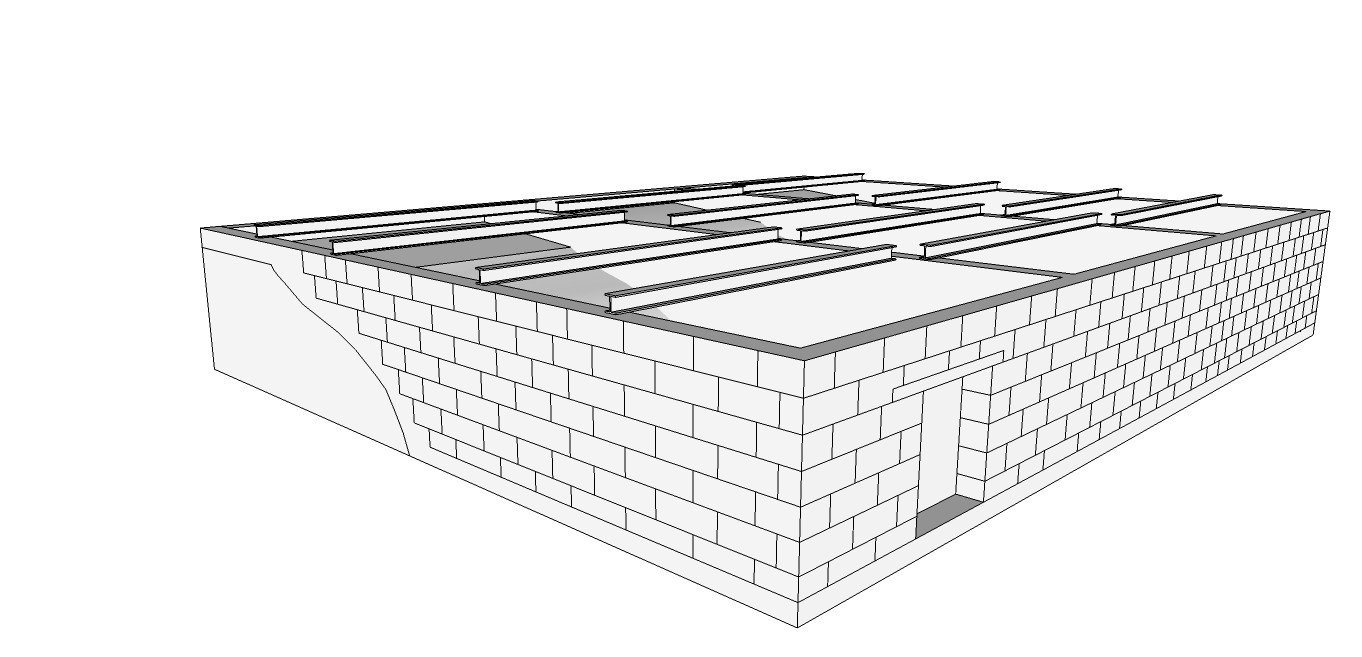
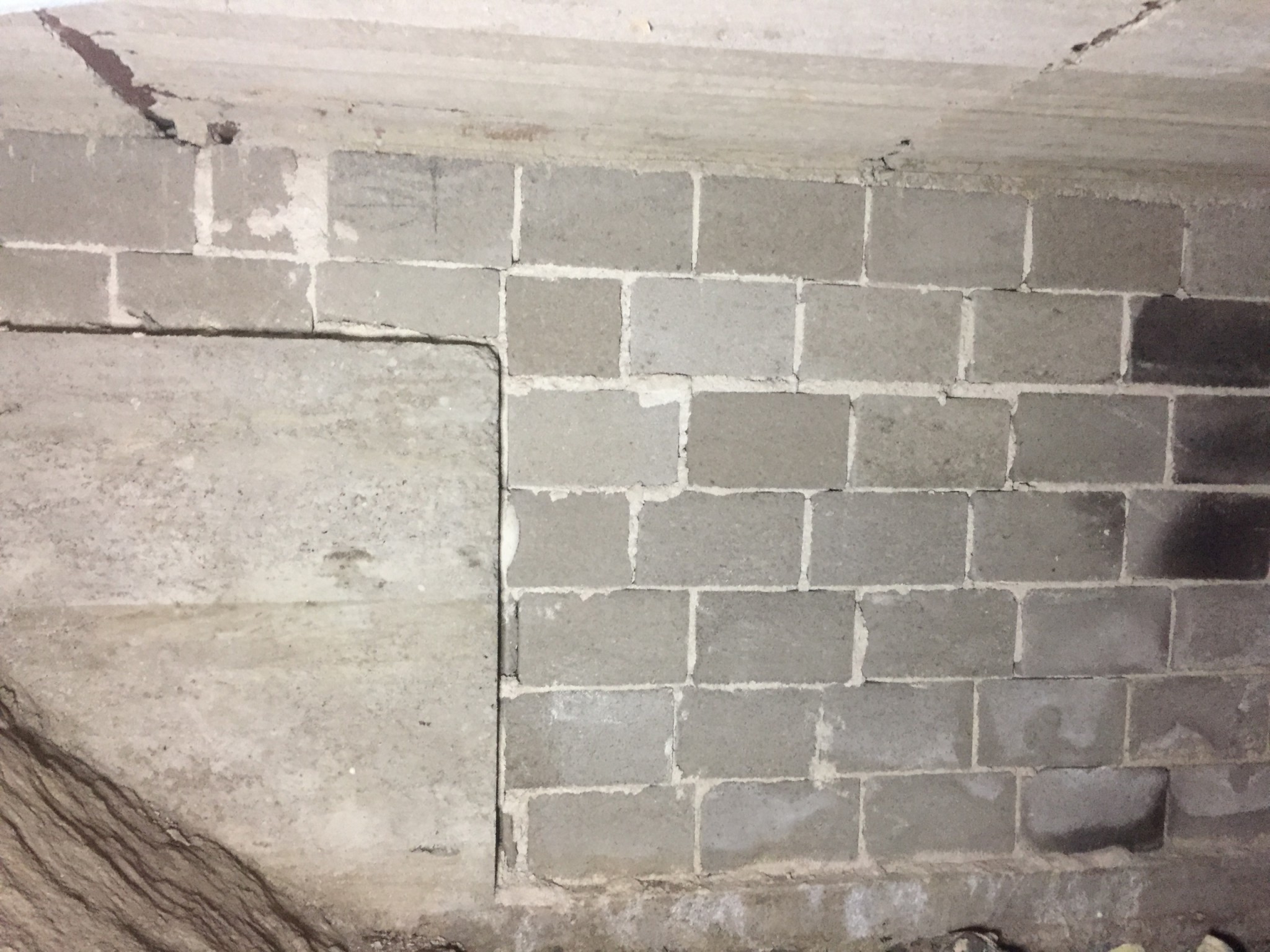
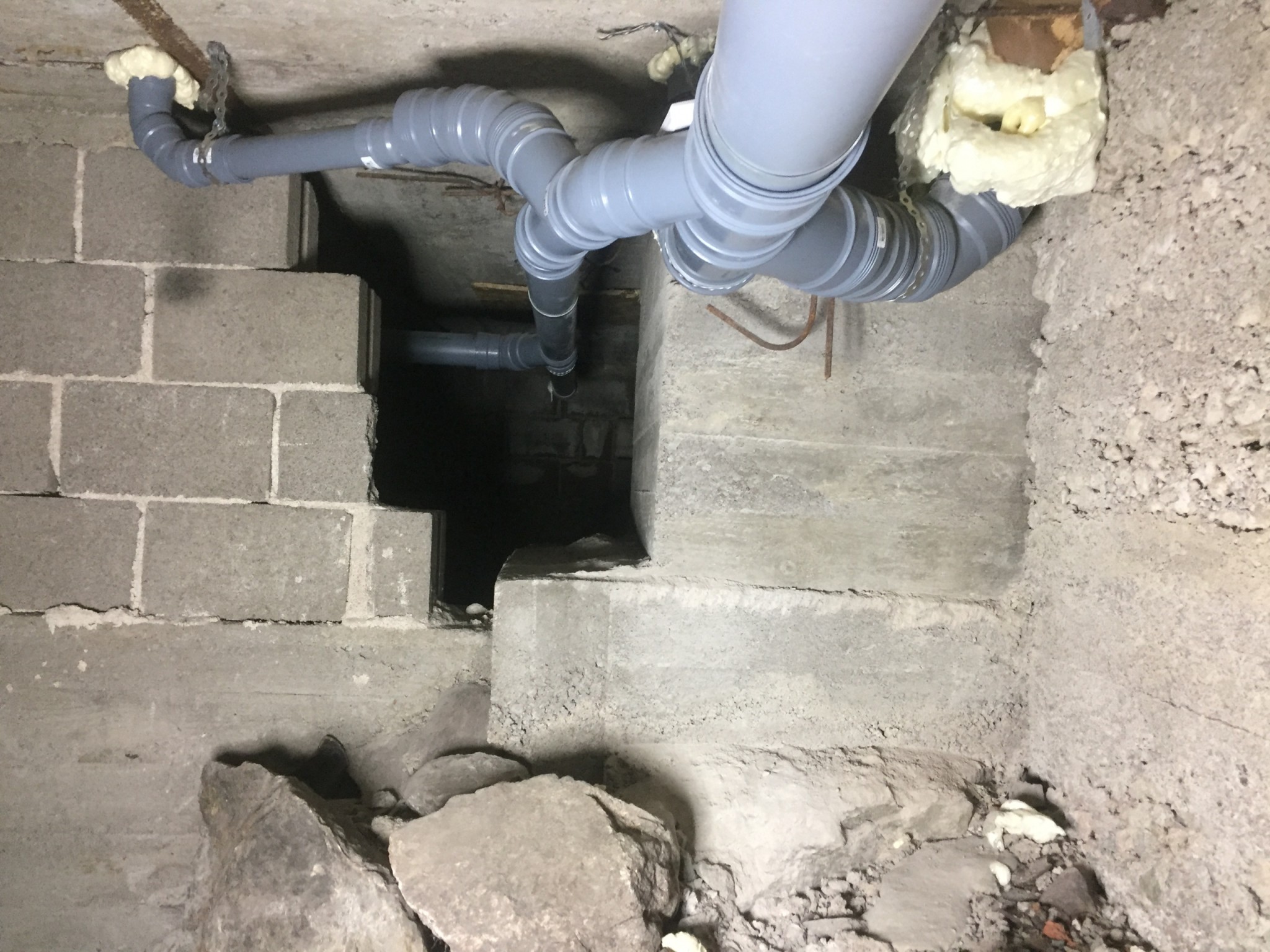
I need to create an opening in the foundation wall of my crawl space from the outside, as well as open up between 2 parts of the crawl space. The house is from the 1930s where the foundation wall, about 1.5m at its highest point, consists of concrete hollow blocks and a cast slab with I-beams and reinforcement. See the sketch:
On top of the slab is the first floor in concrete hollow blocks, about 2.20, and then a new concrete slab, and the upper floor is standing planks. My plan is to cut in 1m L-beams 80x80x12 in the mortar joint on each side and cast with expansion grout. Then open up a 50cm opening below.
I’m also wondering if this might be overkill since there is a slab above the foundation wall that should act as a "beam," but then I assume one must open all the way up to the slab to prevent any block from coming loose.
It should be noted that it is already opened to the third part of the crawl space without any previous support.
So either open all the way to the slab and/or support with 80x80x12 L-profile?
Does this seem sensible, or should I consult with an engineer?
Spontaneously, I think that if the openings should not be wider than 50 cm, you probably don't need to make any reinforcements, if you place them correctly (i.e., not under the support for an I-beam). Masonry is a shell structure where forces are distributed over the entire wall. The construction is a bit tricky, though. The presence of I-beams in the floor suggests that the reinforcement is only local. Your intended L-steel probably won't make any difference. They are not intended as beams and can't withstand significant loads as such.
In the 1930s, they were meticulous. There may still be construction drawings with marked reinforcement at the Building Committee. If you want to be on the safe side, try to find them and consult a competent structural engineer.
In this 1930s era, they weren't so meticulous; according to the construction drawings, it's a concrete base and in-between poured slab. Additionally, it's drawn as if it's a filled basement when everything is actually above ground with a crawl space... Do you mean there should be vertical rebar under the beams or that it's only reinforcement between the shifts under the beams? I've noticed there is reinforcement in the slab anyway. The reason for L-steel would be to keep the stones above the hole so you don't get them on your head one fine day. I've tried to get in touch with a constructor, but it's not the easiest in Stockholm. Those I've reached out to haven't replied.
I interpret your sketch as the steel I-beams are embedded in the slab. This makes one a bit unsure of how the slab's reinforcement looks. I don't think there's any reinforcement in the joints between the concrete bricks.
My suggestion: Make 50 cm wide openings. Do not make openings directly under an I-beam in the slab. Feel free to insert L-steel if you feel more secure doing so. They can't bear large loads but naturally keep the stones in place.
That's correct, they are embedded, and there are also reinforcement bars that have been bent away at the places where there are openings for things like sewage pipes. In the drawings from the building committee, it states reinforcement 8 mm cc 16 cm and distribution bars 8 mm cc 25 cm. It is the slab between the upper and lower floors according to the drawing. As mentioned, the base plate is not included in the drawing as a form of crawl space.
It's worth noting that the space I want to access is under what used to be a garage, so it should be fairly strong.
My latest plan is to open up at the lower edge of the slab to avoid L steel 50x50 cm and of course not under the I-beam. But should I reconsider when opening out from the foundation and not do it on the long side but the short side?
There are more aspects to your last question that I cannot assess, for example, where on the plot will the opening be located? With regard to the construction, the opening should be on the long side, but if you avoid the I-beams, it probably doesn't matter much. Think about the function first and foremost.
Click here to reply
Vi vill skicka notiser för ämnen du bevakar och händelser som berör dig.