There was previously a wash basin there, and we are going to disconnect a water radiator and replace another with a larger one.
The builder suggested that when we break up the floor drains, we also break up around the water pipes and the pipes where the water radiant heat comes up from the concrete floor. This is to be able to cut and plug them under the floor level and then pour over.
That would definitely look the best.
But is it allowed to do so?
Would you recommend doing so?
The alternative is to let them stick up and plug them. I imagine that you can see if the plugging starts leaking and can address it.
Not ok on pressurized water. Risk of legionella and major water damage. Legionella can occur even if it is plugged above the floor.
See säkervatten for more info.
Not ok on pressurized water. Risk of legionella and major water damage. You can get legionella even if it's plugged above the floor.
See säkervatten for more info
Thanks for the reply! I've looked a bit on säkervatten but didn't find anything, but I'll keep looking!
Legionella doesn't sound good. Are there ways to prevent this?
Thanks for your response! I've looked a little on säkervatten but didn't find much, I'll have to search a bit more!
Legionella doesn't sound so good. Are there any ways to prevent it?
You can get Legionella if you have stagnant water in the pipes, which can happen if you remove the option to drain it, depending on how the pipe is laid out, whether it's a branch you need to cap, or if you're shutting down an entire pipe, so to speak. The plumber should be aware of this.
If I understand the question, it concerns heating pipes, not tap water pipes. In that case, it's okay from a regulatory standpoint. Legionella is only a problem in tap water pipes. It is especially dangerous if the infected water comes out through a shower.
If I understand the question, it concerns heating pipes, not tap water pipes. In that case, it is okay from a regulatory standpoint. Legionella is only a problem in tap water pipes. It is particularly dangerous if the infected water comes out via a shower.
Hi,
I might have been unclear and not using the correct nomenclature, but it concerns both tap water and heating pipes.
So it's okay to plug the heating pipe and cast over, but not okay to do the same with tap water? So then the tap water must stick up above the floor.
I'll see if I can find any plumbing drawings that can clarify how the piping is laid out.
I've been looking a bit on säkervatten but didn't think I found anything, but I'll have to look some more!
It's point 5.1.2:
"Unused pipes for cold water, hot water, or VVC should not be longer than 200 mm measured from the water-bearing pipe where they are connected."
And then one might need to clarify that VVC (return chain for hot water, in large buildings, tap hot water is circulated so it doesn't take 5 minutes to get warm water from the tap) is part of the water supply system.
It is point 5.1.2:
"Unused pipes for cold water, hot water, or VVC should not be longer than 200 mm measured from the water-bearing pipe where they are connected."
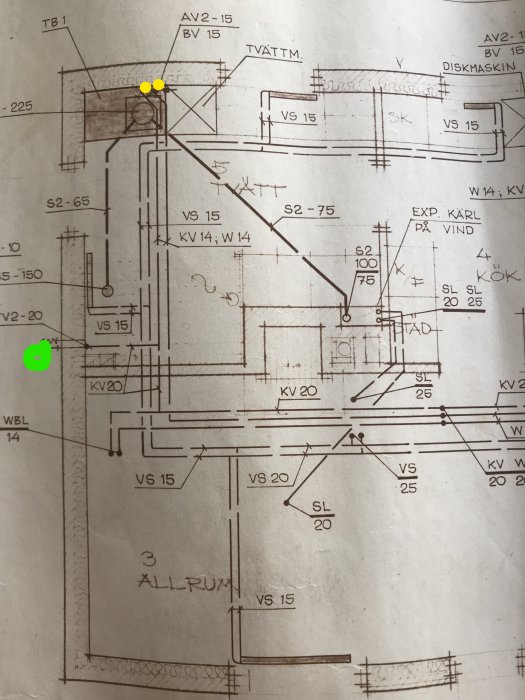
That doesn't seem to be so easy. I have found the drawing, and if I understand it correctly, the pipe which after this intervention will be the "water-bearing" is under the floor in an adjacent room, and I'm not too keen on chiseling there .
I think I'll have to get a plumber to come and take a look before they start chiseling.
The yellow dots I tried to place on the hot and cold water pipes where they emerge from the cast floor.
I noticed that the outdoor water spout (green dot) seems to be connected to the same cold water line. But it's more than 200 mm from this spout to the location where the tap was on the pipes we are now discussing.
Wires should not be spliced inside walls. The water pipe must have a distribution, and it should be outside walls. If this is not the case, you can create your own fix. You simply need to open the wall where the splice is, cut the pipe directly after the Y-junction, and plug it. Then there will be a short stretch of water that stands still. You must not build over this again. Instead, you need to make a false vent on the wall that indicates if water is leaking if that should happen. It should be some form of box around the Y-junction in the wall.
Click here to reply
Vi vill skicka notiser för ämnen du bevakar och händelser som berör dig.



 .
.