I am planning to build a loft in the style of this: http://www.thehandmadehome.net/2011/08/how-to-build-a-loft/ It seems simple enough, but I can't find any non-impregnated beams that are 95x95 (as recommended to support the structure at the corners) at the usual hardware stores. Can I find such beams somewhere? Or would it work with other dimensions, or by screwing together two 45x95, as suggested somewhere, and what should I consider when doing that?
I'm fairly handy, but I have very little experience with projects like this.
That type of lumber can be found at some of the better-stocked lumberyards, such as Beijer in Lissma outside Stockholm. In your area, I'm not quite sure who has the sorting for this.
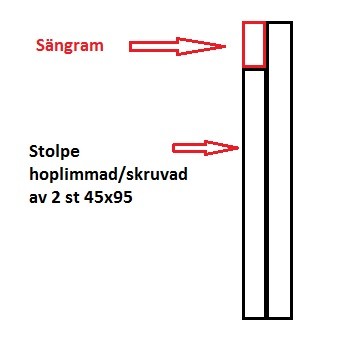
I would have taken 2 pieces of 45x95 instead and screwed and glued them together, also offsetting them at the top. Then the upper construction rests on the post instead of on the screws as they do in the article.
I would have taken 2 pieces of 45x95 instead and screwed and glued them together, offsetting them at the top. Then the upper construction rests on the post instead of the screws as they do in the article.
Can you show how you mean for the construction to look when it rests on the post? I've also considered that it would be beneficial to rest it on the posts instead of hanging it on screws.
Can you show how you mean the construction should look where it rests on the post? I've also thought it would be beneficial to rest it on the posts instead of hanging it on screws.
Now I'm jumping in to show off my skills
The tool guru probably means like this. Viewed from the side, that is:
By the way, I think the construction description was quite "rough". Lag screws everywhere, nothing countersunk.
The tool guru probably means something like this. Seen from the side:
[image]
By the way, I think the construction description was quite "rough" French screw (lag screw) everywhere, nothing countersunk.
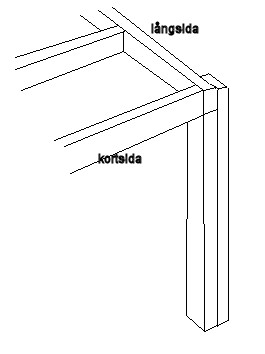
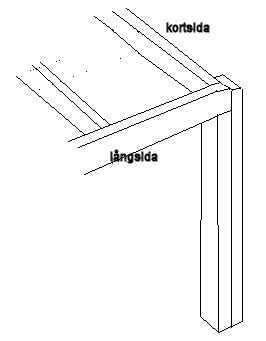
...Without thinking too much (I was in a hurry because the pizza we ordered just arrived ) I drew the following two alternatives. Do you mean one of them (if they can be grasped)?
...Without thinking too much (was in a hurry because the pizza we ordered just arrived ) I sketched the following two options. Like any of them, do you mean (if they can be grasped)?
Wouldn't it be neat to turn the post so that the long part is inward, allowing the short side to be supported as well? I'm referring to the upper/left image, that is.
But things like that usually sort themselves out when you have the parts in hand
Wouldn't it be nice to turn the post, so that the long part is inward?
So that even the short side gets support. I'm referring to the upper/left picture specifically.
But that sort of thing usually solves itself when you're holding the parts in your hands
The long part inward? Not sure I understand what you mean. But in the other picture, both sides get support.
And the next question: What should I consider when I'm "screw-gluing"? I realize it means I should glue and screw the studs together, but anything specific to consider?
...Without thinking too much (we were in a hurry because the pizza we've ordered just arrived ) I drew the following two alternatives. Do you mean like one of them (if they can grasp)?
[image][image]
Been to watch hockey...but I see you've received help from other skilled people in the thread!
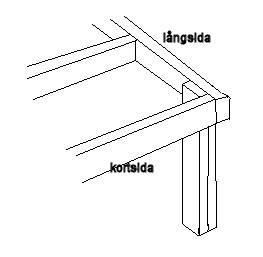
Short side outwards and long sides inwards, so that the frame aligns with the post on the outside. It looks best.
...What should I consider when "screw-gluing"? I realize it means that I should both glue and screw the studs together, but is there anything in particular to consider then?
I would ideally pre-drill for the screws so they have clearance in the "first" piece of wood. This ensures the screw pulls the parts together and doesn't just bore down. Then you don't need as many clamps.
Been watching hockey...but I see you've been helped by other skilled people in the thread!
Short side outward and long side inward, so that the frame aligns with the post on the outside. That looks best.
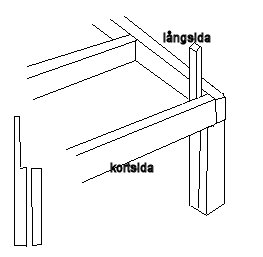
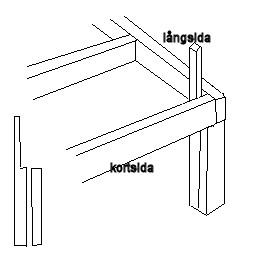
Do you mean like this (if it's possible to understand what I mean)? so that only the long side rests on (half of) the post?
I would also appreciate a description on how to screw glue effectively.
Otherwise, would this work, where you essentially put together the rule from a 45x95-rule and a 45x95-rule that has been sawed as shown at the bottom left. Then both sides would rest on the rule and no part would protrude. I was thinking of possibly using the protruding 45x45-rule to attach a railing (or alternatively, sawing it off along the "floor height" of the loft).
Vi vill skicka notiser för ämnen du bevakar och händelser som berör dig.