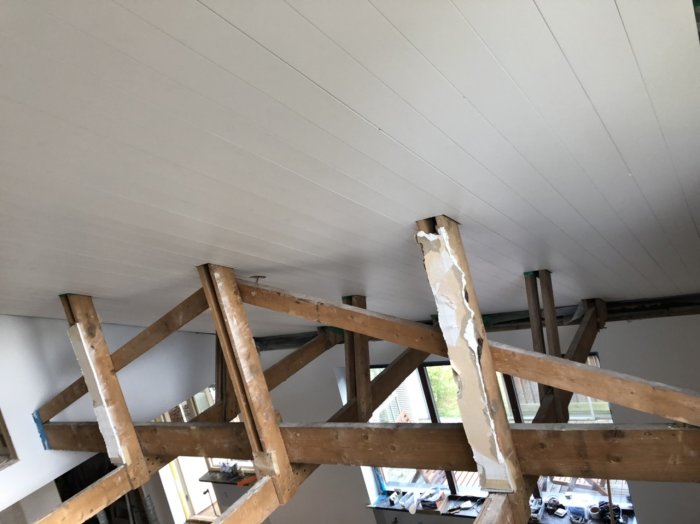
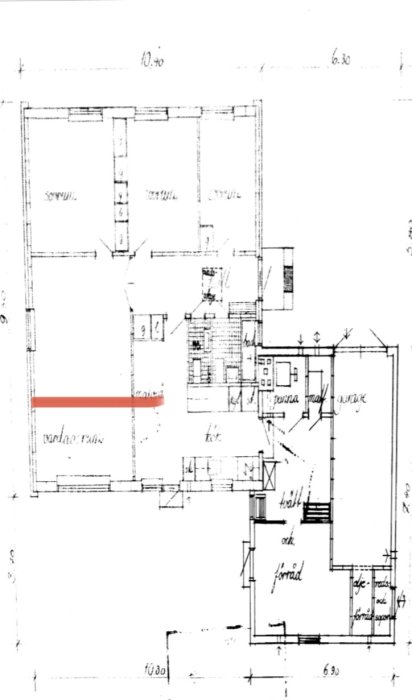
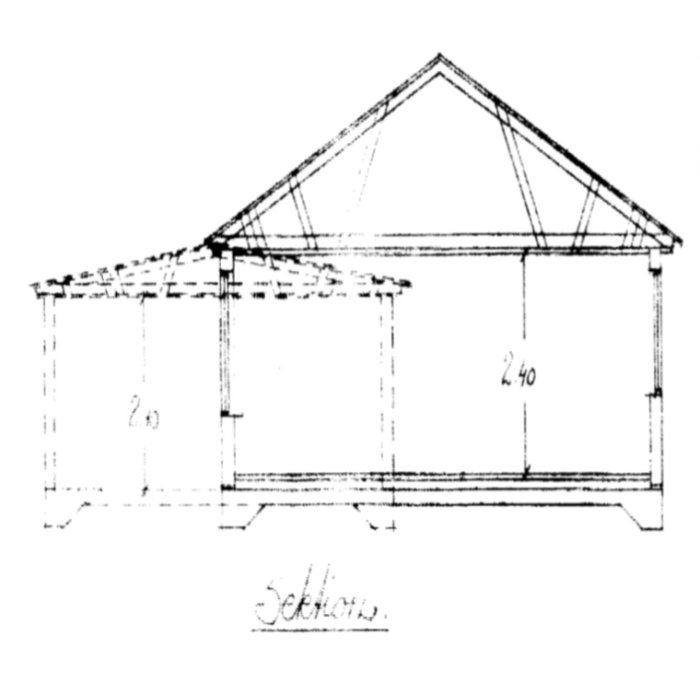
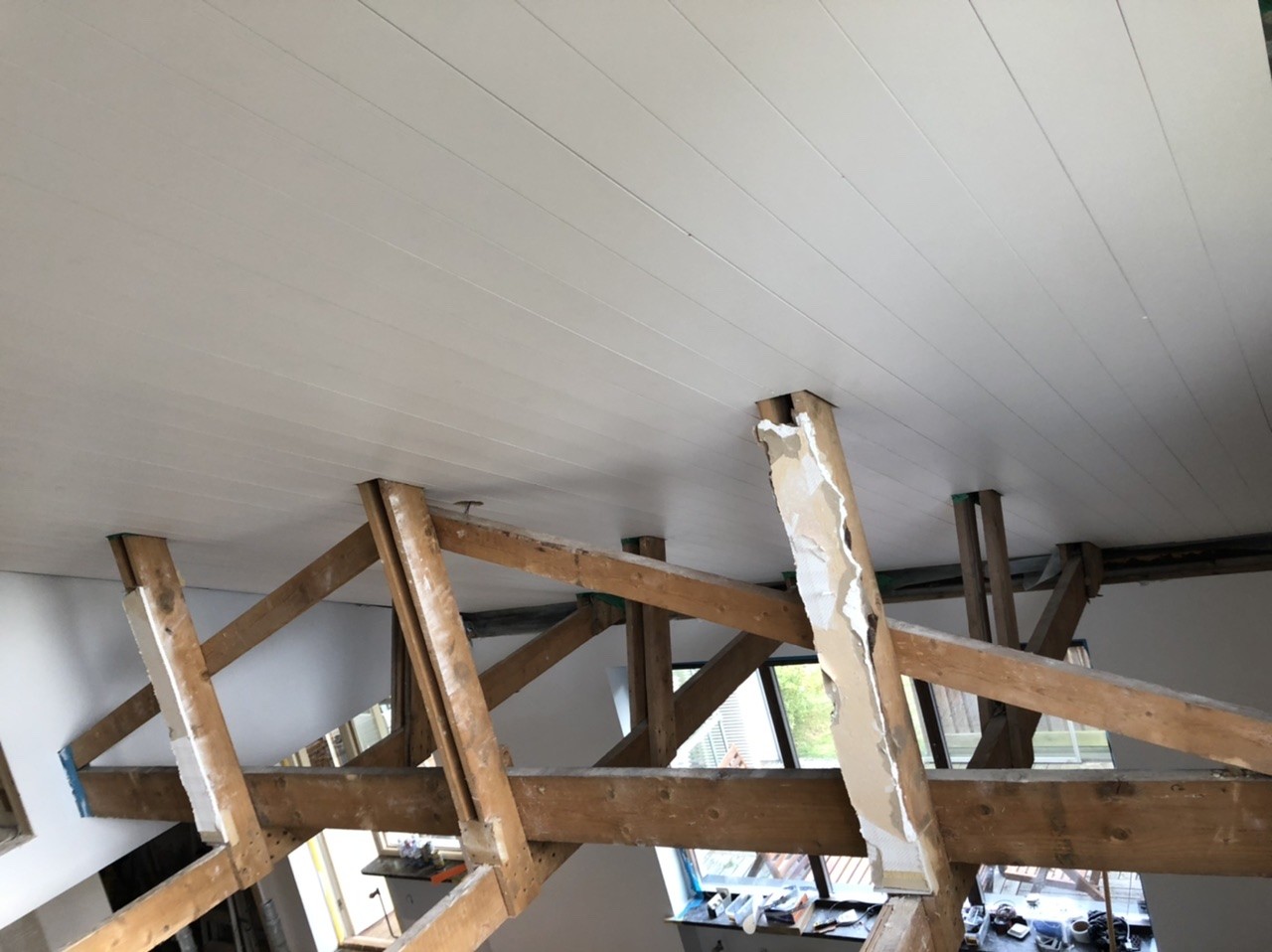
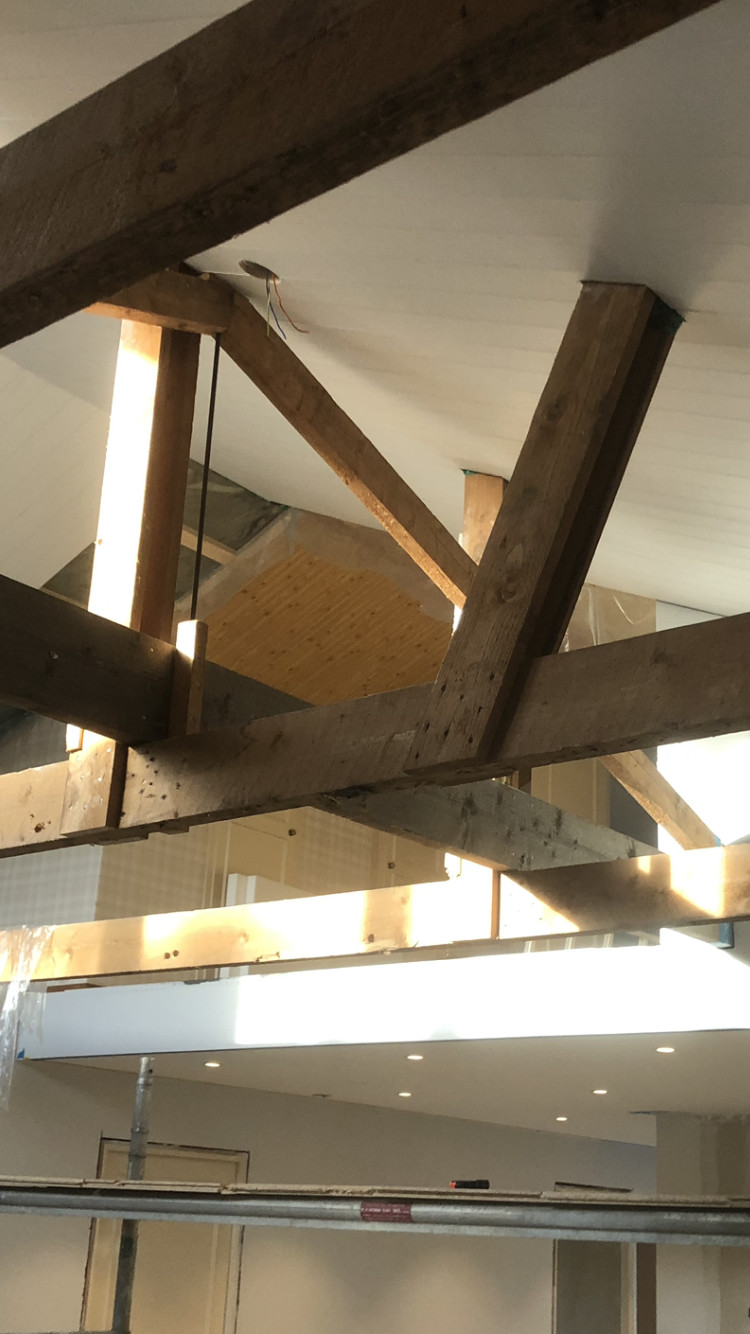
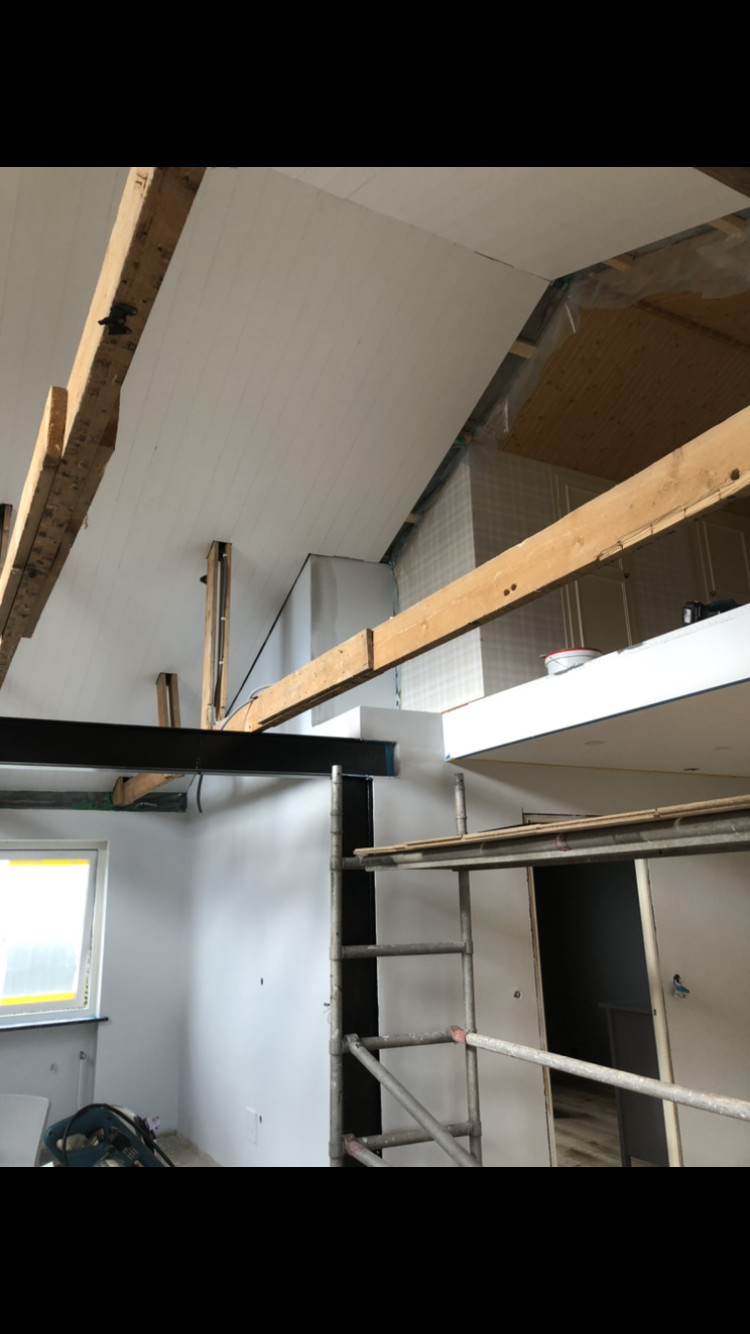
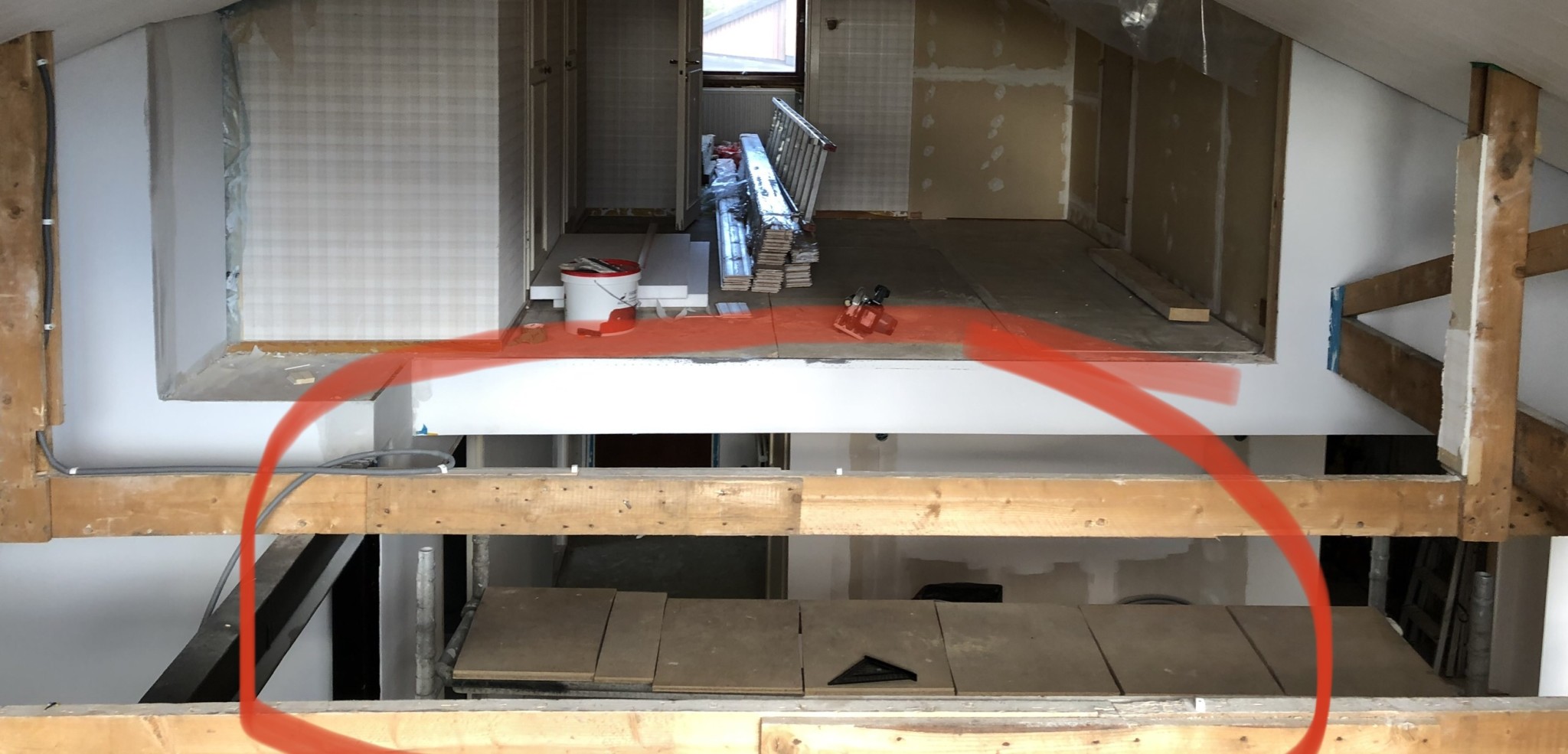
We have a house from '63 with a finished attic. Since the ceiling height was very limited there, we have chosen to open up to the ridge with exposed rafters. On one side, there is some sort of "avväxling" or similar, please see the images below. Is this something that is still useful today when the joists are no longer in place? Is it possible to potentially remove it without compromising anything? Or perhaps it can be altered in some other way?
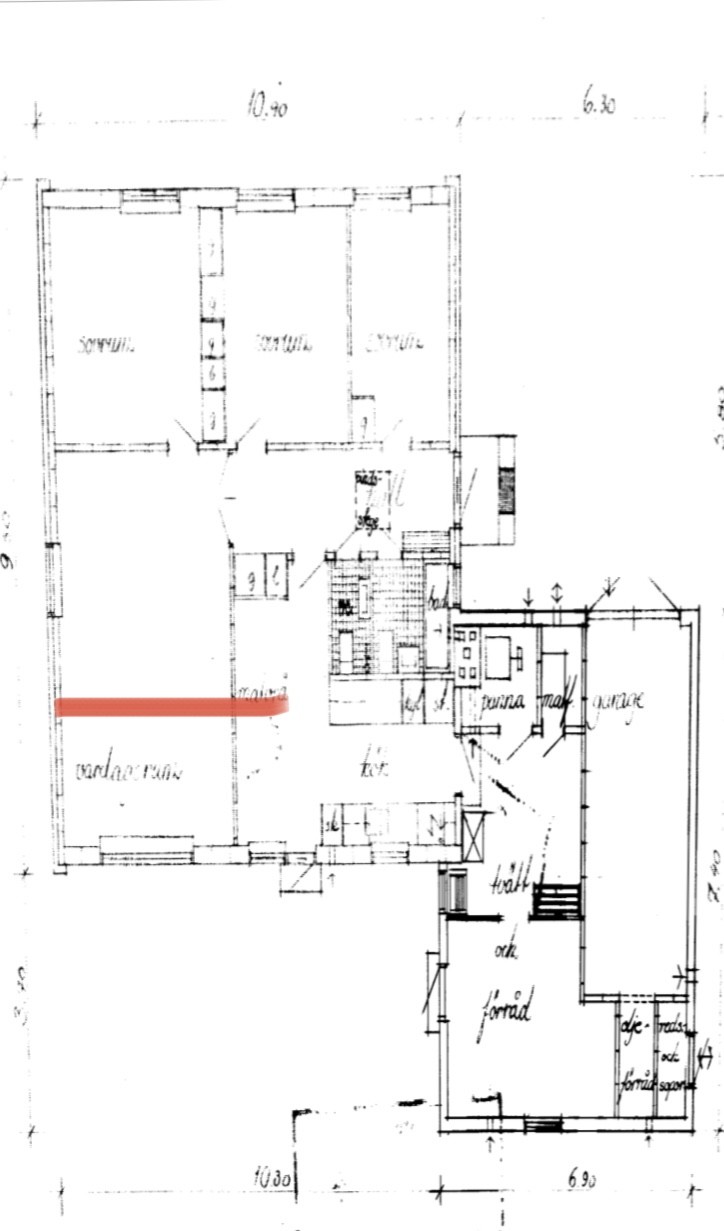
It is where I drew the red line on the drawing.
Thanks in advance!
The arrangement you're talking about seems to be a leftover from the construction, intended as temporary stabilization. With the rough boards on the roof and longitudinal walls in the center of the ground floor, I don't think it's necessary. The trusses themselves seem to be somewhat homemade, so they probably shouldn't be touched.
I had something similar across some of our rafters. The carpenter said that it was quite common to do so when erecting rafters in the past to have some lateral stability during the construction process. In my case, it didn't bother me, so our diagonal brace is still in place...
The arrangement you're talking about seems to be a remnant from the construction, intended as a temporary stabilization. With tongue-and-groove boards on the main roof and longitudinal walls in the middle of the ground floor, I don't think it's needed. The trusses themselves seem to be somewhat homemade, so they probably shouldn't be tampered with.
Ah okay, so you think it's possible to remove it?
Yes, we initially wanted to get rid of the support legs but quickly realized it seemed to be a hopeless project unless we wanted to rebuild the trusses. They are spliced and patched in places.
I had something similar across some of our roof trusses. The carpenter said it was quite common to do that when erecting roof trusses in the past to have a bit of lateral stability during construction. It didn't bother us, so our diagonal brace remains...
Okay, did you open up to the ridge? There's a threaded rod so it can be tensioned in the middle. That's why I was wondering if it was a "reinforcement" for the floor structure.
Okay, did you open it to the ridge? There is actually a threaded rod so you can tighten it in the middle. That's why I wondered if it was a "load distribution" for the floor structure.
No. Completely renovated the attic and that looks more serious than a temporary construction brace. You probably need to contact a structural engineer to understand its function.
No. Completely renovated the attic and that looks more serious than a temporary construction brace. You probably need to get in touch with a structural engineer to understand its function.
Okay, thanks for the info. I've been trying to get in touch with a structural engineer for over 2 months but it seems like no one really has the time or wants to deal with older houses here...
The arrangement you're talking about seems to be a remnant from the construction, intended as a temporary stabilization. With planking on the outer roof and longitudinal walls in the middle of the ground floor, I don't think it's needed. The trusses themselves seem to be a bit DIY, so they probably shouldn't be touched.
What do you think Justus when you see the additional picture?
I would have been happier if I could see it on-site. The diagonal boards are of no use, you can remove them. I don't think the horizontal beam does either, but it's probably good if someone knowledgeable in construction looks at it on-site. The roof trusses are a homemade solution by a person who doesn't understand the problem. They imitate a truss solution without doing it the right way. This uncertainty is likely the explanation for why it looks the way it does.
I would have been happier if I could see it on-site. The diagonal boards are of no use, you can remove these. I don't think the horizontal beam is doing any good either, but it would be best if someone knowledgeable in construction could take a look at it on-site. The trusses are a DIY construction by someone who doesn't understand the problem. They mimic a truss solution without doing it the right way. This uncertainty is probably the explanation for why it looks the way it does.
Jjustusandersson said:
I would have been happier if I could see it on-site. The diagonal boards are of no use, you can remove these. I don't think the horizontal beam is doing any good either, but it would be best if someone knowledgeable in construction could take a look at it on-site. The trusses are a DIY construction by someone who doesn't understand the problem. They mimic a truss solution without doing it the right way. This uncertainty is probably the explanation for why it looks the way it does.
Okay, super. Then I know a little at least. The house was built in '63 and shortly afterwards they chose to furnish the attic. I don't know how much they chose to change the trusses then. Could a few more pictures from another angle help to possibly say if it can be removed? Or does it require someone to physically be on-site?
I would look for unexpected joints in the subframes near the horizontal beam, which could indicate that it forms a load transfer between some of the trusses' subframes. This should be done on-site.
I would look for unexpected joints in the underframes near the horizontal beam, which could indicate that it serves as a truss between some of the underframes of the rafters. This should be done on-site.
Okay, the only joints that exist on the rafters are in the middle of the lower arms. See pictures below.
When I see the last picture, I understand better. Let the horizontal bar stay. It probably has the same function as the one on the left. Perhaps it was added in connection with the attic being furnished and it was then discovered that it wobbled a little too much.
Has there possibly been a load-bearing wall under these roof trusses?
For me, there are several suspicious things.
First, the dimension of the lower frame suggests something other than a temporary construction for stabilization during the build, and your threaded rod additionally indicates that. The consumption seems to support the lower frame on a number of roof trusses.
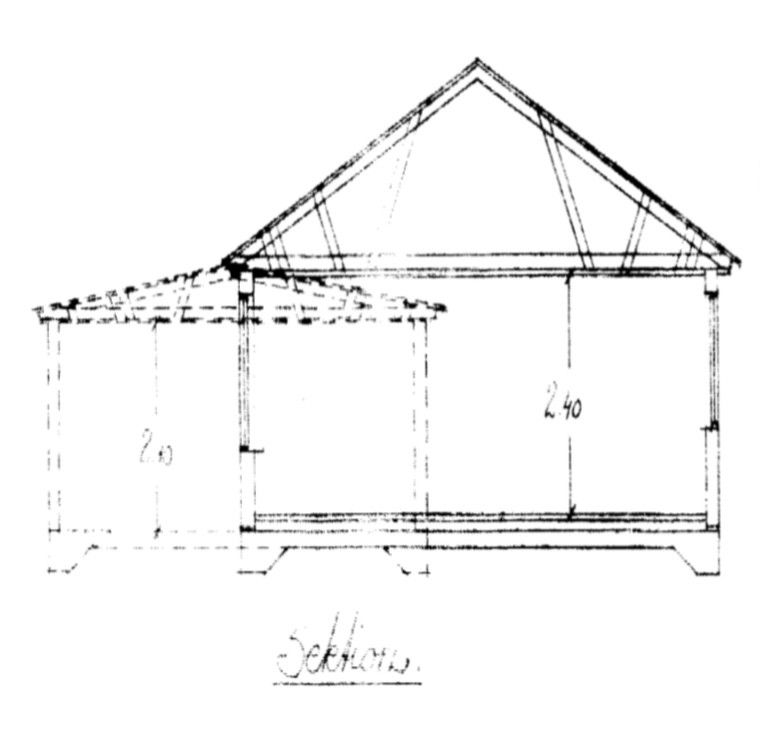
Then, your current roof trusses do not match the drawing you attached. According to the drawing, there would hardly have been room to furnish an upper floor, and it looks to me like someone is converting a gabled roof truss to a framework truss. Do you possibly have old nail holes somewhere in your lower frame?
An engineer should look at this.
Vi vill skicka notiser för ämnen du bevakar och händelser som berör dig.