I'm going to take on building our interior staircase and wanted to ask for some advice and thoughts. I'm an experienced carpenter, but I've never done something quite like this before. It's a new build, so there's no staircase here yet. Very grateful for any opinions and input.
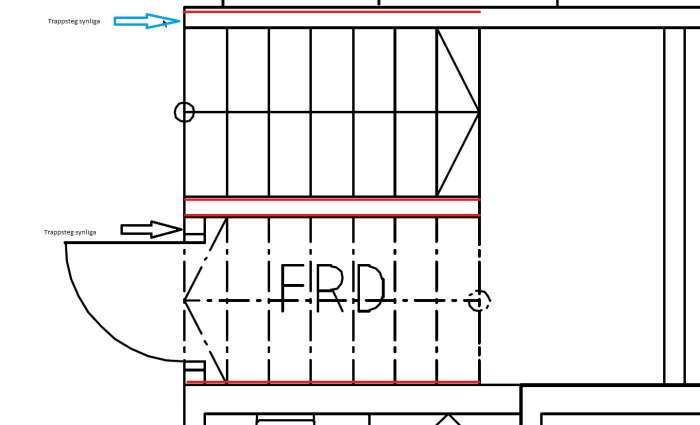
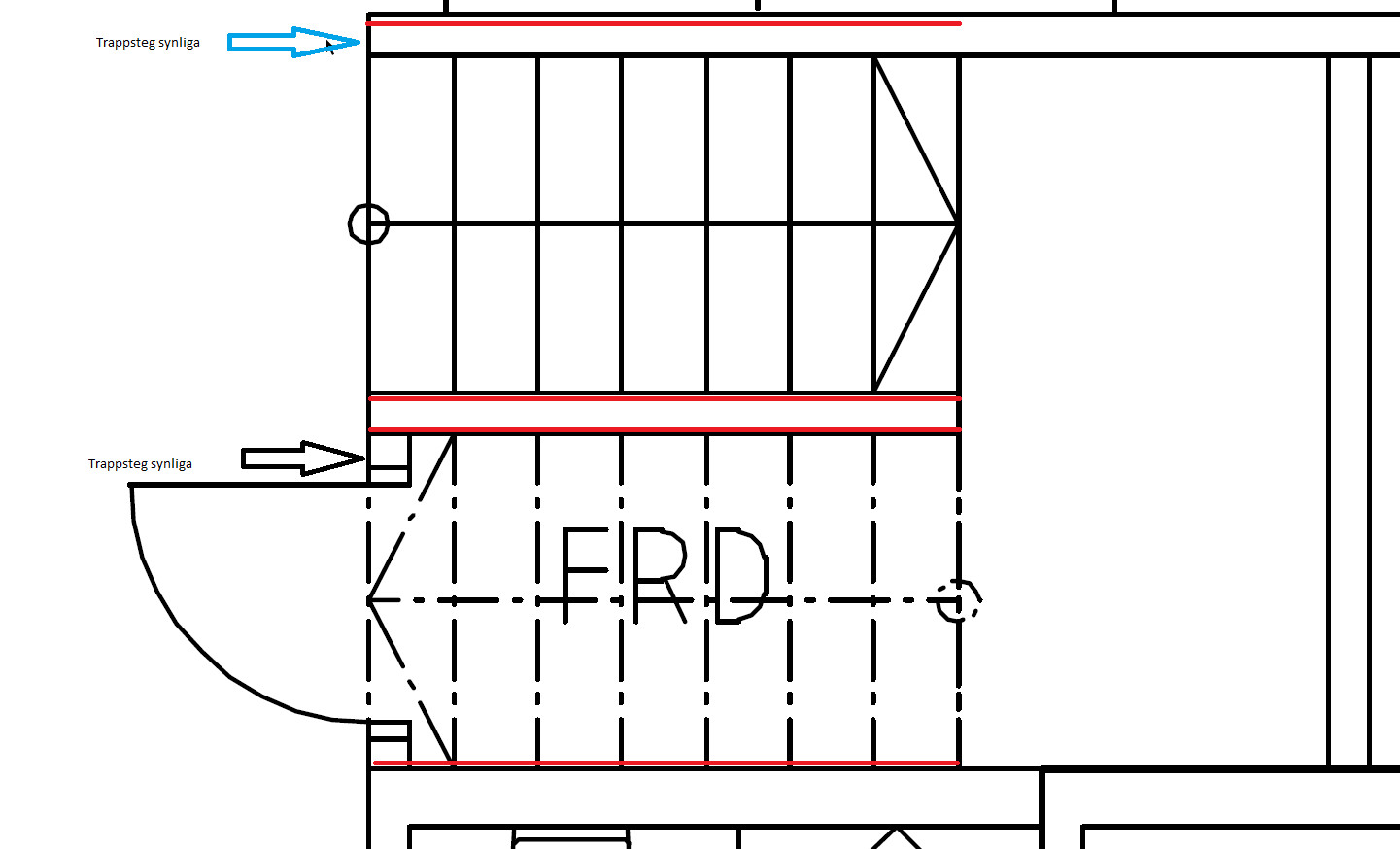
It's a staircase according to the drawing, with a landing halfway up. Total height from finished floor to finished floor is 2.9 m. The landing is 1100 mm and the total width is 2240 mm. A step is therefore about 1 meter in width.
The staircase should be closed, and underneath there will be a storage space.
Upwards on the drawing is a living room. The steps in oak should be visible in that direction, applicable to both the upper and lower part of the staircase.
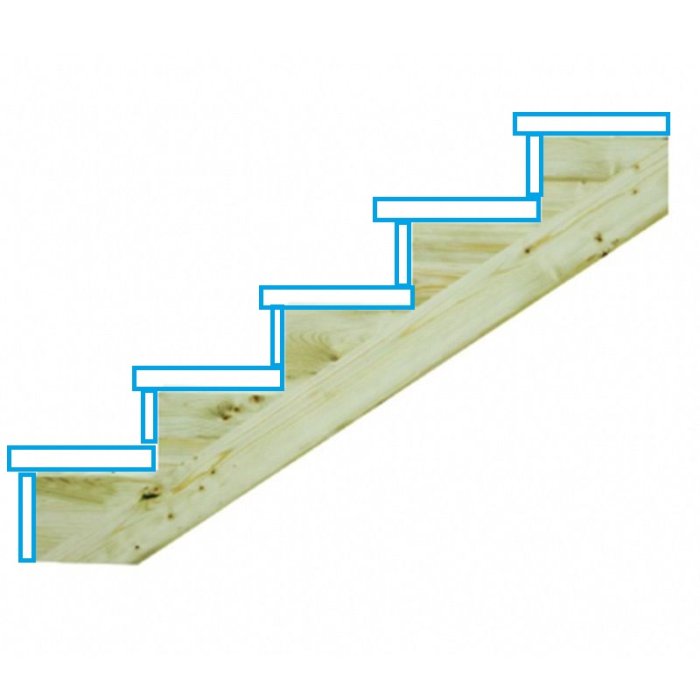
So, the basic idea is to build the landing, then attach the stringers cut out of generously sized beams. Buy 40 mm thick oak that is industrial lacquered, and cut the risers and treads (blue squares on the steps below). From floor up to risers/treads, a regular gypsum wall will be built.
Squeaking is completely forbidden; the staircase must be well-built.
My specific thoughts are:
1. How strong do the stringers need to be? That is, primarily how high do they need to be to hold and to have space for cutting out the steps?
2. Cutting out stringers? I'm thinking of taking a plywood sheet and mapping with it. Positioning it in place and drawing with the help of a square, spirit level, and laser measure from the floor to get exact placements of each step. Then cutting this out, transferring it to the final stringers, and cutting out. I think this is a critical moment. I can handle a rail + plunge saw, but then I have to hand saw the last bit because a blade is round. You can then sand with a machine, but then you risk that the stringer won't be perfect against the opposite side, and then there are problems with squeaking, etc. An alternative, I think, is a dimensioned drawing that is entered into a CAD program and then cut with a computer-controlled saw.
3. Protruding treads or flush with the riser? Perhaps it's nicest flush (together with a slightly rounded front edge) but harder to get it exactly matched and worse to walk on?
4. LED lighting. I would like to embed some form of LED lighting. The natural place might be in the protrusion of the tread? That would decide point 3 above.
5. Handrail? Where and how is it best to place a handrail in such a staircase?
6. Screwing the steps. How do I screw this invisibly? Place an extra piece of wood inside the riser to screw up into the tread from below? A similar problem when the tread needs to be attached to the stringer. Gluing alone doesn't feel sufficient, right?
Thanks in advance. I promise to come back with some construction photos and text on this later, regardless of which methods I end up with.
As an amateur, I built a simple staircase (U) by first finding the right formulas for steps, etc., then creating a template in hardboard. After that, I glued two construction plywood boards together and sawed them out. I saved a few mm around the marking and filed the rest, but the stringers "gripped" when I tested if they fit. Then I built upon it, and the last step was the floor step and the cover board. I let the floor step stick out a bit so you can get your foot/toes slightly underneath. It felt more comfortable that way.
As mentioned, a very simple covered staircase by an amateur who didn't have the budget to buy a new one.
I bought the railings at Bauhaus (stainless steel and plexiglass).
You can dimension the string according to common deflection criteria. With such short stair flights as you have in mind, however, you don't need to consider deflection calculations since other factors will govern the dimensions. 42 mm laminated wood is a good material to use for the stringers as it is strong and dry. With straight stair flights, I would skip the step with templates and draw directly on the material. It's possible to complicate it considerably with grooves, etc. A simple method is to attach slats as support for the treads and risers directly to the insides of the stringers. Rounded stair nosings without protruding treads can be very elegant. Personally, I like such stairs that seem to float in the air, but it's a lot of work and not everyone likes walking on such stairs. You should ideally place handrails on the surrounding walls 800 mm above the stair nosings. Diameter 30-50 mm, at least 45 mm from the wall. If you have the right dimension on the treads in relation to the stair width, squeaking is not a problem. The risers are screwed to the back edge of the treads. With a width of 1 meter, the treads should be about 37 mm thick if you use oak (which has 20% better performance than pine/spruce).
You can dimension the stringers according to common deflection criteria. With stair flights as short as you have in mind, you don't need to worry about deflection calculations since other factors will be determining. 42 mm glulam is a good material to start with for the stringers as it is strong and dry. With straight stair flights, I would skip the template stage and draw directly on the material. It can be quite complicated with routings, etc. A simple method is to mount strips as support for the treads and risers directly on the insides of the stringers. Rounded stair noses without protruding treads can be very elegant. I personally like such stairs that seem to float in the air, but it's a lot of work and not everyone likes to walk on such stairs. You can place the handrails on the surrounding walls approximately 800 mm above the stair noses. Diameter 30-50 mm, at least 45 mm from the wall. With the right dimension of treads in relation to the stair width, creaking should not be a problem. The risers are screwed to the back edge of the treads. With a width of 1 meter, the treads should be about 37 mm thick if you use oak (which has 20% better performance than pine/spruce).
Thanks for the valuable tips.
However, I can't calculate deflection well myself, but I'm pretty good at using my judgment and going a bit overboard, so it usually holds up
But can you estimate how high stringers (glulam) I might need for this? That is, the height before I notch for the steps.
I'm thinking of using 40 mm oak steps, so it sounds reasonable according to you.
If I make the landing 1110 mm wide (according to the drawing), it will be as follows:
The depth of each staircase is 1772 mm, height 1444 mm.
With approximately 180 mm step height, there will be 8 "heights" (risers) and 7 treads if you don't count the floor or landing as a step.
The depth of each tread would then be 253 cm.
If I reduce the width of the landing, I will of course get slightly deeper treads, but that's probably not necessary.
If you cut the stringers from 42 mm laminated timber, they should never be lower than 95 mm. Your riser heights and tread depths will be fine.
Received a suggestion from a staircase manufacturer. 40 mm wide stringers. The drawing isn’t dimensioned, but by enlarging and measuring it seems to be a total of 380 mm high stringers. I didn't measure the part corresponding to your 95 mm but I think it's much more than that. Possibly unnecessary.
Laminated timber with a width of 42 mm seems to only be available up to 270 mm, and that doesn't seem sufficient. However, you can buy 90 mm x 400 mm. I'll keep looking
42 mm glulam should be available in heights up to 405 mm, delivery times may apply. It is produced by splitting 90 mm glulam. An alternative is to increase the width to 56 mm.
@martinradbo how did it go with your staircase? I'm curious because I'm about to start a new build and plan to construct a similar staircase like yours. Do you have any finished pictures and some from during the construction period?