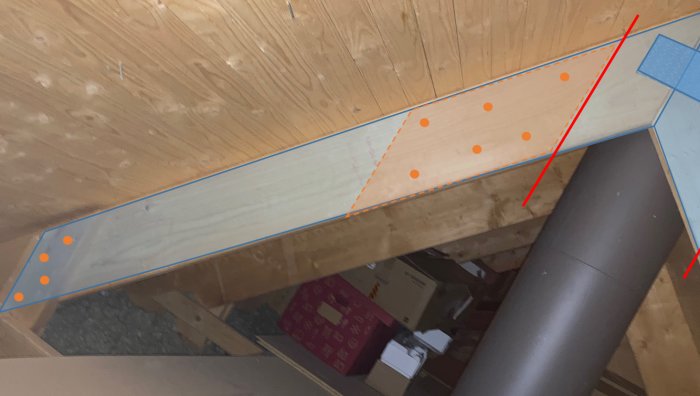
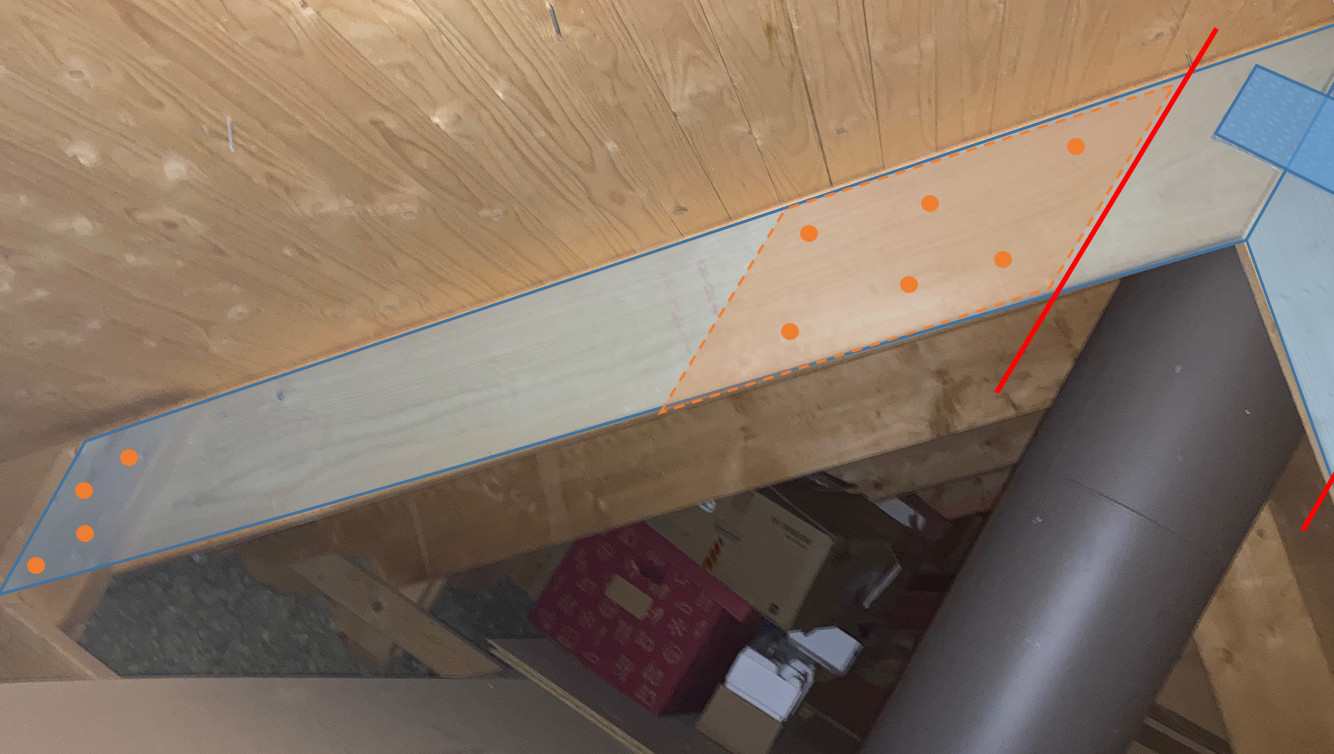
The chimney installation was rejected during inspection because the chimney is almost touching a roof truss. I don't understand how the installation was approved during construction over 10 years ago...
In any case, the distance needs to be at least 50mm from combustible materials, and I plan to cut the roof truss according to the red line in the attached sketch and screw a new one to the existing beam with a spacer according to the orange-colored areas. This will give me a distance of about 90mm (2x45mm beams). The question is whether this is an acceptable roof truss installation or if there's a better way to do it?
Okay, sounds like a significantly larger operation with new pre-modular parts to move laterally and a new hole in the ceiling. Can't it be solved by moving the roof truss or what is the risk with this?
Ok, sounds like a significantly larger operation with new pre-module parts to move sideways and a new hole in the roof. Can't this be solved by moving the roof truss, or what is the risk with this?
Building a couple of new roof trusses and replacing the one that's in the way is an option, but it is likely to require planning permission.
Both proposals are quite extensive but are probably the best solutions from a construction standpoint. However, I think it should be possible to solve it in a simpler yet functional way. Does anyone have any other suggestions?
Cutting off and trying to modify an existing truss is the worst option; you will never get it strong and safe, or for that matter, approved by the building permit authorities.
If you skip the distancing and only build with a new beam screwed directly onto the existing rafter (as long as possible on both sides), it seems like it should hold well. However, you should perhaps check with a designer. Then you'll have an increased distance of 45mm compared to now, which might be enough to get the 50mm you need.
If there is a 5mm gap, i.e., the chimney is not in contact, then I would have made a completely new rafter that I would screw and glue together with the current one. But then cut away the part that gets too close to the chimney.
It's a bit of the same idea as Nikorasu above, but make it whole, so it will ultimately be stronger than today, instead of risking weakening.
If it is in contact, you can cover the new rafter in the space you "notched" with gis, fiber cement board etc., so it's no longer combustible. For example, 2 layers of gypsum in the cut-out. Then there will only be 20mm left, but it's not combustible material. (Perhaps someone who knows stoves can answer if this is okay.)
Click here to reply
Vi vill skicka notiser för ämnen du bevakar och händelser som berör dig.