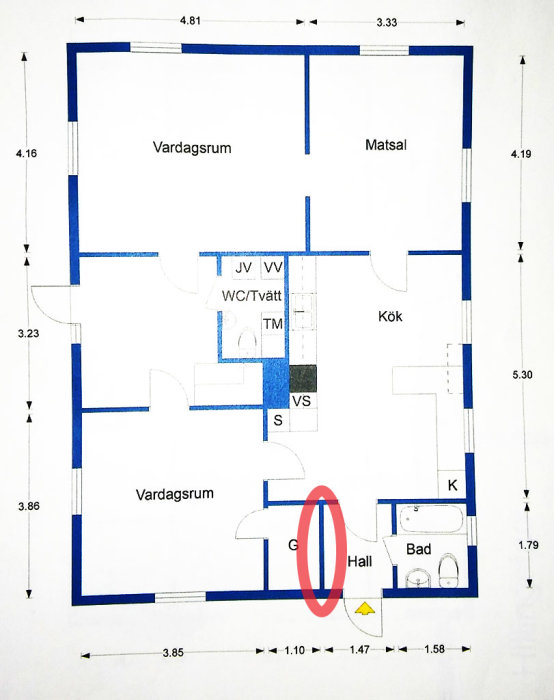
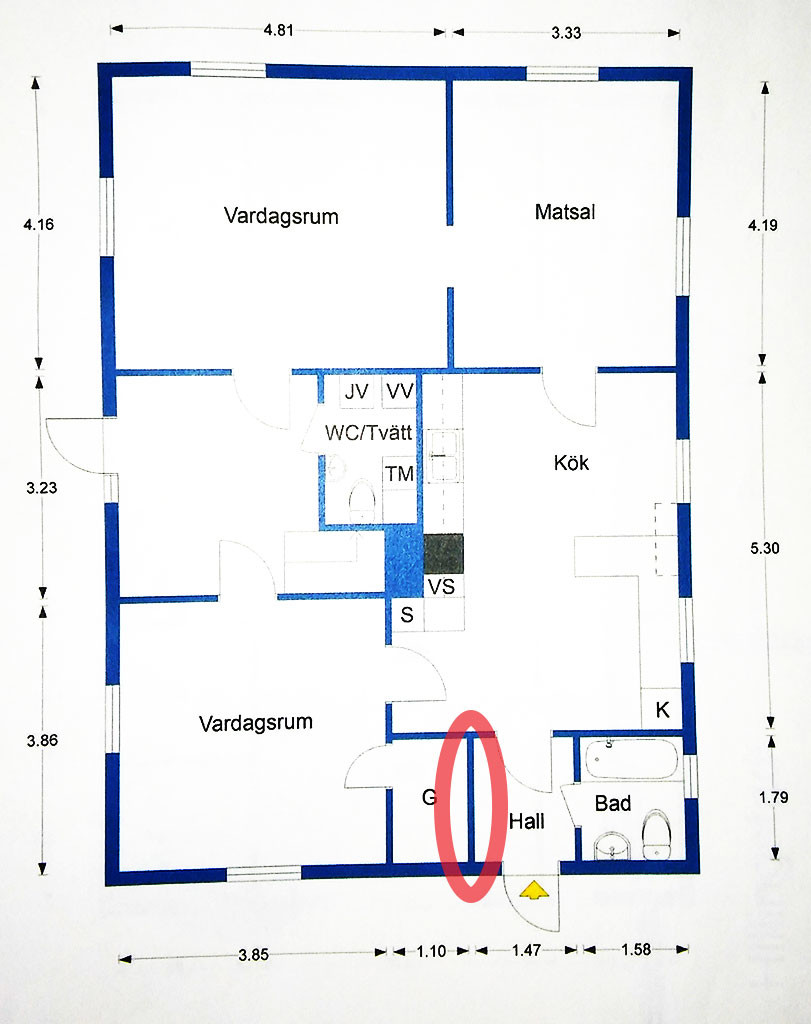
Hi! I've searched, and the more I read, the more uncertain I become. The problem is the following: I have a storage room where I want to open a door directly opposite the current one so that I can access the storage from the mudroom. The wall where I intend to open it is marked with a red circle. The question is brief, but I suspect the answer is much more complicated.
The question is, is this wall load-bearing?
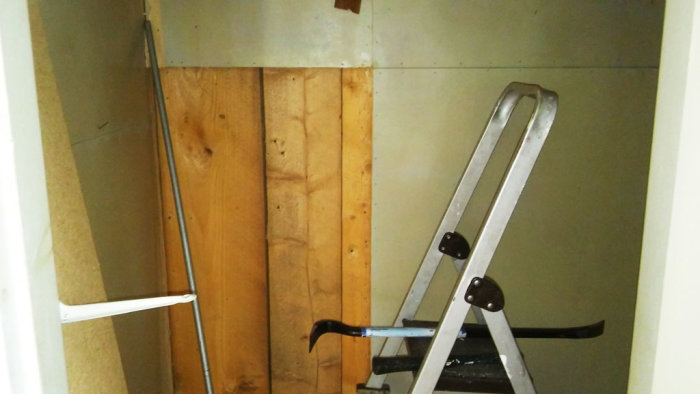
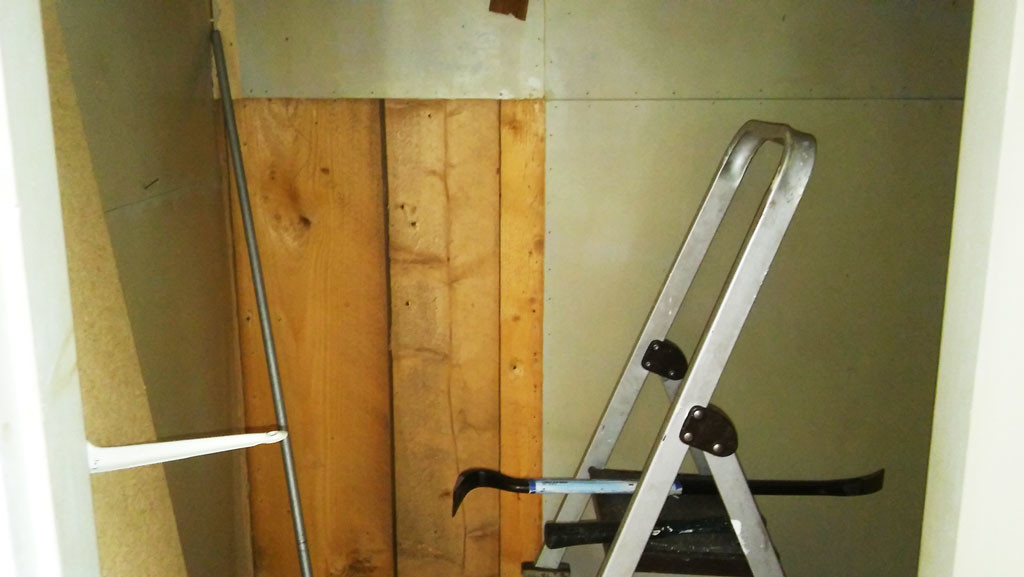
The wall consists of standing 2-inch planks. One of the boards is jointed, and I assume you wouldn't do that on a load-bearing wall? On the planks is Ljusne-wallboard, and the wall, in its entirety, is no more than 6cm thick.
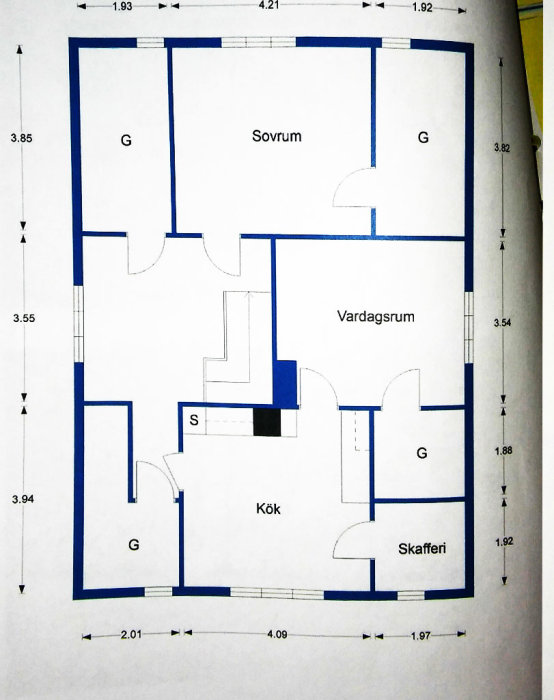
Upstairs, there is no wall where this one stands.
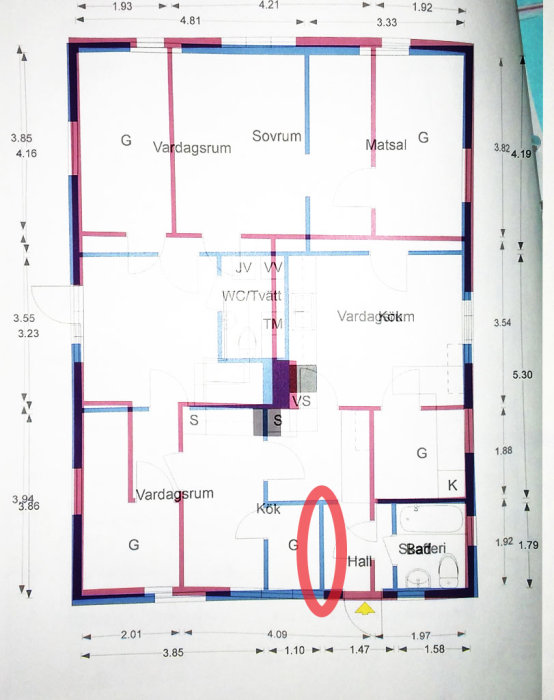
When I try to overlay the sketches, you can see that there are few walls aligned between the floors. This is the realtor's drawing, but it seems to match reality reasonably well.
It is not possible to give a definite answer based on the sketch, but either
A: Your red-marked wall or (more likely)
B: The wall with the door to the closet is load-bearing.
"Impossible" to determine without breaking up the ceiling or floor on the upper level …
The third option is that there is no load-bearing "heart" wall.
Our house is about the same size, the floor structure between the basement and ground floor is self-supporting, however, there is a wall throughout the basement that is about 0.5-1cm below the tongue and groove in the basement ceiling.
It is not possible to give a definite answer based on the sketch, but either
A: Your red-marked wall or (more likely)
B: The wall with the door to the closet is load-bearing.
"Impossible" to determine without tearing up the ceiling or floor in the upper floor …
Thanks for the reply (also applies to Demmpa)!
Does the below help or do I have to tear down the actual ceiling? (Something I prefer not to do.)
Since the house has a plank frame, it was likely built before 1950. Back then, construction wasn't as systematic, and the floor joists were joined where possible. Thus, there are several walls that function as load-bearing walls. Additionally, it wasn't always a priority to ensure that the walls on floor 2 were directly above the walls on floor 1.
I consider it much more likely that the wall of the closet facing the living room is load-bearing than the one facing the hallway. The aim was probably to have a span of about 4 meters for all the floor joists. However, the fact that the planks are joined vertically doesn't provide any definitive information. I am convinced that you can open a door to the hallway without any problem. The sawn-off planks left above the actual opening must be supported by inserting a horizontal plank to support them. (Use a piece of the sawn-off planks) Make this piece slightly wedge-shaped at the ends so that it can rest on the planks remaining on either side of the opening.
Click here to reply
Vi vill skicka notiser för ämnen du bevakar och händelser som berör dig.





fahlis said:

