
3,696 views ·
8 replies
4k views
8 replies
Load-bearing, stabilizing, or neither interior wall.

Hello!
I recently bought a somewhat unique house and am about to start renovating the whole endeavor.
Now I plan to take down two walls in the house and am unsure if the walls serve any function other than as walls. I had an architect in the house a week ago who claimed the walls aren't load-bearing and I have no reason to doubt him. However, I suspect they might be stabilizing as one of the walls runs between the exterior walls.
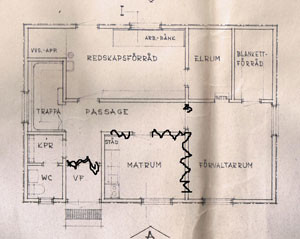
I have attached drawings of the ground floor, I've scribbled on the walls I plan to take down.


I recently bought a somewhat unique house and am about to start renovating the whole endeavor.
Now I plan to take down two walls in the house and am unsure if the walls serve any function other than as walls. I had an architect in the house a week ago who claimed the walls aren't load-bearing and I have no reason to doubt him. However, I suspect they might be stabilizing as one of the walls runs between the exterior walls.
I have attached drawings of the ground floor, I've scribbled on the walls I plan to take down.
Last edited:
Welcome to the forum!
It's not possible to determine for sure from the drawing alone whether the walls are load-bearing or not. Additionally, you can't 100% rely on a drawing. It might be that they improvised during construction and deviated from the drawing. So the best thing is to have someone come and look at the house in reality.
The house seems intriguing. "Blankettförråd," "Förvaltarrum." What are those?
It's not possible to determine for sure from the drawing alone whether the walls are load-bearing or not. Additionally, you can't 100% rely on a drawing. It might be that they improvised during construction and deviated from the drawing. So the best thing is to have someone come and look at the house in reality.
The house seems intriguing. "Blankettförråd," "Förvaltarrum." What are those?
The house is an old steward's house for a petroleum storage facility. In the adjacent mountain, there is a gigantic cistern that previously contained combustion oil and aviation kerosene.
As for blueprints, there are blueprints galore; it is built to withstand a war, and the basement is a shelter with associated gas locks and airtight armored doors.
Electricity and HVAC are separate for the ground floor and basement.
It will be really fun to fix up the house and remove the old government feeling that's somewhat pervasive throughout the house.
I have another question while I'm on the subject.
There is a vinyl floor on the concrete floor on the ground floor. Is it possible to leave it in place and install underfloor heating and tile directly on top?
It is indeed adhered very firmly.
As for blueprints, there are blueprints galore; it is built to withstand a war, and the basement is a shelter with associated gas locks and airtight armored doors.
Electricity and HVAC are separate for the ground floor and basement.
It will be really fun to fix up the house and remove the old government feeling that's somewhat pervasive throughout the house.
I have another question while I'm on the subject.
There is a vinyl floor on the concrete floor on the ground floor. Is it possible to leave it in place and install underfloor heating and tile directly on top?
It is indeed adhered very firmly.
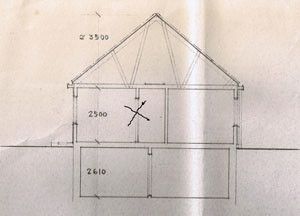
One more question regarding the right drawing of the house. What is meant by the two longitudinal walls being drawn differently? The right one is not drawn all the way to the floor like the left one.
I interpret it as meaning that the right and basement walls are more load-bearing accordingly.
The drawing matches to the last millimeter, electrical, plumbing, and everything.
I interpret it as meaning that the right and basement walls are more load-bearing accordingly.
The drawing matches to the last millimeter, electrical, plumbing, and everything.
That is the door to the "matrum" you see. It has nothing to do with load-bearing or stabilization. This is not reported at all on the A-documents, which is what you have.
The section is taken at the vertical lines you see on the floor plan.
The section is taken at the vertical lines you see on the floor plan.
I was thinking of updating since I have received quite a few interesting responses and solutions for my interior walls.
An architect says that the walls leading to the dining room are not load-bearing.
A structural engineer says that all walls bear equally according to the roof trusses.
A worker at a larger construction company says that the wall that runs like a T through the dining room and electrical room between the outer walls, along the roof trusses, holds the outer walls together since the roof pitch is so steep and the weight is on the outer walls. It's also the house's thickest tongue-and-groove wall, 200mm compared to otherwise 150mm.
All have been out to look at the walls and all have seen that there is a ceiling board between the walls and the roof trusses, which means that the interior walls were built after the roof was set.
Thus, no interior wall can be load-bearing?? Only the trusses which are of standard design!?
In any case, the walls are down according to my sketch, so I'll see when the snow sets if I urgently need to fetch some timber and put together my own supports
I will post some project pictures from the bunker anyway in the project thread.
An architect says that the walls leading to the dining room are not load-bearing.
A structural engineer says that all walls bear equally according to the roof trusses.
A worker at a larger construction company says that the wall that runs like a T through the dining room and electrical room between the outer walls, along the roof trusses, holds the outer walls together since the roof pitch is so steep and the weight is on the outer walls. It's also the house's thickest tongue-and-groove wall, 200mm compared to otherwise 150mm.
All have been out to look at the walls and all have seen that there is a ceiling board between the walls and the roof trusses, which means that the interior walls were built after the roof was set.
Thus, no interior wall can be load-bearing?? Only the trusses which are of standard design!?
In any case, the walls are down according to my sketch, so I'll see when the snow sets if I urgently need to fetch some timber and put together my own supports
I will post some project pictures from the bunker anyway in the project thread.
Click here to reply
Similar threads
-
The classic question: load-bearing or non-load-bearing?
Building Materials and Construction Technology -
Avgöra om en vägg är bärande eller inte
Planlösningar -
Load-bearing or decorative iron in the fireplace?
Building Materials and Construction Technology -
Do I need to brace the rafters or are they self-supporting?
Building Materials and Construction Technology -
Load-bearing beam or?
Building Materials and Construction Technology