
4,085 views ·
13 replies
4k views
13 replies
Load-bearing glulam beam bending?
Hello!
About 3 years ago, we tore down a load-bearing wall and installed a glulam beam.
We consulted a structural engineer who calculated that a glulam beam of 115*270 mm was needed.
We then got help from a carpenter who purchased and installed the glulam beam.
We think everything has turned out well and we don't notice any significant sag on the upper floor, but a few months ago we noticed that in the middle of the largest span (4 meters), it looks like the glulam beam has bent and left about a 3 mm gap against the ceiling of the middle floor.
My question is simply if this is normal and if it can happen after a year or so?
Will it continue to bend or will it "settle"?
Is there any risk that the middle floor/glulam beam could give way?
As mentioned, we don't notice any problems on the upper floor; we just want to feel secure that nothing has gone wrong.
Grateful for your response.
Best regards,
/Andreas
About 3 years ago, we tore down a load-bearing wall and installed a glulam beam.
We consulted a structural engineer who calculated that a glulam beam of 115*270 mm was needed.
We then got help from a carpenter who purchased and installed the glulam beam.
We think everything has turned out well and we don't notice any significant sag on the upper floor, but a few months ago we noticed that in the middle of the largest span (4 meters), it looks like the glulam beam has bent and left about a 3 mm gap against the ceiling of the middle floor.
My question is simply if this is normal and if it can happen after a year or so?
Will it continue to bend or will it "settle"?
Is there any risk that the middle floor/glulam beam could give way?
As mentioned, we don't notice any problems on the upper floor; we just want to feel secure that nothing has gone wrong.
Grateful for your response.
Best regards,
/Andreas
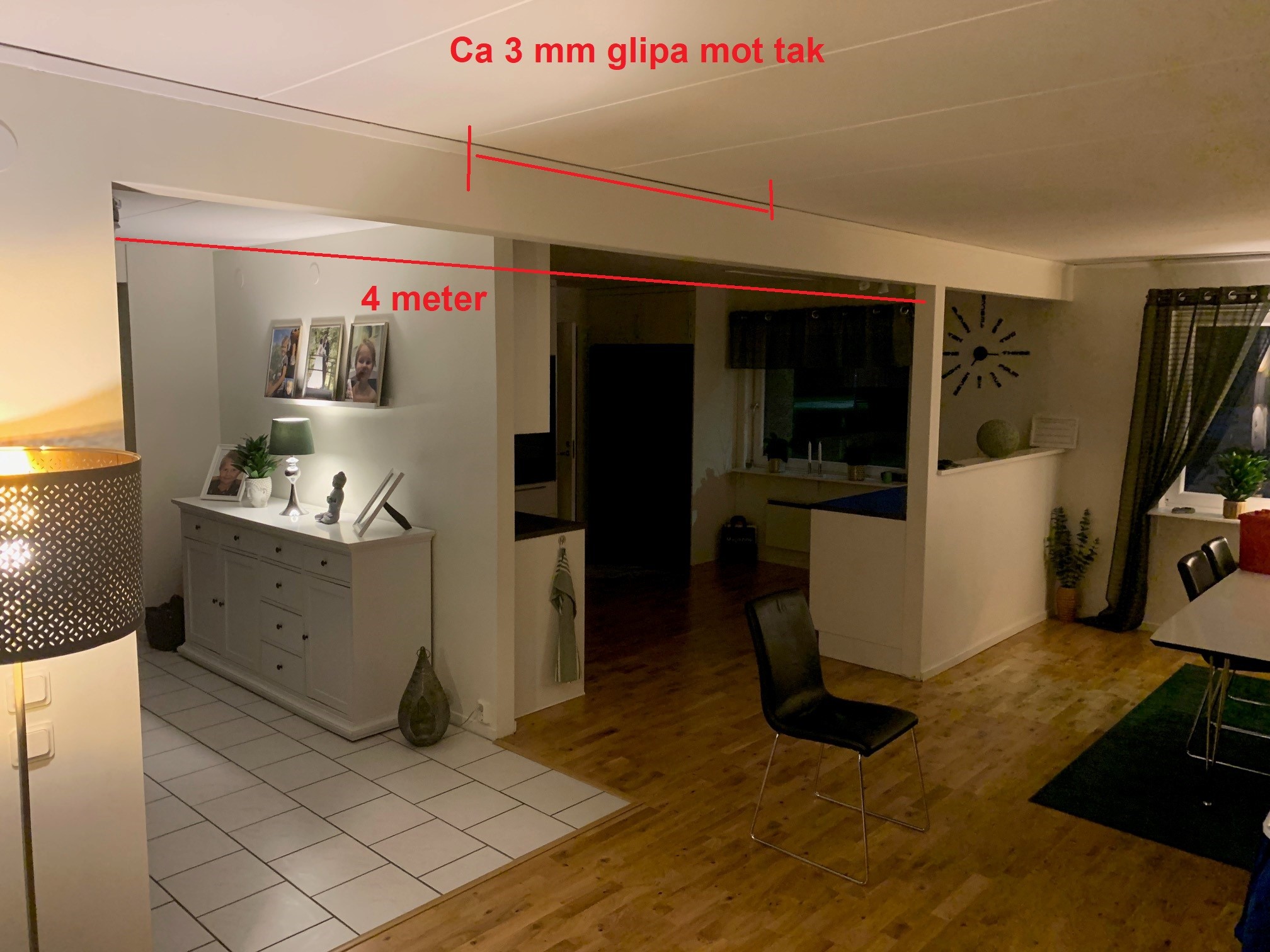
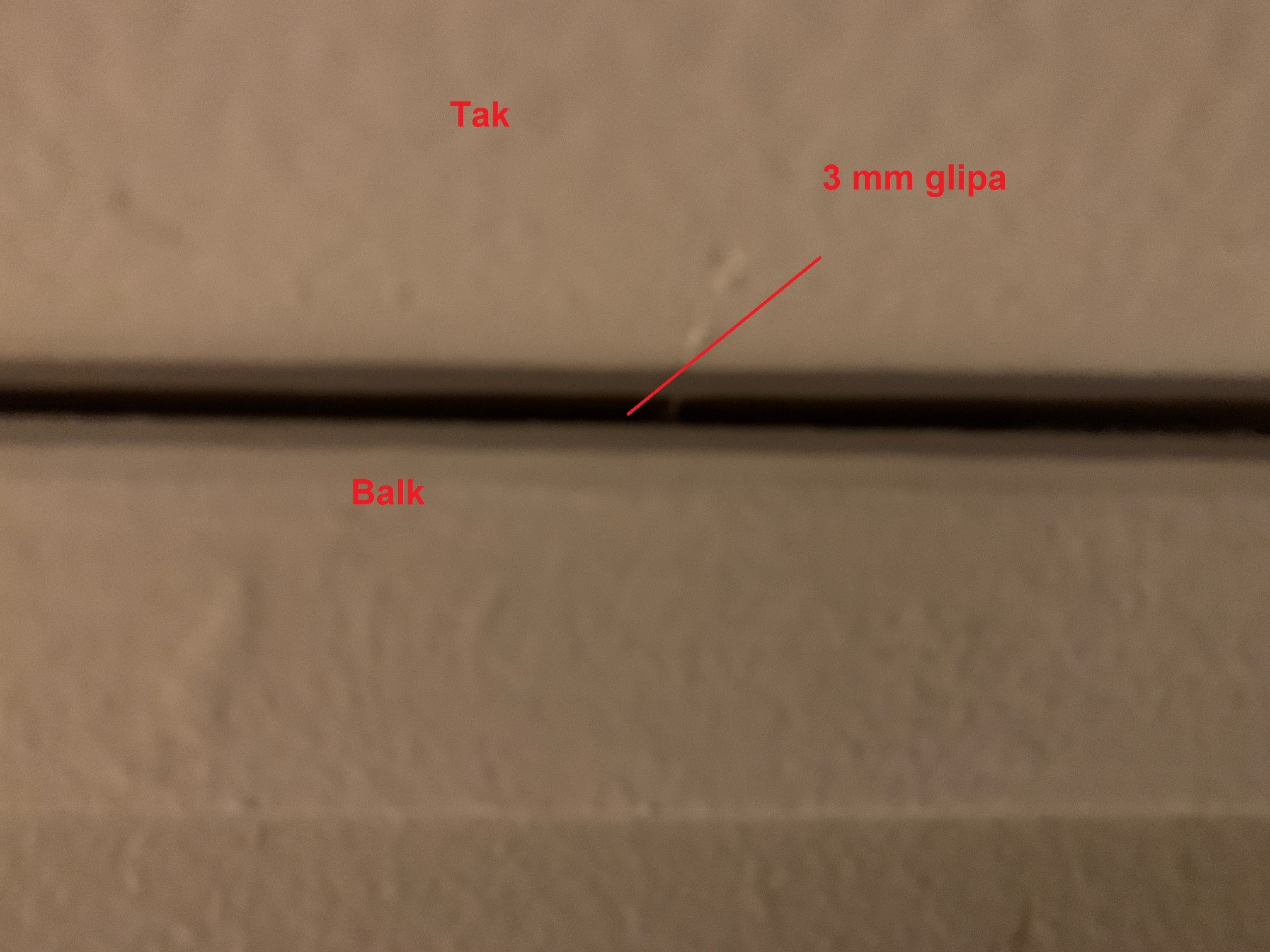

If the beam sags, then the ceiling should follow...
Start by stretching a masons line or thin string under the beam to measure any deflection.
Start by stretching a masons line or thin string under the beam to measure any deflection.
As previously mentioned, the ceiling should have followed along if the beam started to sag.
Take something of the same length, like a straightedge, and place it underneath, or a thin string against it, and then you'll see if it sags.
Take something of the same length, like a straightedge, and place it underneath, or a thin string against it, and then you'll see if it sags.
Aha, it's an optical illusionT Taxture said:
 If you look at the floor, you'll see the difference between the partition wall and the beam. The distance between the partition wall and the beam is 90 cm, so we felt it took away much of the open floor plan if there were a solid wall all the way up to the beam.
Thank you for your response!W Willewonka said:
Tried pulling a string and can't see any sag, it's difficult to see a possible sag of 2-3 mm on a 4-meter string but can't see anything.
I also tried checking the gap while we had people walking around upstairs, but nothing moves at all.
Member
· Västra Götaland
· 1 849 posts
Regardless of the gap or not, the calculated deflection of the beam is probably more than 2-3 mm. Your engineer can inform you about the calculated deflection.
All beams have a deflection and 2-3 mm is nothing to worry about.
All beams have a deflection and 2-3 mm is nothing to worry about.
Hi! I checked through the papers we received from the constructor, and he writes the following "115x270 Kval L40 is the minimum that manages both load and deflection. The deflection will be about 12mm."A Autodidak1 said:
So in other words, this shouldn't be a problem and is quite normal? Is it also normal for this deflection to occur over time?
As mentioned, we are completely satisfied and don't feel any flex or similar, we just want to reassure ourselves that there's nothing wrong here and that the entire intermediate floor won't collapse or anything
Member
· Västra Götaland
· 1 849 posts
The strength is normally not the problem in constructions of this type. What determines the dimension is flex and deflection.A AndreasJohansson80 said:Hi! I looked through the papers we got from the engineer and he writes the following, "115x270 Grade L40 is the minimum that can handle both loads and deflection. The deflection will be about 12mm."
So in other words, this shouldn't be a problem and is completely normal? Is it also normal for this deflection to occur over time?
As we said, we're completely satisfied and don't feel any flex or anything, we just want to assure ourselves that there isn't something wrong here and that the entire middle floor might collapse or something
So you can sleep peacefully
Click here to reply
Similar threads
-
Help Wanted - Glulam Beam Load-bearing Wall Above Garage Door
Building Materials and Construction Technology -
Supporting a Load-bearing Glulam Beam
Building Materials and Construction Technology -
Remove post under glulam beam (load-bearing)
Building Materials and Construction Technology -
SIZING: Monster for glulam beam. Install garage door under load-bearing column
Building Physics -
Bärande limträbalk
Attefallshus, friggebod, garage & andra småhus